7 May 2026 · Artur Kiwa
Was Paul on Crete? A Ship, a Storm, and a Thousand Years of Legend
It all begins with a grain ship, an autumn storm, and a prisoner who knew more about the sea than the captain. Acts of the Apostles 27 is one of the most precise accounts of ancient seafaring to have survived to our time. Crete appears in it as an incidental backdrop — not a destination. And yet a thousand years later a wandering monk builds a church on a Cretan beach in honour of that prisoner. Between those two moments lies a question to which scholarship has no definitive answer.
September or October, the year 59 or 60 AD — the dating depends on which chronology of Paul's life one accepts, and that is itself a matter of debate. An Alexandrian grain ship fights the wind along the southern coast of Crete. On board, somewhere between the centurion Julius and the rest of the prisoners being transported to Rome, stands a man who has survived three shipwrecks and spent a full day and night adrift on the open sea. This man says: we should not sail on. Nobody listens.
This is the only place in the New Testament where Crete appears with certainty. Everything else is a matter of interpretation.
Fair Havens — the geography of certainty
Acts of the Apostles 27 is an exceptional document in ancient literature. Its anonymous narrator — tradition attributes it to Luke, though modern biblical scholarship is more cautious — describes a sea voyage with a precision that has fascinated maritime historians for centuries. Port names, wind directions, sounding depths, the method of mooring the ship during the storm: the details are so accurate and so consistent with what we know of first-century Mediterranean seafaring that Ernest Renan in the nineteenth century and James Smith in his classic study The Voyage and Shipwreck of St. Paul (1848) independently concluded that the text must have been written by an eyewitness or from an eyewitness account.
The ship was sailing westward from Myra in Lycia toward Italy. A north-westerly wind prevented a straight course — the captain had to seek shelter under the island and sail along its southern shore. "We made our way with difficulty and came to a place called Fair Havens, near the city of Lasea" (Acts 27:8).
Fair Havens — Kaloi Limenes. The harbour exists today under the same name, on the southern coast of Crete, about eight kilometres east of Cape Matala. The identification is secure. Confirmation came empirically: Captain Thomas Abel Brimage Spratt, surveying the Cretan coastline in 1853, noted that winter winds from the east and south-east blow directly into the bay — exactly as the text of Acts implies when it says the harbour is unsuitable for wintering. Nearby, among the buildings of a small village, stand the ruins of an early Byzantine chapel — local tradition associates it with Paul's stay, but archaeology can neither confirm nor refute that attribution.
Paul advised wintering at Fair Havens. The centurion followed the captain and the owner of the ship. They sailed on toward Phoenix — a harbour on the western coast of Crete, which scholars identify with the area around present-day Loutro or the bay of Finikas near Cape Mouros. They never arrived. A north-easterly wind, called Eurakylon — a term that is a hybrid of the Greek euros and the Latin aquilo, found nowhere else in ancient literature — drove the ship toward Malta. Crete disappeared over the horizon.
The prisoner had been right. But that is another story.
The second question — the mission
This is where the problem begins.
If Acts of the Apostles were the only source, the matter would be straightforward: Paul was on Crete once, as a prisoner, for a few days, and conducted no missionary activity whatsoever. Crete was nothing more than a meteorological obstacle on his route to Rome.
But there is also the Letter to Titus.
Titus 1:5 reads: "The reason I left you in Crete was that you might put in order what was left unfinished and appoint elders in every town, as I directed you." The sentence assumes that Paul was on Crete as a missionary — that he worked there long enough for communities to arise requiring organisation, that he left his co-worker behind, that he wrote to him with instructions.
If this letter is authentic, Paul visited Crete twice: once as a prisoner (Acts 27), and once as a missionary — after his release from his first imprisonment in Rome, sometime between 62 and 64 AD.
If it is not — the history of Christianity on Crete begins without Paul.
The authorship dispute
The Letters to Timothy and to Titus — collectively known as the Pastoral Epistles — are the subject of one of the more fiercely contested disputes in New Testament scholarship. The debate has continued since the nineteenth century and remains unresolved.
Arguments for authenticity: the letters contain biographical details impossible to fabricate (specific names, places, circumstances), the style is consistent with Paul's undisputed letters, and early patristic tradition accepted their authenticity without reservation.
Arguments against: the vocabulary differs from the uncontested Pauline letters — approximately three hundred words appear here and nowhere else in the New Testament. The organisational structure of the Church that the letters presuppose seems to correspond more to the second century than the first. The tone is more institutional, less personal. The most significant problem: Acts of the Apostles, which follows Paul almost step by step through his missions, says nothing about a voluntary stay on Crete with a missionary purpose — and it should, had such a stay taken place.
The official position of the United States Conference of Catholic Bishops (USCCB) in its introduction to the Letter to Titus states plainly that Crete is a place "where Paul had never been, according to the New Testament" — meaning that even within a church institution, academics allow for the pseudepigraphical character of these letters.
The consensus of contemporary critical biblical scholarship leans toward pseudepigraphy — a text written in the spirit and tradition of Paul by his disciples, perhaps at the end of the first or the beginning of the second century. But "leans toward" is not "resolves". There are serious scholars who defend authenticity.
What this means for Crete
If the Letter to Titus is authentic: Paul was on Crete as a missionary, founded or strengthened communities, and left Titus as their organiser. Church tradition — Eusebius of Caesarea in the fourth century — made Titus the first bishop of Crete. The network of Cretan dioceses, which by the fifth and sixth centuries numbered twenty episcopates, would be rooted in apostolic mission.
If it is a pseudepigraph: we do not know who founded Christianity on Crete. Acts 2:11 mentions Cretans in passing among the audience at Peter's Pentecost sermon — perhaps that is how the faith reached the island, through diaspora returning from Jerusalem. But that too is speculation.
One thing is certain: when in the fifth century the Cretan coastline was densely scattered with basilicas — and it was, we know of several dozen — no one any longer remembered who had truly begun.
The beach, the hermit, and the church of stones
A thousand years after Paul, in the year 970 or shortly after, a child was born on Crete. He came into the world into a wealthy family in the village of Siba, identified with present-day Sivas on the Mesara plain. As an adult he abandoned his inheritance and began to wander "from mountain to mountain" — his own words — through western Crete, founding churches and monasteries wherever the voice of God or a vision of the saints stopped him.
We know him as Agios Ioannis Xenos — Saint John the Stranger. His life is known to us from two sources: the autobiography Bios kai politeia, preserved in a fifteenth-century manuscript in the Bodleian Library in Oxford and in the Codex Cisamensis of 1703 — and from the testament he drew up on 20 September 1027, confirmed by the signatures of two protospatharioi, strategoi of Crete, and a notary of the fort of Chandax.
That testament — published in a scholarly edition by Gianfranco Fiaccadori in Byzantine Monastic Foundation Documents, Dumbarton Oaks 2000, vol. 1, pp. 143–147 — is a surprisingly brief document. Just three clauses: all my foundations I subordinate to the monastery of Myriokephala, a curse on anyone who violates this, a blessing on anyone who respects it. No inventories. No names of specific churches.
And here the problem with the legend begins.
Popular descriptions of the church on Selouda beach repeat unanimously: built by Agios Ioannis Xenos, as he mentions in his testament. The formulation is imprecise on two counts. The testament is a general document — it names no church specifically. The individual foundations are listed in the Bios, not the testament.
For decades, moreover, the prevailing view was that the reference to a Pauline church in the Bios concerned an entirely different location. The first critical edition of the text was prepared by Hippolyte Delehaye in 1921 — and it was he who placed Xenos's Pauline foundation in the area of Azogyres and Palaiochora, at the far western end of the island. The error was repeated by N.B. Tomadakis in his editions of 1948 and 1983–86, and after him — in 2000 — by Gianfranco Fiaccadori in the Dumbarton Oaks edition.
The correction came from Sophia Oikonomou in her dissertation The Life of Ioannes Xenos: Critical Edition and Commentary (King's College London, 1999) — the only complete English-language critical edition of the text. Oikonomou demonstrated that the phrase ὀπίσω αἰγιάλ — "the rear shore" — refers to the southern coastline between Loutro and Agia Roumeli, not to the area around Palaiochora. "The rear shore" is the text's term for the south of the island, as distinct from the more accessible northern coastline from which ships arrived from Byzantium. In her commentary on line 123 of the Bios, Oikonomou identifies the church at Selouda as Xenos's foundation directly: "This church built by Xenos should be identified with the small 'free-cross' domed church that still survives today in a very good condition on the seashore between Loutro and Hagia Roumeli."
Why is the church on this beach
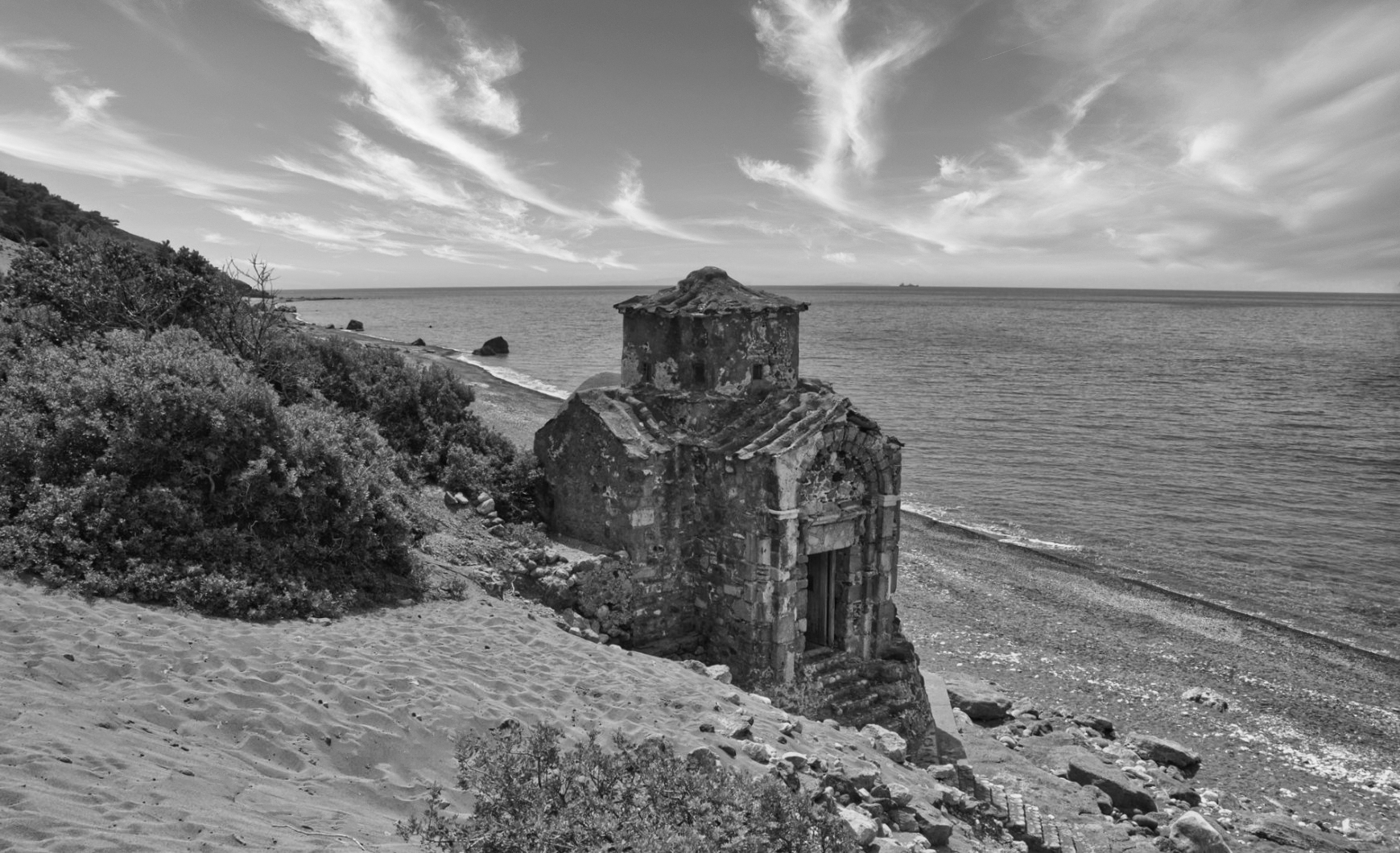
Regardless of who built it, the church at Selouda demands explanation. Why here — on an inaccessible, wild shoreline, far from any settlement, reachable only by boat or an hour's scramble over rocks?
There are two possibilities, and both may be true simultaneously.
The first: local tradition, reaching back at least to the early medieval period, associated this coastline with the route of the ship from Acts 27. Geographically this is sound — the ship sailed along precisely this shore, from Fair Havens toward Phoenix, before the Eurakylon struck. Selouda beach lies exactly on that route. Someone, at some point between the fifth and tenth centuries, concluded that it was here that the ship had passed, and that Paul — the prisoner, the future apostle, the man who had warned and been right — had looked out at these rocks from the deck. That was enough for the place to become sacred.
The second: John Xenos was looking for solitude. His autobiography describes several times his flight from people who flocked to him as a holy man and made contemplation impossible. The Sfakia coastline — the most inaccessible in all of western Crete — offered exactly that: silence, sea, rock. If Xenos came here, it was not to evangelise but to be quiet.
The text of the Bios at line 123 says plainly that Xenos built the church of Saint Paul after spending a considerable time in that place. Oikonomou adds an interpretation of his motive: Xenos chose this remote spot not only for the solitude, but because it was already regarded as sacred on account of its association with Paul — "it is common for holy men to visit places where other holy men and Saints have been; it is a sort of pilgrimage." The church was built here for both reasons at once: the hermit sought silence, and the place was already marked.
Paul and Crete — a reckoning
What can we be certain of?
Paul was on Crete. The ship stopped at Kaloi Limenes in the autumn of 59 or 60 AD. Paul was a prisoner, not a missionary. A few days, at most a few weeks — however long the deliberations about continuing the voyage took. Acts of the Apostles 27 is a primary source, written by or from an eyewitness, geographically and nautically consistent with what we know of first-century Mediterranean seafaring.
Did Paul return to Crete as a missionary? That depends on whether one accepts the authenticity of the Letter to Titus. If so — he did. If not — there is no evidence for it. Contemporary biblical scholarship is divided, and any confident claim in either direction is intellectually dishonest.
Was Paul at Selouda beach? Almost certainly not. The ship passed along this coastline but did not call here. The legend is at least a thousand years old — and that is itself fascinating, because it shows how a place can become sacred not through historical fact but through geographical narrative. The ship sailed past. That was enough.
Did John Xenos build the church at Selouda? Yes — this is confirmed by Bios line 123, in the identification by Oikonomou (KCL 1999), which corrects the mistaken localisation accepted by earlier editions. The testament does not confirm this directly, being a general document — but the Bios does.
Epilogue: what remains
On Selouda beach, reached by boat from Agia Roumeli or after an hour's walk along the E4, stands a church built from the stones of that same beach. It is so embedded in the rock that it is hard to make out from the sea. The interior is simple: a few fragments of fresco on the walls of the chapel, a dome, silence.
Someone prayed here in the eleventh century. Someone painted frescoes here in the thirteenth. Someone came here through the centuries — through Venetian Crete, through Ottoman Crete, through two wars — and lit a candle under the dedication of Paul of Tarsus.
The historian must say: we do not know whether Paul was here. But the church is. And it endures.
Novum Testamentum, Acts 27:1–28:1 (the voyage to Rome, Crete, the Eurakylon, Malta).
Titus 1:5 and the authorship debate: Fiore, Benjamin. "Titus, Letter to." In: Freedman, D.N. (ed.), Anchor Bible Dictionary, vol. 6. New York: Doubleday, 1992, pp. 605–607; USCCB, Introduction to the Letter of Paul to Titus, usccb.org.
Smith, James. The Voyage and Shipwreck of St. Paul. London: John Murray, 1848. Classic nautical study; fourth edition 1880.
Spratt, Thomas Abel Brimage. Travels and Researches in Crete. London: John van Voorst, 1865, vol. 2.
Thomas, John Philip; Constantinides Hero, Angela (eds.). Byzantine Monastic Foundation Documents. Dumbarton Oaks Studies 35. Washington D.C.: Dumbarton Oaks, 2000. Vol. 1, no. 8: Testament of John Xenos, trans. Gianfranco Fiaccadori, pp. 143–147.
Oikonomou, Sophia. The Life of Ioannes Xenos: Critical Edition and Commentary. Ph.D. dissertation, King's College London, 1999. Available in the KCL Research Portal: kclpure.kcl.ac.uk.
Andrianakis, Michalis. "Aghios Ioannis Xenos and His Cult." In: Routes of Faith in the Medieval Mediterranean. Thessaloniki: European Centre of Byzantine and Post-Byzantine Monuments, 2008, pp. 256–268.