5 June 2026 · Artur Kiwa
When Constantinople Fell, Crete Rose
On 29 May 1453, Constantinople fell. For many, it marked the end of the Byzantine world. For Crete, it became the beginning of an extraordinary age of artistic, intellectual and spiritual flourishing.
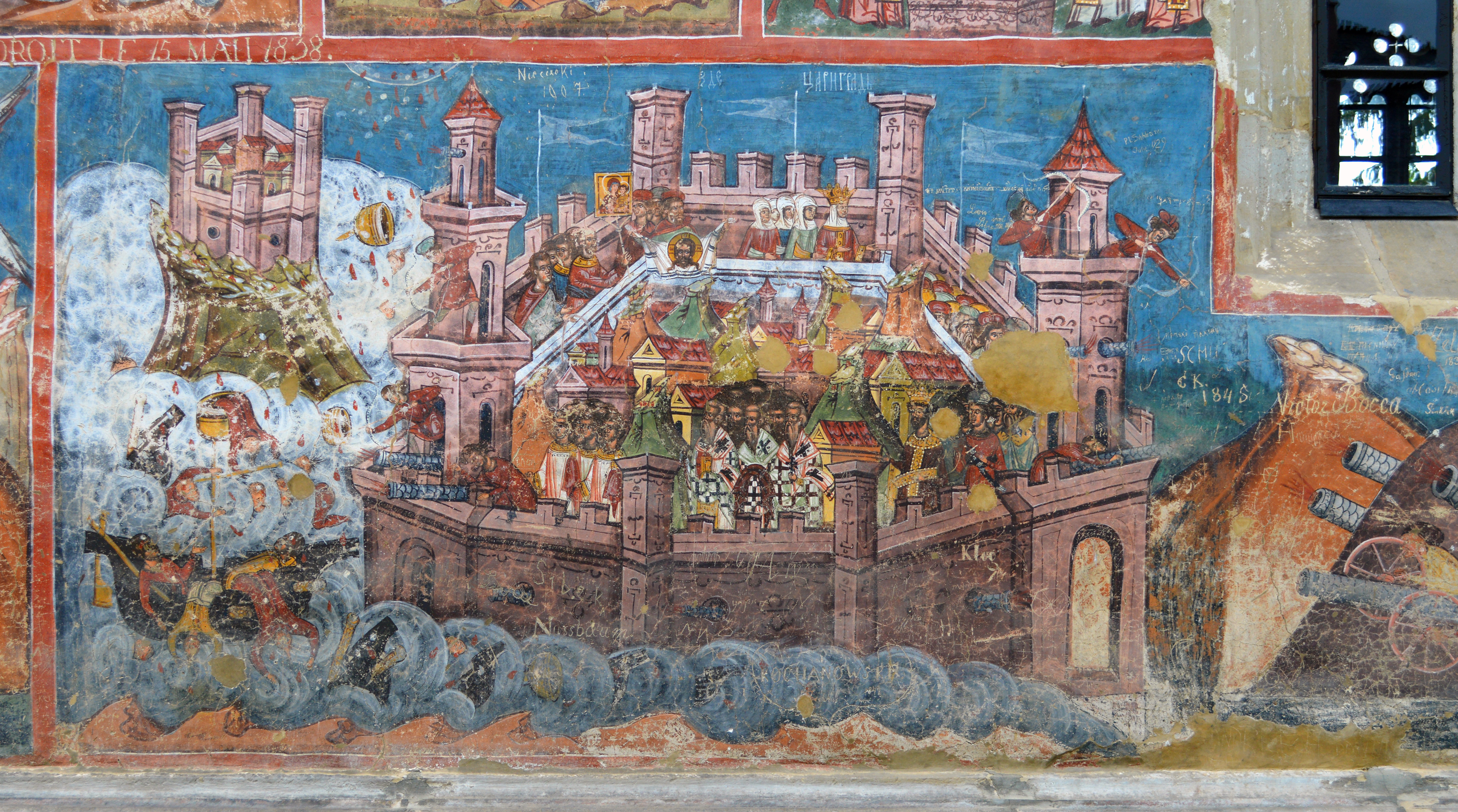
29 May 1453. Constantinople falls. Crete flourishes.
When Sultan Mehmed II rode into Hagia Sophia on 29 May 1453, it seemed that an era had come to an end. And indeed it had. But for a small island in the southern Aegean, that same day marked the beginning of something nobody expected: a golden age.
To understand why it was Crete, and not somewhere else, we must turn the clock back a few hours.
Three Hundred in the Towers
While the city was already falling—and by the afternoon Mehmed had entered Hagia Sophia—the fighting continued in three towers overlooking the Golden Horn. The defenders were Cretans.
They had not arrived there by accident. Since 1211 Crete had belonged to Venice, yet the region of Sfakia in the south retained a degree of autonomy. According to Cretan tradition, it was from Sfakia that a force led by Manousos Kallikratis sailed in response to the call of Emperor Constantine XI Palaiologos: around 1,500 volunteers on five ships. The core of the force is said to have consisted of Sfakians, a mountain people who had spent centuries resisting every conqueror and rarely concerned themselves with Venetian diplomatic calculations.
They reached the besieged city and fought throughout the two-month siege. When Constantinople finally fell on 29 May, a contingent of three hundred men remained. Retreating into the towers, they refused to surrender and repelled repeated Ottoman assaults for hours after the city itself had been lost.
Mehmed, now effectively master of Constantinople and contemplating the interior of the greatest church in Christendom, was informed that fighting was still continuing in the harbour. He sent a messenger.
The offer was simple: surrender and live.
The Cretans refused.
The first time I encountered this story, I laughed. It was exactly the sort of response one might expect from the people of Sfakia.
Only when Mehmed personally guaranteed their safety, promising passage back to Crete and freedom for all survivors, did the remaining 170 defenders lay down their arms. The Sultan kept his word.
A handful of warriors in towers, hopelessly outnumbered, defending a city already lost—the comparison with Thermopylae comes naturally, and not without reason. Yet there is one important difference.
Leonidas and his Spartans died, and that sacrifice became the foundation of their legend. The Sfakians survived. They returned to their villages, their families and the communities that had sent them. They carried home not only the memory of the fall of the greatest city of the Christian world but also the knowledge that they had stood their ground to the very end and lived to tell the story.
For a community, survival may be more powerful than martyrdom. A legend carved on a tombstone endures, but a legend embodied by living people who gather around a fire and recount what happened becomes something else entirely. Sfakia would become famous for resistance—to Venice, to the Ottomans and to anyone who attempted to subdue it. Not by accident.
The Serenissima Allows It—Because It Benefits
By 1453 Crete had been under Venetian rule for more than two centuries. Venetian administration was efficient, disciplined and rarely sentimental. The island was valued primarily as a strategic commercial hub and agricultural supplier. The Greek population enjoyed limited rights, Orthodox clergy were tightly controlled and Latin influence steadily expanded.
Yet after 1453 Venice did something it had previously been reluctant to do.
It allowed things to happen.
Not out of generosity, but out of necessity.
The fall of Constantinople was a geopolitical disaster for the Venetian trading empire. The Ottoman state now controlled many of the routes through which silk, spices and grain flowed. Venice needed Crete more than ever.
As a result, Venetian authorities increasingly tolerated the arrival of what was, in effect, the displaced Greek world. What might once have been seen as a political problem suddenly became an asset: people, knowledge, language, manuscripts, workshops, networks and artistic skills.
Scholars arrived. Scribes arrived. Theologians, poets and artists arrived.
Above all, painters.
One of them was Michael Apostolios, among the most distinguished humanists of late Constantinople. Captured during the siege and later released, he eventually settled on Crete. He earned a living copying manuscripts for Italian patrons. In one manuscript he left a note that survives today:
"The king of the poor of this world wrote this book for his livelihood."
Few people in Europe possessed his level of education, yet he lived in poverty. Such was the price of survival.
But the refugees brought with them something that would transform Crete completely.
A Centre Unlike Any the Greek World Had Known
Candia—modern Heraklion—became far more than an important Venetian port in the years after 1453.
It emerged as one of the most significant artistic and intellectual centres of the Greek world after the fall of Constantinople. Not because of grand political schemes, but because it was relatively safe. Here people could paint, write, copy manuscripts and trade.
Around 120 painters can be documented as working in Candia between 1453 and 1526 alone. They organised themselves into a guild, the Schuola di San Luca, modelled on Venetian professional associations. Artistic production became organised, professional and increasingly export-oriented.
And export they did.
A Venetian document from 1499 records an order for 700 icons of the Virgin Mary in a single commission—500 in the Western style and 200 in the Byzantine style. Cretan icons became luxury goods, sought after from Venice to Mount Athos.
What emerged is known today as the Cretan School, one of the most remarkable artistic phenomena in European history.
Cretan artists worked between two worlds. Byzantine iconographic tradition encountered the Venetian Renaissance, the art of Giovanni Bellini, Titian and later Veronese. The result was neither purely Byzantine nor purely Western. It was something distinct.
Its most famous product?
Doménikos Theotokópoulos.
Born on Crete in 1541, trained within the tradition of Cretan icon painting and later a student of Titian in Venice, he became known to the world by another name:
El Greco.
What It Meant for Crete
The consequences of 1453 remain visible on Crete to this day.
Churches and chapels built or decorated during the late fifteenth and sixteenth centuries bear witness to this remarkable fusion. Frescoes from the period preserve Byzantine conventions while experimenting increasingly with space, light and perspective inspired by the Western Renaissance.
Iconostases produced in Candia found their way into monasteries across the Greek world. Painters themselves were highly mobile, working on Crete, travelling to Venice or Mount Athos and often returning again.
It was an extraordinary era.
And it did not last forever.
It ended in 1669, when Candia surrendered to the Ottomans after a siege lasting twenty-one years. That is another turning point in Cretan history, and another story entirely.
Yet between 1453 and 1669, Crete became something few would have expected: the place where a large part of post-Byzantine Greek culture survived and flourished.
Byzantium did not die on 29 May 1453.
It moved south.
Today works of the Cretan School can be found in some of the world's greatest museums, from the Louvre to the Hermitage. Yet its traces remain visible on Crete itself—in monasteries, village chapels and churches that survived both Venetian rule and centuries of Ottoman domination.
These are the places we catalogue.
Post Scriptum: The Sources Behind the Story of the Sfakian Defenders
The account of Manousos Kallikratis and the Cretan defenders of Constantinople differs in nature from the rest of this article.
It belongs less to the mainstream history of the Cretan School and more to the historical identity of the people of Sfakia. The story has lived for centuries in local tradition, preserved in the name of the village of Kallikratis in the White Mountains and in the rizitika, the heroic songs passed from generation to generation.
The figures and details—1,500 volunteers, five ships and the defence of three towers—appear in a chronicle attributed to George Sphrantzes, a Byzantine courtier and diplomat who witnessed the siege. Sphrantzes is regarded as one of the most important primary sources for the fall of Constantinople.
Yet the situation is more complicated than it first appears.
Modern scholarship distinguishes between two works transmitted under his name: the authentic Chronicon Minus, a relatively brief memoir, and the much longer Chronicon Maius, now recognised as a sixteenth-century forgery created by Bishop Makarios Melissenos, a figure known for fabricating documents.
The genuine Sphrantzes devoted surprisingly little attention to the siege itself, focusing instead on personal and family tragedies. As a result, the detailed account of the defence of the towers may derive from Pseudo-Sphrantzes, a source of disputed historical value, although still important as a literary work.
There is also another testimony: a manuscript dated 1460 and preserved at the Monastery of Vatopedi on Mount Athos, describing the defence of the towers by Cretans under Captain Grammatikos. This source still awaits thorough scholarly evaluation.
What does this mean?
The story of Kallikratis and the Sfakian defenders rests on a strong local tradition—ancient, coherent and deeply rooted in collective memory. It also draws upon written sources whose historical reliability remains the subject of scholarly discussion.
Readers should know this.
Not because the story is necessarily false, but because distinguishing between historical tradition and firmly documented fact is the honest approach for anyone wishing to explore the subject further.
For the people of Sfakia, however, the story never required footnotes.
Their village has carried the admiral's name for more than five centuries.
Bibliography
Panagiotakis, Nikolaos M., El Greco: The Cretan Years, translated by John C. Davis, Ashgate, 2009.
Maltezou, Chryssa A., Byzantine "consuetudines" in Venetian Crete.
Vassilaki, Maria (ed.), The Hand of Angelos: An Icon Painter in Venetian Crete, Lund Humphries / The Benaki Museum, Athens, 2010.
Vincent, Alfred, Myth-History: Venice, Crete and Erotokritos, Kampos: Cambridge Papers in Modern Greek, no. 20, 2013.
Trombley, Frank, The Fall of Constantinople in 1453 and Late Medieval Greek Culture: The Experience of Defeat.
Sphrantzes, George, The Fall of the Byzantine Empire: A Chronicle 1401–1477, translated by Marios Philippides, University of Massachusetts Press, Amherst, 1980.