28 May 2026 · Artur Kiwa
Agios Stefanos. A small church with an enormous story inside
At the edge of an oak forest near Drakona stands a church so small that it would be easy to take it for an unremarkable roadside chapel. And yet, in its faded frescoes, a rare story of Saint Stephen, the first martyr of Christianity, has survived — together with a trace of a world in which Byzantine Crete met the West.
The Church of Saint Stephen in Drakona. A small church with an enormous story inside
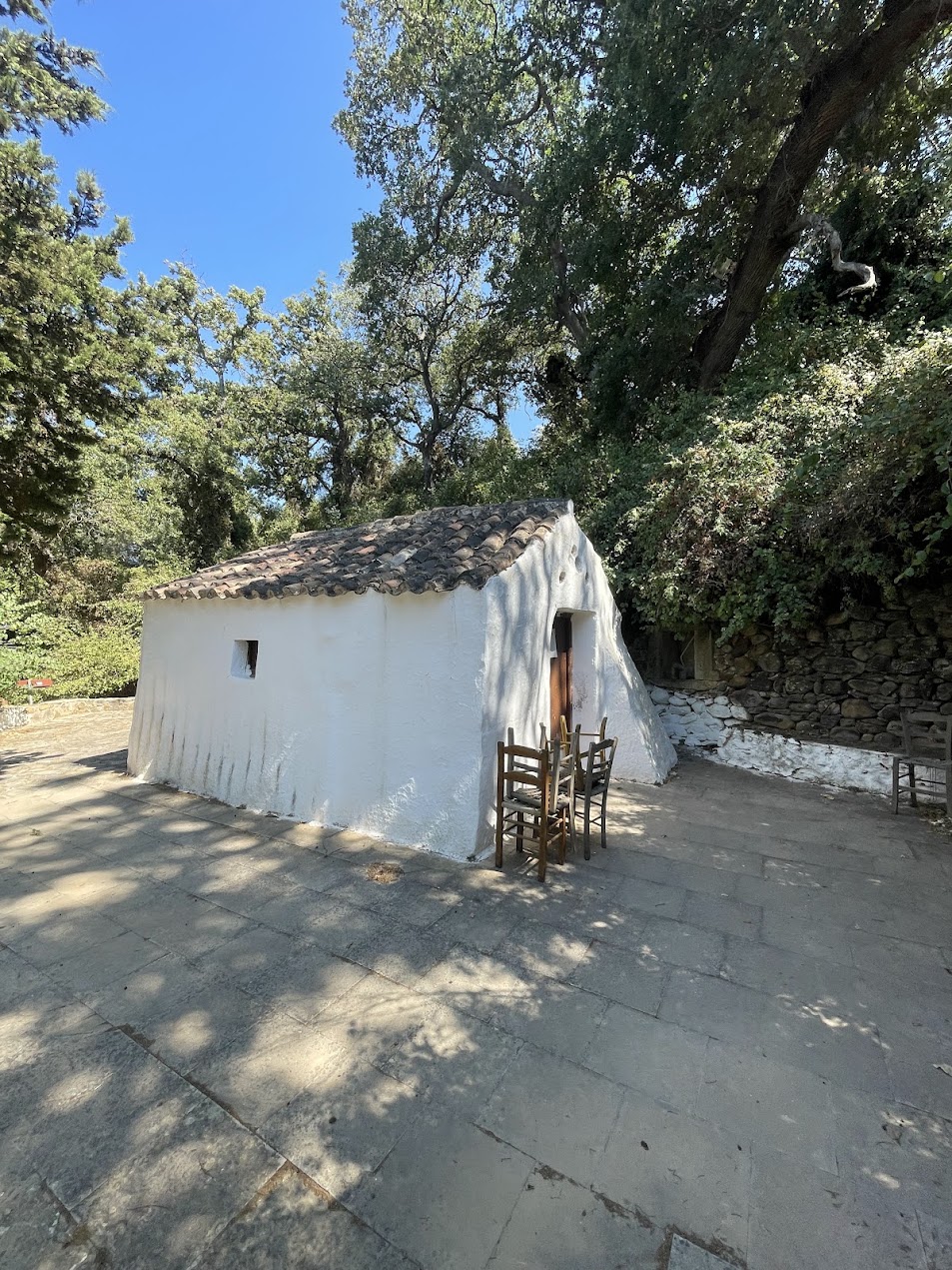
There are many churches in Crete that announce their importance at once. There are great monasteries, famous shrines, places described in guidebooks and catalogues, churches that almost shout with their scale, history and significance. The church I am writing about today does not belong to that category. Beside such places, the Church of Saint Stephen in Drakona looks almost like a joke. It is tiny, low, modest, as if someone had taken a normal Byzantine church and reduced it to the size of a model. It stands at the edge of an oak forest, near the village of Drakona, and it would be very easy to pass it by without much interest.
And yet it is precisely here, in this miniature building, that frescoes of exceptional value have survived. Not because they are the most spectacular in Crete, because they are not. Not because the interior overwhelms you with its scale, because it overwhelms with nothing at all — two people barely fit inside. Their importance lies elsewhere. On the walls of this small church, the story of Saint Stephen, one of the first martyrs of Christianity, was told in a rare and surprising way. This is one of those places that do not impress from a distance. You have to come closer, step inside, let your eyes adjust to the half-light. Only then does it become clear that this unassuming chapel at the edge of the forest contains a story that barely fits within its walls.
Agios Stefanos stands a few kilometres from one of the most important monuments in this part of Crete — the Rotunda at Episkopi Kissamou. And that is probably the best way to visit it: not as a separate half-day excursion, but as a small side turn from a much better-known place. The contrast is beautiful in itself. The Rotunda has the weight of history, monumentality and obvious importance. Agios Stefanos does exactly the opposite. It does not try to overwhelm anyone. It stands quietly at the edge of the forest, looking almost as if it were not entirely sure whether it wants to be noticed.
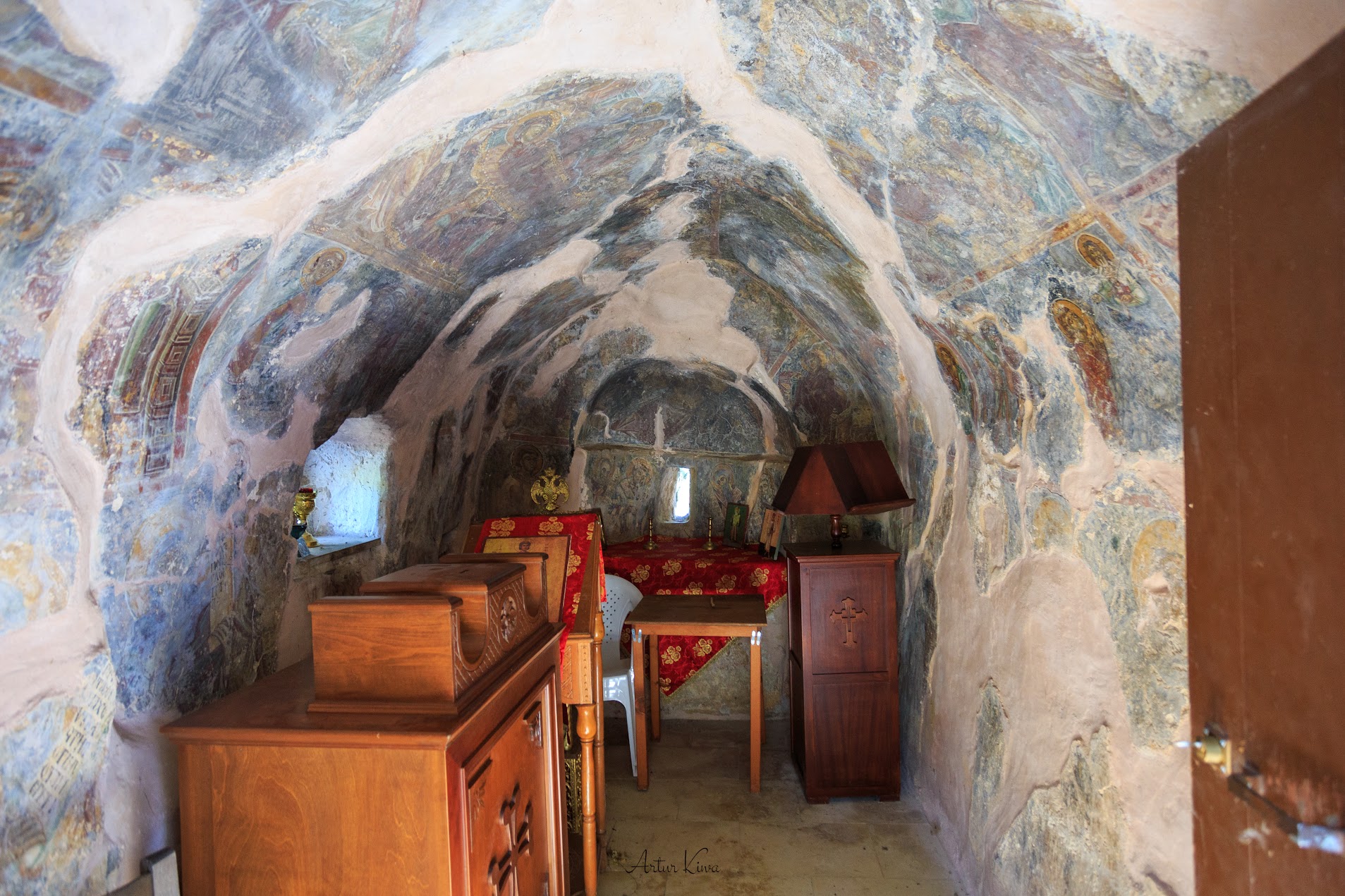
Getting there is simple, but there is no proper parking area by the church. The car has to be left carefully on the roadside. It is a small detail, but worth remembering, because the place is small not only architecturally — the space around it has not been prepared for tourist traffic either. Inside, this sense of scale becomes even more absurd. The thick walls take away what little space remains, and you immediately feel that this is not a church designed for a crowd. It is rather an interior for concentration, almost private, perhaps even a little austere.
The frescoes do not strike you like freshly cleaned decoration in popular monuments. They are pale, damaged in places, interrupted here and there by repairs. But after a while they begin to work. Not through a spectacle of colour, but through presence. As if these walls were still speaking, only more quietly than before. And this is exactly where the problem with this church begins, because if one judged it only with the eyes of a tourist looking for a strong visual effect, it would be easy to dismiss it. Small, faded, cramped, without grand architecture. But Agios Stefanos is not important because it is spectacular. It is important because, within such a small space, it has preserved a painted programme of surprising ambition.
The patron of the church is Saint Stephen, the first martyr of Christianity and one of the first deacons of the Jerusalem community. In Byzantine churches he appears frequently, especially in the sanctuary, as a deacon taking part in the liturgy. That in itself is not yet unusual. What is unusual is something else: in Drakona they did not stop at a single image of him. On the walls, three scenes from his story were shown — his preaching, his defence before the high priests, and his stoning. It is a rare biographical cycle, especially valuable precisely because it is found not in a great monastery or an urban church, but in this tiny chapel at the edge of the forest.
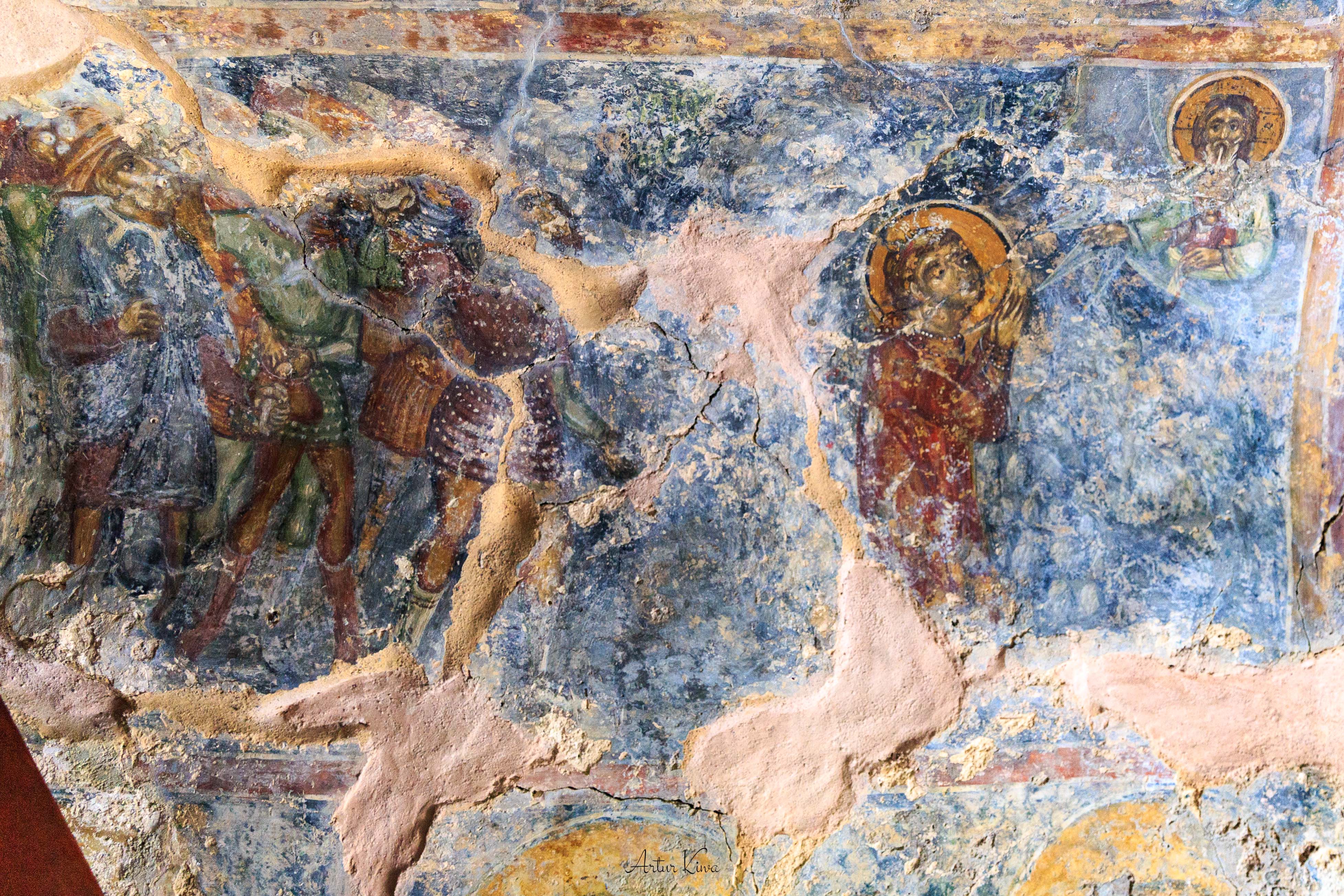
The most interesting scene is the stoning. It is the moment in which the small church in Drakona suddenly opens onto the wider world of the 14th century. In the way the persecutors are shown — their clothing, movement, violence, and the body of the martyr itself — scholars detect influences from Western painting. This is not a matter of simple copying, but of contact. Crete under Venetian rule was a place where images, models and ideas circulated between the Greek and Latin worlds. And this is one of the reasons why this church is so interesting. Inside it, we do not see a closed, isolated “Byzantineness”, but the living world of an island that for centuries was a space of encounter, tension, borrowing and resistance.
In the scene of martyrdom there is also a vision of the Holy Trinity. And here it becomes even more interesting, because this motif can be read as a strong theological accent. If the painter used Western models, he did not adopt them passively. He inscribed them into the language of Orthodox iconography and local tradition. This is very Cretan. Not a pure imitation of the West, not a simple isolation of the East, but a creative tension between the two. A few metres of wall, and inside them the whole Venetian period in miniature.
Numerous monks and ascetics also appear on the walls. This is not a random gallery of saints. Their presence gives the interior a distinctly monastic, concentrated character. Today it is probably impossible to say with certainty whether the church was connected with a specific community of monks or hermits, but the thought suggests itself, especially when one stands there, in that tiny space, at the edge of the forest. It does not look like a church of a large community. It feels more like a place made for silence, prayer and memory.
That is why Agios Stefanos is worth seeing precisely when visiting the Rotunda at Episkopi Kissamou. The Rotunda presents the great history of the region in monumental form. Drakona shows the opposite: how a great story can fit into a space so small that one almost touches its walls with one’s shoulders. This is not a church that will impress every visitor at first glance. It does not have the obvious spectacular quality that looks good in guidebooks. But if you give it a little time, it begins to work very strongly.