30 May 2026 · Artur Kiwa
An Island at the Crossroads of Death. Crete in the Time of Plague
In the summer of 1347, a ship from Constantinople sailed into the port of Chandax. It brought something no one was waiting for: a plague that would cut through medieval Crete, its cities, villages, ports, wills, and religious imagination.
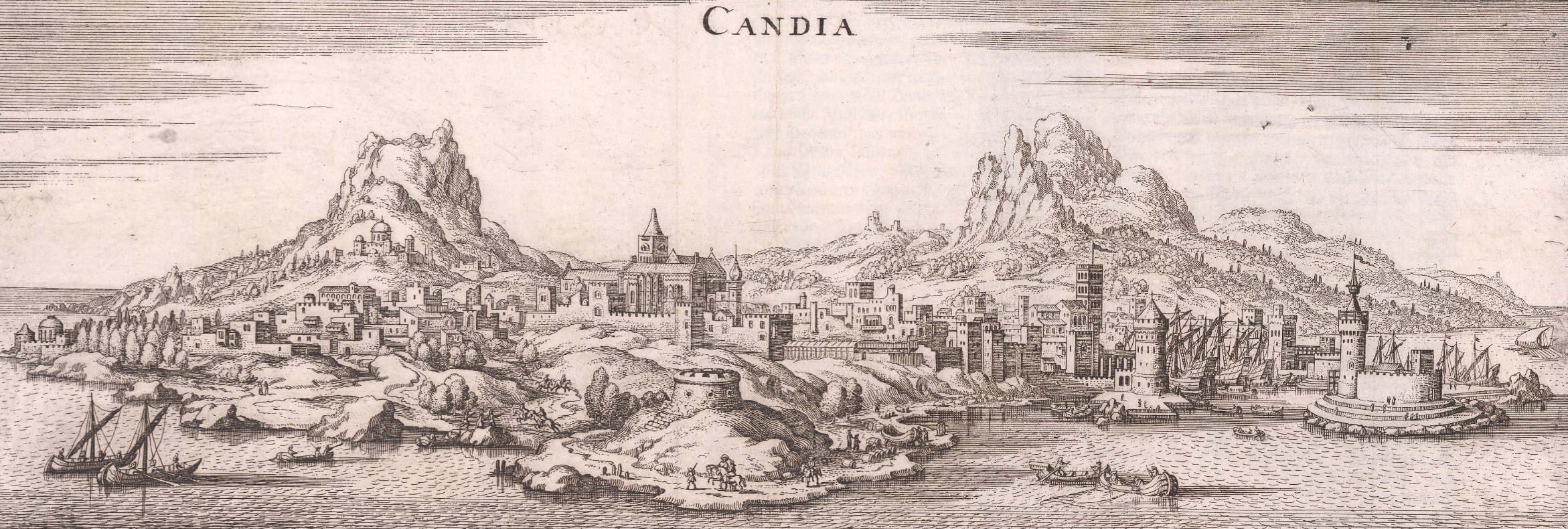
In the summer of 1347, a ship from Constantinople arrived in the port of Chandax — today we would say Heraklion. Nothing unusual. Ships from Constantinople came regularly; Crete lived from the sea, from trade, from the constant movement of goods between East and West. Silk, spices, wine, grain, icons, slaves — everything passed through Chandax. The Venetians, who had held the island in an iron grip since 1204, knew that their colony was worth as much as its ports were worth.
This particular ship brought something no one was waiting for.
All we know about it is that it existed. We know because the year 1347 appears in Venetian and Byzantine sources as the date of the first outbreak of plague on Crete — the same plague that was then emerging from Constantinople, moving at the same time toward Sicily, Marseille, and all the great ports of the Mediterranean. The Black Death did not travel on foot. It sailed, from port to port, from city to city.
The Kingdom of Candia, or Venice in the East
To understand why Crete was so vulnerable — and why its history in the time of plague is so extraordinary — we have to see it as it was: a large, complicated, restless colony.
After the Fourth Crusade and the sack of Constantinople in 1204, Crete was granted to Boniface of Montferrat, who soon sold it to Venice. Before the Republic could actually take possession of the island, however, it first had to drive out Genoa, which had already occupied it. It was not an easy gift to keep. During the first decades, the island repeatedly erupted in revolt — the Greek population had no intention of accepting Latin lords and the Western rite. Over time, however, something peculiar emerged: a society that was neither purely Venetian nor purely Greek, but both at once, and something third besides.
In the ports lived Venetian merchants, alongside Jewish merchants, alongside Armenian merchants. In the small stone churches scattered through the mountains of western Crete, Orthodox peasants prayed before frescoes painted by local artists who knew both Byzantium and Italian fashion. In Chandax, notarial offices operated in Latin, and wills were dictated there by both Latins and Greeks. Venice imposed taxes, filled offices, sent governors — but it never managed to remake the island in its own image. Crete remained itself.
And it was wealthy. Cretan wine — the sweet, dense wine the West called malvasia — flowed throughout Europe. Olive oil production, livestock, the transit trade from the East — all of this gave the colony an importance out of proportion to its size. And with wealth came movement: of people, goods, and — when the time came — diseases.
How the Plague Came to the Island
Yersinia pestis — a bacterium no one then saw and no one knew anything about — travels with a host. Its hosts are rodents and fleas, and these readily inhabit the holds of ships. When rats die in port, fleas look for a new host. A crowd on the quay is enough.
Autumn 1347. Crete lies at the crossroads of all the major sea routes. To the west — Sicily and Genoa. To the northwest — Venice. To the east — Cyprus, Syria, Alexandria. To the north — Constantinople, Thessaloniki, the entire Greek world. Each of these directions was now bringing death.
Sources mention plague on Crete already in 1347 — almost at the same time as the first reports from Sicily and Constantinople. In 1348, the disease broke out on Rhodes, Cyprus, and across the eastern Mediterranean. Crete was in the middle.
How badly the island suffered during the first wave is difficult to say with precision today. Demographic data from fourteenth-century Crete are incomplete — we have estimates, not censuses. We do know, however, that across Europe the Black Death killed between a quarter and a half of the population, and in some urban areas even more. Chandax, a crowded port animated by trade, had every condition needed to fall into the worst category.
And then the plague returned. And again. Between 1347 and 1453, epidemiologists have counted, in the Byzantine world and its surroundings, nine major waves of plague, eleven local outbreaks, and sixteen relatively calm periods. Crete appears in this accounting repeatedly: 1362, the years 1376–1389, 1398, between 1410 and 1420 — and so on, every dozen years or so, like a heartbeat, except deadly. Plague became a fixed element of the Cretan landscape, something one waited for, lived with, and prayed in the face of.
Voices from the Archive: Wills as Testimony
There is an archive in Venice — the Archivio di Stato — where the documents of the Republic and its colonies are preserved. Among them, in bundles marked Notai di Candia, lie hundreds of parchment wills from Chandax, dated from 1312 to 1420.
Sally McKee, a Canadian historian, read them all. In 1998 she published a three-volume collection containing almost seven hundred and ninety documents — will after will, dictated by women and men, Latins and Greeks, merchants and craftsmen, free people and freedmen.
Wills are a special kind of source. They are dictated when one feels death approaching. In peaceful years, they appear mainly among the elderly or the seriously ill — among those who have time and opportunity. In plague years, the curve is different. Suddenly wills are dictated by young people, healthy only a week earlier, who have felt a swelling lump under the arm or in the groin and know — because everyone already knows — what it means.
One reads these documents with a strange sense of closeness. I, Maria, wife of Nikolaos, being of sound mind but uncertain of tomorrow... Then comes the list of possessions: a house, a garden, two horses, an icon of the Most Holy Virgin Mary set in silver, a chest of fabrics. Who receives this, who receives that. Who the witnesses were. What name was borne by the notary who recorded the last will of a woman we no longer remember.
In these documents, plague reveals itself partly through absence. A husband named as a witness in his wife’s will soon appears in another person’s will as recently deceased. Notaries vanish from their registers for several weeks, then a new notary appears and the protocols begin again. Continuity breaks. Then it goes on.
Ioannis Pagomenos: A Painter Caught by Plague on the Road
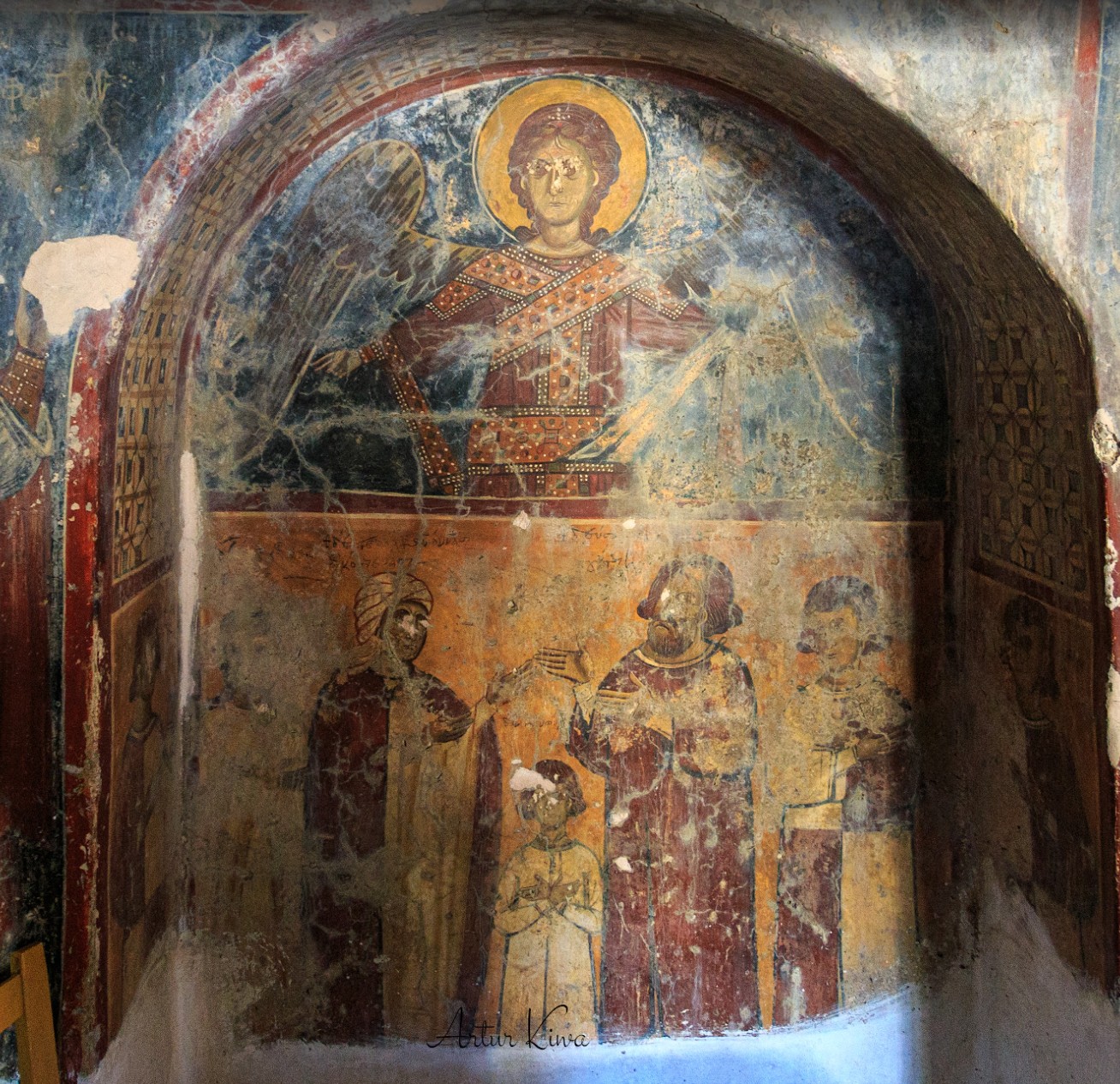
In western Crete, far from the bustle of the port of Chandax, from the mountains of Sfakia to the valleys of Selino, there stand dozens of small stone churches. Most are locked; to enter, one has to ask the priest or the village elder, and even then it often turns out that the key is held by a neighbor. Inside, on the walls and vaults, the frescoes live.
One painter signed his work in nine of these little churches. His name was Ioannis Pagomenos, and he worked in the first half of the fourteenth century — from 1313 to around 1340. We know about him only what the walls have told us: a name scratched into plaster, a date, one or two words of dedication. No documents, no accounts, no portrait of his face. Only frescoes.
And the frescoes are extraordinary. Not because they equal the mosaics of Ravenna or the frescoes of Giotto — they are humbler, provincial, painted for peasant communities that could not afford a more renowned artist. But they are alive. Pagomenos’s saints have the faces of real people; their eyes look out with something that can be called presence. Christ Pantokrator in the little church at Komitades looks straight at the person entering — attentively, as if he knew why they had come.
Pagomenos worked in the world just before the catastrophe. His last dated works come from around 1340. Plague struck Crete seven years later. Did the painter live to see the epidemic? Did he survive it? We do not know. His son Nikolaos continued the workshop in the 1360s — which suggests that the family survived. But what happened to Pagomenos himself in the summer and autumn of 1347, when people began dying in the ports? The walls do not tell us.
What we do know for certain is that Pagomenos worked for patrons from the peasant and minor noble strata — for those who built small churches in the mountains, far from Venetian offices and Latin bishops. In a sense, his frescoes are a portrait of the world that the plague was about to destroy. Not the catastrophe, not its traces — but the moment before.
Two Languages in the Face of Death: East and West
When the Black Death struck western Europe, local artists gradually developed their own visual language. Dances of Death appeared — processions of skeletons leading popes, kings, merchants, and beggars by the hand. Triumphs of Death appeared, like the one painted in the Camposanto in Pisa: a vast fresco in which Death, as a skeletal woman, cuts everyone down without exception. Plague became a direct subject of art, without veils.
On Crete — and more broadly in the Byzantine tradition — this language did not exist. Not because death was any less real. It was at least just as present. But Orthodox culture, shaped over centuries, had a different way of speaking about dying and salvation.
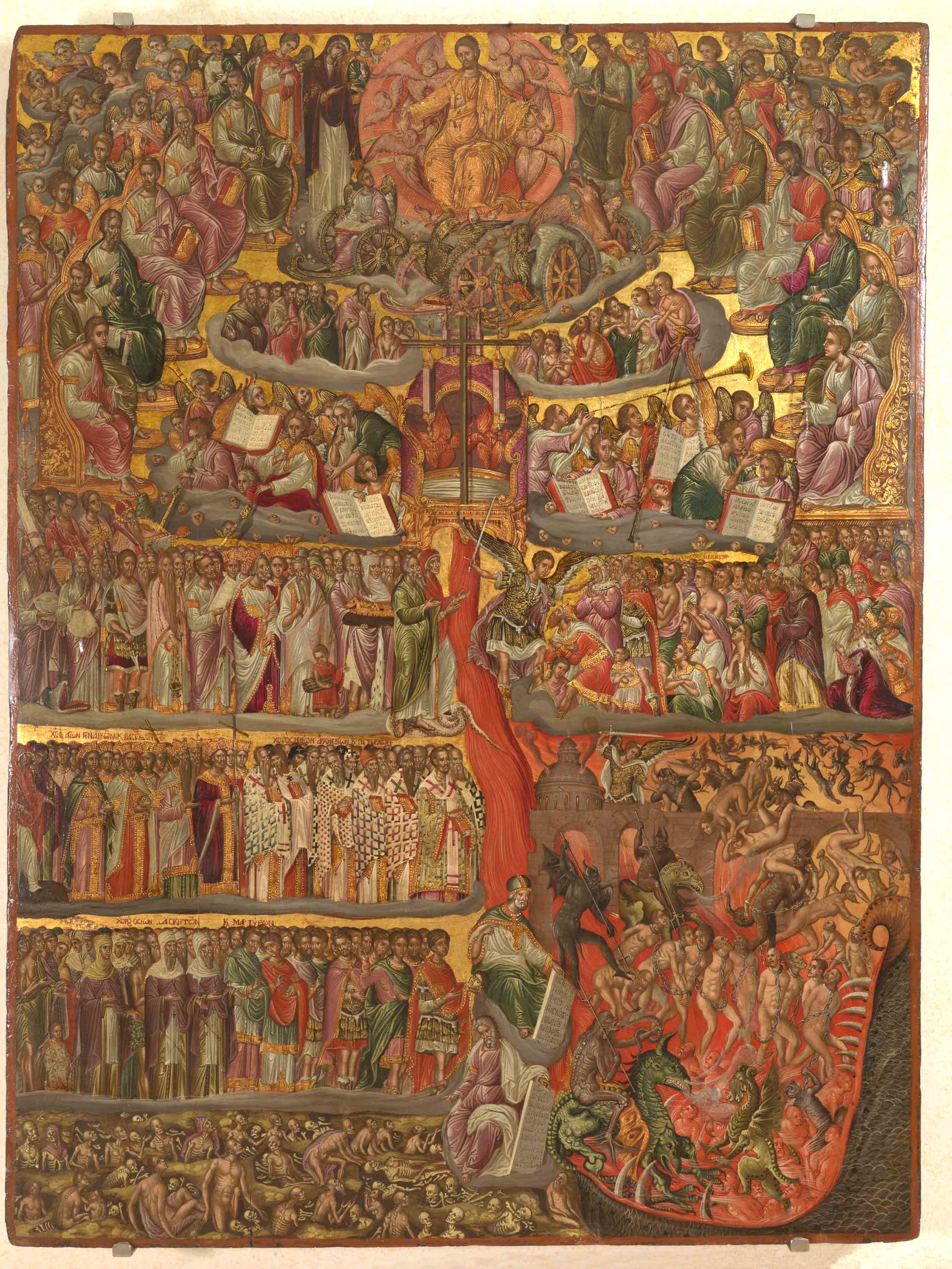
Instead of the personification of Death with a scythe — the intercession of saints. Instead of processions of skeletons — the Last Judgement, where every soul stands personally before Christ the Judge, while the Deesis — the Mother of God and John the Baptist on either side of the throne — pleads for mercy. Instead of macabre still lifes — icons of the holy physicians Cosmas and Damian, or of Saint Sebastian, whose arrow wounds people associated with certain symptoms of plague.
The Last Judgement as an iconographic theme flourished especially strongly on Crete precisely after the first waves of plague — not as a literal response to the epidemic, but as a question that plague made urgent and burning: what will happen to my soul? When death may come tomorrow, the day after tomorrow, in a week — when half a city dies, whole villages, entire families at once — the question of Judgement ceases to be a theological abstraction. It becomes a practical matter.
Later Cretan painters, such as Georgios Klontzas in the sixteenth century, expanded the iconography of the Last Judgement into multi-figured compositions in which demons, angels, the damned, and the blessed swarm together. Scholars debate whether this was a direct response to the trauma of repeated epidemics or rather part of a broader European fashion for eschatological themes. Probably both — fashion never has only one easily grasped cause.
Plague and the Birth of a School
Here the story takes an unexpected turn. The Black Death destroyed a large part of the Cretan population. It killed craftsmen, merchants, patrons, perhaps painters as well. It disrupted workshops and networks of patronage. All of this is true. And at the same time — indirectly — it contributed to the emergence of something extraordinary.
Successive waves of plague and the gradual collapse of the Byzantine Empire — the Ottoman Turks captured Constantinople in 1453 — pushed successive groups of people from the center toward the periphery: scholars, theologians, copyists, painters. Crete, under Venetian control, was safe. It had ports, it had a market, it had clients. It also had something priceless: the status of a borderland between East and West, between Byzantium and the Renaissance.
This is how the Cretan school of icon painting was born — one of the most important currents in the history of the icon. Its painters learned from Constantinopolitan masters of the Palaiologan tradition, but they also saw Italian works, Florentine perspective, Venetian feeling for color. They developed a style that was a synthesis — gold grounds as in Byzantium, but increasingly natural poses and faces; the hieratic calm of the icon, but also a lyricism breathed into it by the Western Renaissance.
Its most famous pupil, who went his own way, was Domenikos Theotokopoulos, born on Crete in 1541 and known to the world as El Greco. When he left for Venice and then for Spain, he took both languages with him — and out of their collision made something third, something his own, something unmistakable. But that is another story.
What Remained
In today’s Heraklion, around Eleftherias Square and the nearby cafés, it is difficult to think about plague. The city is noisy, sunlit, crowded with tourists in summer. The port gives the impression that it has always served mainly ferries to Piraeus and Athens.
But if one travels west, into the interior of the island, through the mountains of Sfakia and the valleys of Apokoronas — those little churches are still standing there. Limestone faded by the sun, doors often secured with a new padlock. Inside — half-darkness, the smell of wax and old plaster, and on the walls faces painted by Pagomenos or someone from his workshop more than six hundred and eighty years ago.
We do not know how many of these faces survived the plague of 1347. We do not know whether any did. The peasants who built the churches and the craftsmen who decorated them — most of them left behind only names in dedicatory inscriptions, or left nothing at all. The notaries of Chandax recorded some of them in wills; the rest passed without a trace.
But the frescoes remained. And this may be the most interesting conclusion of this history: the plague did not leave images of plague on Cretan walls, nor skeletons, nor dances of death, no literal testimony at all. It left saints still gazing at those who prayed — and the absence of those who stopped coming to pray.
What disappeared was never painted.
Sources and Further Reading
For those who would like to explore the subject further, there is a solid bibliography:
Historical and epidemiological: C. Tsiamis, E. Poulakou-Rebelakou, A. Tsakris, Epidemic waves of the Black Death in the Byzantine Empire (1347–1453 AD), “Infezioni in Medicina” 2011 — available on ResearchGate, the best synthetic treatment of the subject for the Greek area. On the nineteenth-century plague in Crete, with a historical introduction reaching back to the fourteenth century: The Plague in Crete During the 19th Century, PMC 2023.
Archival material: Sally McKee (ed.), Wills from Late Medieval Venetian Crete 1312–1420, Dumbarton Oaks 1998 — three volumes, seven hundred and ninety wills. This is essential for anyone who wants to come closer to the concrete people of that period.
Art: Angeliki Lymberopoulou, Fourteenth-century Regional Cretan Church Decoration: the Case of the Painter Pagomenos and his Clientele, in: Series Byzantina VIII, 2010 — one of the most important studies on Pagomenos. On plague art more generally: Millard Meiss, Painting in Florence and Siena After the Black Death, Princeton 1951 — a classic, now partly contested, but still an essential point of reference. Cristina Stancioiu leads the research project Salvaging Crete: Late Byzantine Churches and the Legacy of Painter Ioannis Pagomenos (Dumbarton Oaks grant 2019–2020).
Venetian context: K. Konstantinidou et al., Venetian Rule and Control of Plague Epidemics on the Ionian Islands during 17th and 18th Centuries, “Emerging Infectious Diseases” 2009 — available free of charge through PubMed Central (PMC2660681).