17 June 2026 · Artur Kiwa
Fourteen Faces from Kavallariana
In 1327, four families from a mountain village in Selino built a church, hired a painter, and carved into stone a sentence no one before them had dared to write. Seven hundred years later, their faces are still on the wall.
It was the year 1327, or perhaps 1328 — no one knows for certain, because time was counted differently then. On Crete, years were reckoned from the creation of the world, so the date in the inscription reads: six thousand eight hundred and thirty-six. Converting to our calendar takes a moment and yields those two possibilities. The year in which four families from a small village in the mountains of Selino decided to build a church.
Kavallariana lies beside Kandanos, in a hollow of land encircled by higher ridges, at an altitude of around five hundred metres. Today it counts a few dozen souls, surrounded by olive groves and dry stone walls. In the fourteenth century it was an inhabited, agricultural, entirely ordinary place. Venice had ruled Crete for over a century — since 1211, when the island was purchased from Boniface of Montferrat for a sum that now seems laughable. The Greeks, the island's former masters, had become subjects of the Serenissima. Some rebelled almost immediately. Some reached a compromise. Most simply went on living — sowing grain, pressing olives, baptising children, burying the dead.
Theotokis Kotzis, Manouel Melisourgos, Nikitas Sideris, and his kinsman — brother or son, we cannot say — Demetrios Sideris belonged to that last category. There is no trace of their having fought Venice. No trace of their having courted it beyond measure. They were ordinary people from the province of Selino who one day decided they wanted a church of their own.
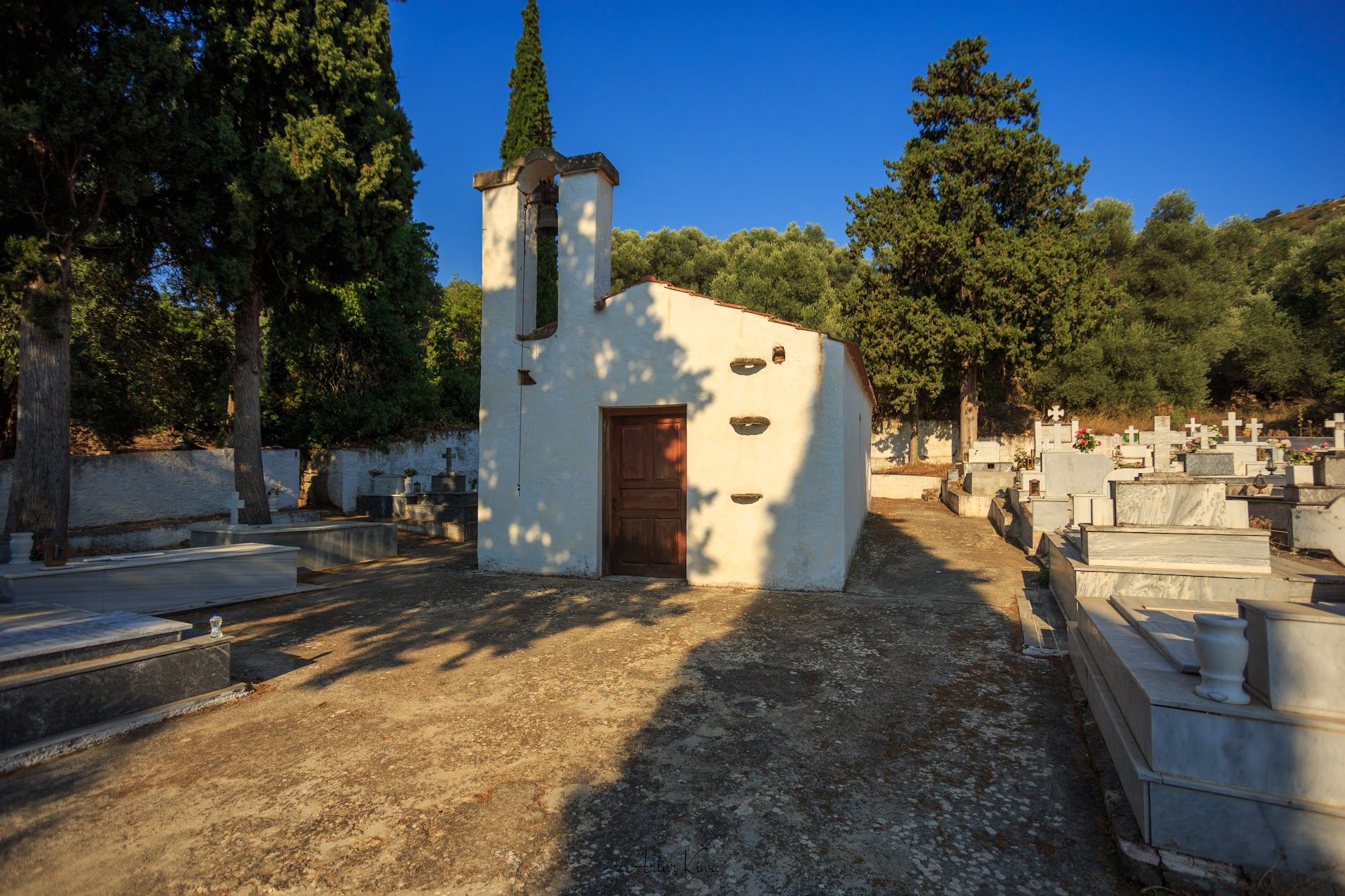
The decision to build a church in fourteenth-century Crete was not purely a religious one. It was a collective, legal, economic, and — in a certain sense — political act. A donor church is not merely a place of worship. It is a declaration of presence. A cornerstone of family memory. The donors would enter and see themselves painted on the wall — not as abstract devotional figures, but as specific people, recognisable to every villager. Their names were inscribed. Their faces fixed. They remained in the church even after death, because the church was most often the burial place of the founding family.
The four men of Kavallariana chose the Archangel Michael as their patron. Not by chance. Michael, in Eastern theology, is the one who stands at the scales of souls on the Day of Judgement. A church dedicated to him is a church tasked with guarding the donor's soul at the moment when everything is decided. The cemetery outside — the same one that exists to this day — was an integral part of the plan.
They commissioned a painter. We know his name, because he left it himself — he signed the dedicatory inscription with a singular modesty: Ioannis, τάχα κε ζωγράφου. Ioannis, perhaps also a painter. That phrase — "perhaps also a painter" — is not coyness or ironic detachment. It is a formula of humility, the same used by scribes copying manuscripts when they called themselves "unworthy" and "sinners." Ioannis Pagomenos was in fact a painter, and a remarkable one. His hand is behind the churches at Komitades, Anisaraki, Kakodiki, Maza, Kavallariana. He travelled across Selino from workshop to workshop, commission to commission, perhaps with apprentices, perhaps alone. We do not know where he came from. We know he was active in the 1320s and 1330s, and that wherever he worked, he left something better than he found.
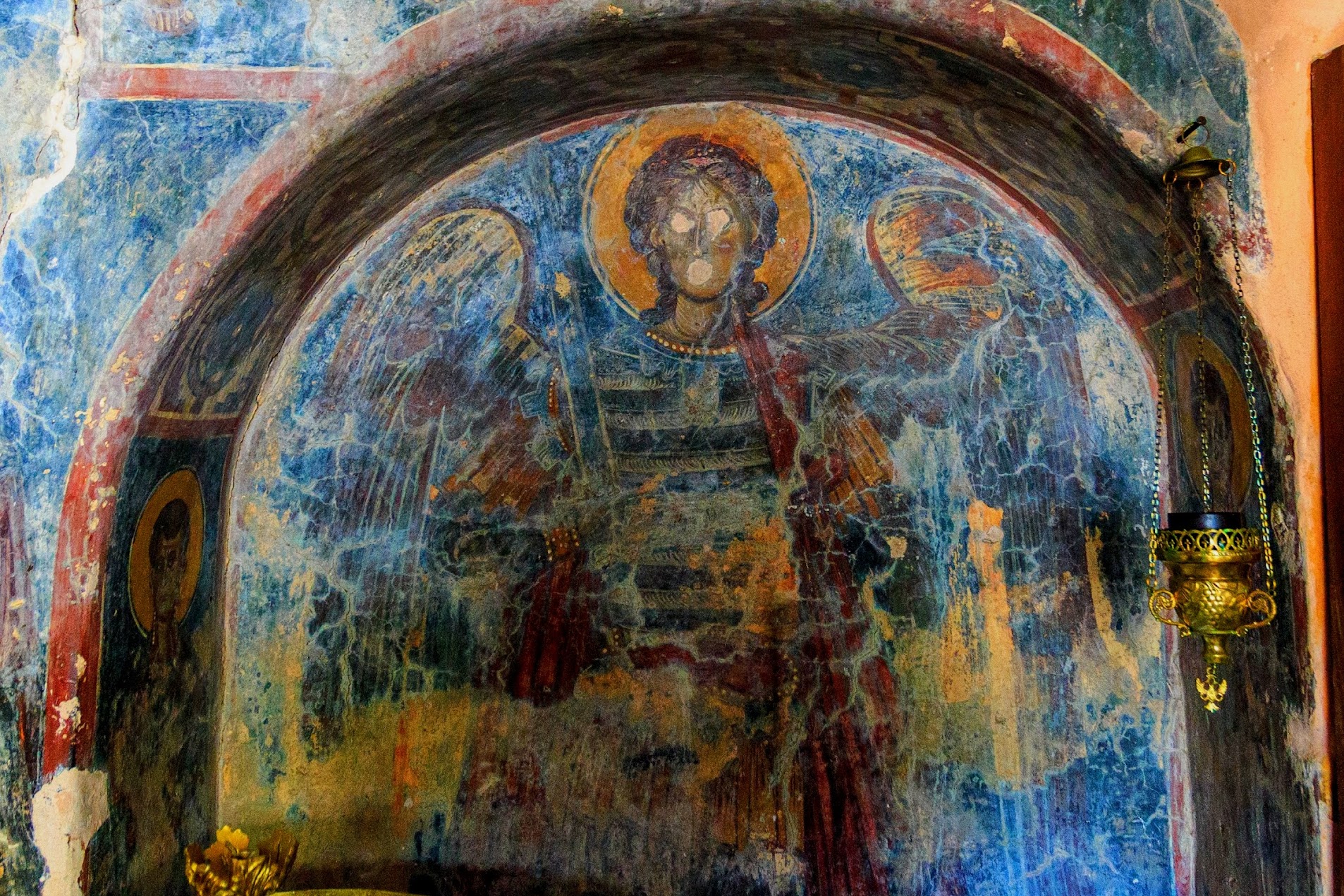
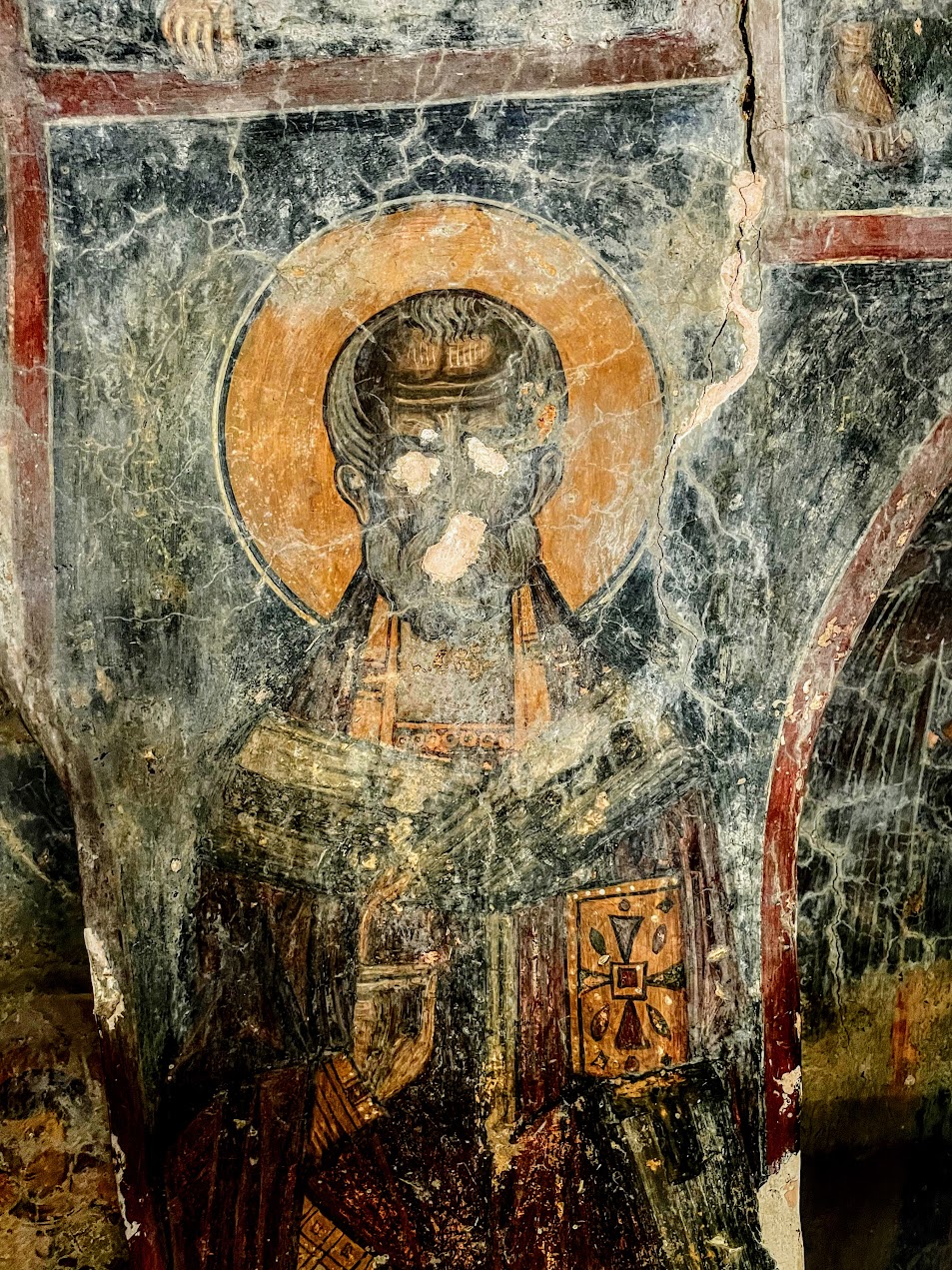
Inside, the church is single-nave — an elongated hall covered by a barrel vault, three blind arches on each of the long walls. Small, like most rural churches of Selino. Imagine how it looked just after completion, before seven centuries had done their work. Fresh plaster, saturated colours. In the apse, the Pantokrator — the solemn, frontal face of Christ, gaze fixed on whoever entered. Below, a register of hierarchs in chequerboard omophoria. On the vault, the Christological cycle laid out: the Betrayal of Judas, the Transfiguration, the Presentation at the Temple, the Ascension. On the south wall, in a blind arch, Saint George on horseback — golden armour, golden ground, the horse at full gallop.
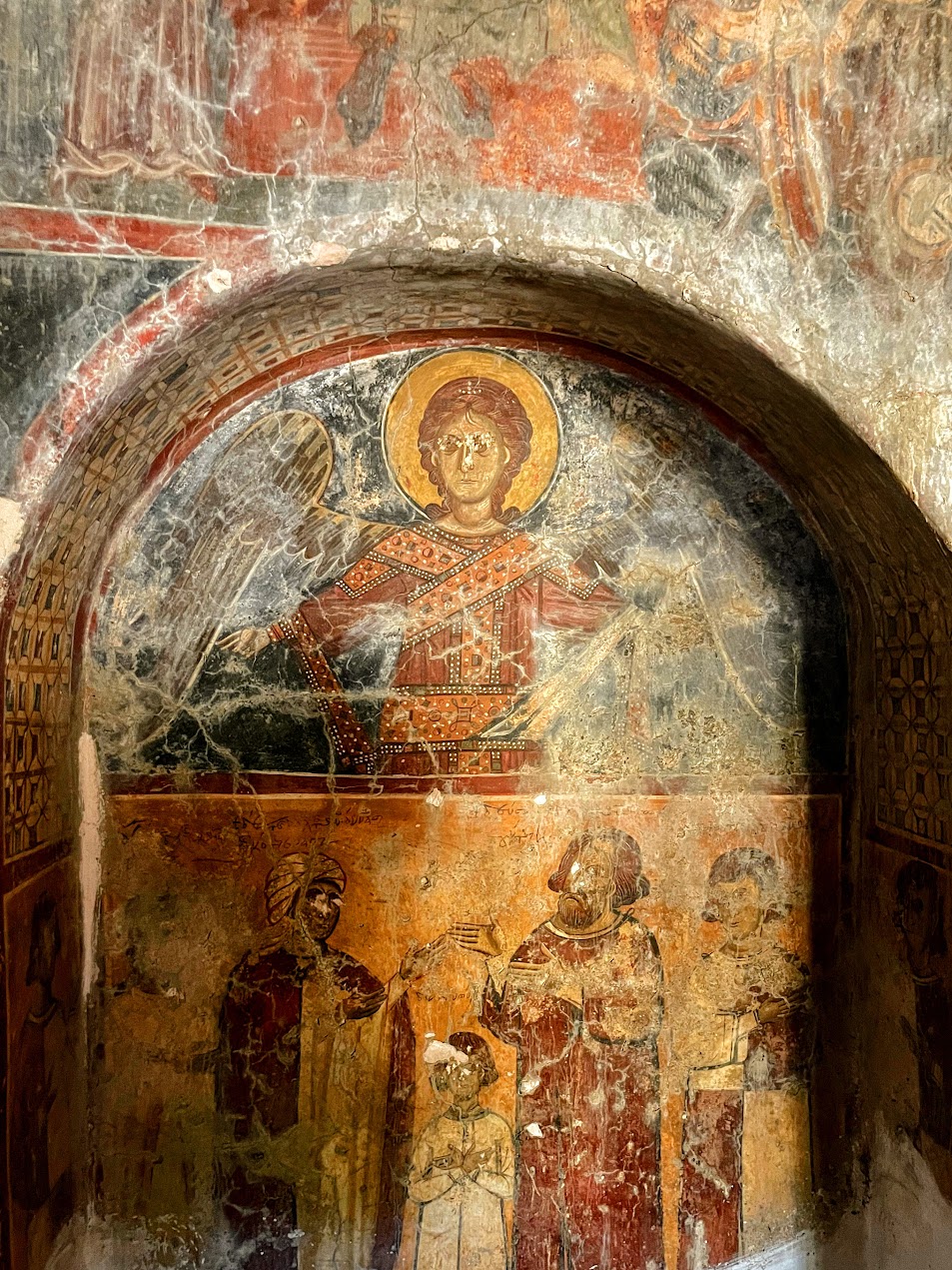
And in the central arches — them. Fourteen faces.
On the north wall, Theotokis Kotzis with his wife Anna and their children. Theotokis himself chose Greek dress — hypokamison, outer garment, no western ornament. Perhaps it was deliberate. Perhaps the painter simply painted him that way. Perhaps Kotzis was an older man who wanted no part of mi-parti. Beside him, Anna — head covered, face composed, hands folded. Their son Manouel stands between his parents with arms crossed over his chest — in Byzantine convention, this gesture signals that the person was already dead when the portrait was painted. The boy died before the church was finished. Then Theodoros, Georgios, Michael — three young beardless men, meaning unmarried. And an unnamed woman whose name did not survive, because the plaster fell away at that spot.
On the south wall, Manouel Melisourgos with his wife and small daughter. Nikitas Sideris with his wife Katerina. Demetrios — no surname, which means he is a Sideris but not the head of the family. Perhaps Nikitas's son, perhaps his brother. Two women in the reveals of the arch whose names did not survive. All the men in this group wear mi-parti: fabrics in chequerboard or horizontal or diagonal stripes, heraldic colours, western fashion. The scholar Angeliki Lymberopoulou, author of a monograph on this church, notes that such dress need not have signified identification with Venetian culture. Mi-parti was fashionable, it was prestigious, perhaps copied from imported fabrics brought by Venetian merchants. It spoke of prosperity and a knowledge of the wider world — not of any renunciation of Greek identity.
Between the two groups — the inscription.
The inscription is carved into the plaster beneath the donor scene on the south wall. Gerola transcribed it in the early twentieth century, when it was still legible. The text states: the Church of the Archangel Michael was built "during the rule of our great and masters the Venetians" — τῶν μεγάλων κε ἀφέντον ἡμῶν Βενετηκῶν.
That sentence has no equivalent in any other Cretan church inscription of the period. Nowhere else are the Venetians called "great and masters." In dozens of other fourteenth-century donor inscriptions on Crete, their presence is noted in neutral terms — as a chronological frame, a historical backdrop, scenery. Here they are "great and masters." Ours.
Why?
Lymberopoulou considers this question carefully and offers no definitive answer, which is honest, because no definitive answer exists. One possibility can be dismissed at once: this was not an impulse. A donor inscription is a considered text, often composed with the participation of a priest or notary, approved by the donors. Every word carried weight. Someone — perhaps Kotzis himself as the head of the enterprise, perhaps Pagomenos, perhaps the local cleric — decided that the Venetians would be named here by what they called themselves.
The historical context offers some guidance. The year 1327 falls midway between two significant moments. Twenty-eight years earlier, in 1299, Venice concluded a treaty with Alexios Kallergis — the most powerful Cretan aristocrat, who had led an armed rebellion against the colonisers since 1283. The treaty was a compromise: Kallergis kept his land and standing, Venice kept the island. It demonstrated that at least part of the Cretan elite was prepared to live with the Venetians within a negotiated order. Forty years after the church was built, between 1363 and 1367, the revolt of Saint Titus broke out — unique in that not only Greeks but Venetian settlers joined the rebels against the mother city. The church at Kavallariana was built, then, in a relatively calm interval, when tensions had subsided.
But there is another reason, simpler and more earthly. The donors were building a burial church. They wanted it to stand. To cause no trouble. To give no Venetian official a pretext for interference. Small rural communities in Selino lived far from Chania and from the Venetian administration, but the law reached everywhere. Flattery carved in stone is a cheap insurance policy. Great and masters — and leave us in peace.
I do not know what Theotokis Kotzis thought when he stood in the finished church and looked at his portrait. Whether he was pleased with the likeness — if likeness was even a consideration here. Whether he prayed for his son Manouel, who had died too soon and stands on the wall with arms crossed. Whether he looked across the nave at the Sideris neighbours and thought it had truly been worth pooling their resources.
The church still stands today in the cemetery at Kavallariana. The outer walls are whitewashed — a modern intervention that covered the stone. Inside, the frescoes are heavily damaged, illegible in places. The Pantokrator in the apse survives only in fragments. George on horseback — better. The faces of the donors — varying. Some distinct, others reduced to a halo and the outline of a robe.
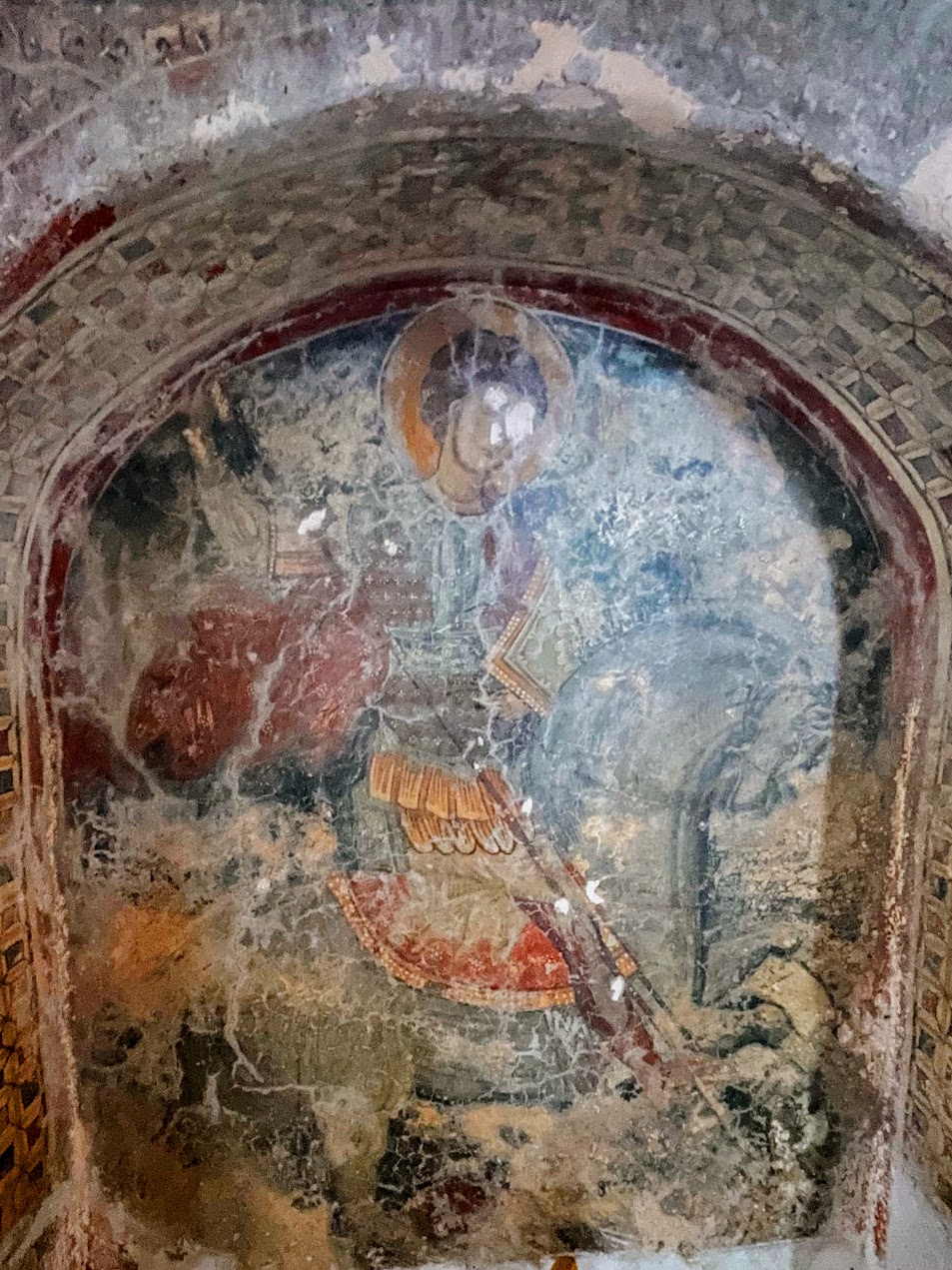
But they are there. After seven hundred years they are still on the wall — Theotokis Kotzis and his neighbours, in their mi-parti and their Greek robes, with their children and wives, with the painter's name and with their flattery of Venice, which may have been an insurance policy, or may have been something more complicated: an acceptance of the world as it was, because no other existed.
Ioannis Pagomenos, a painter, perhaps, had done his work.