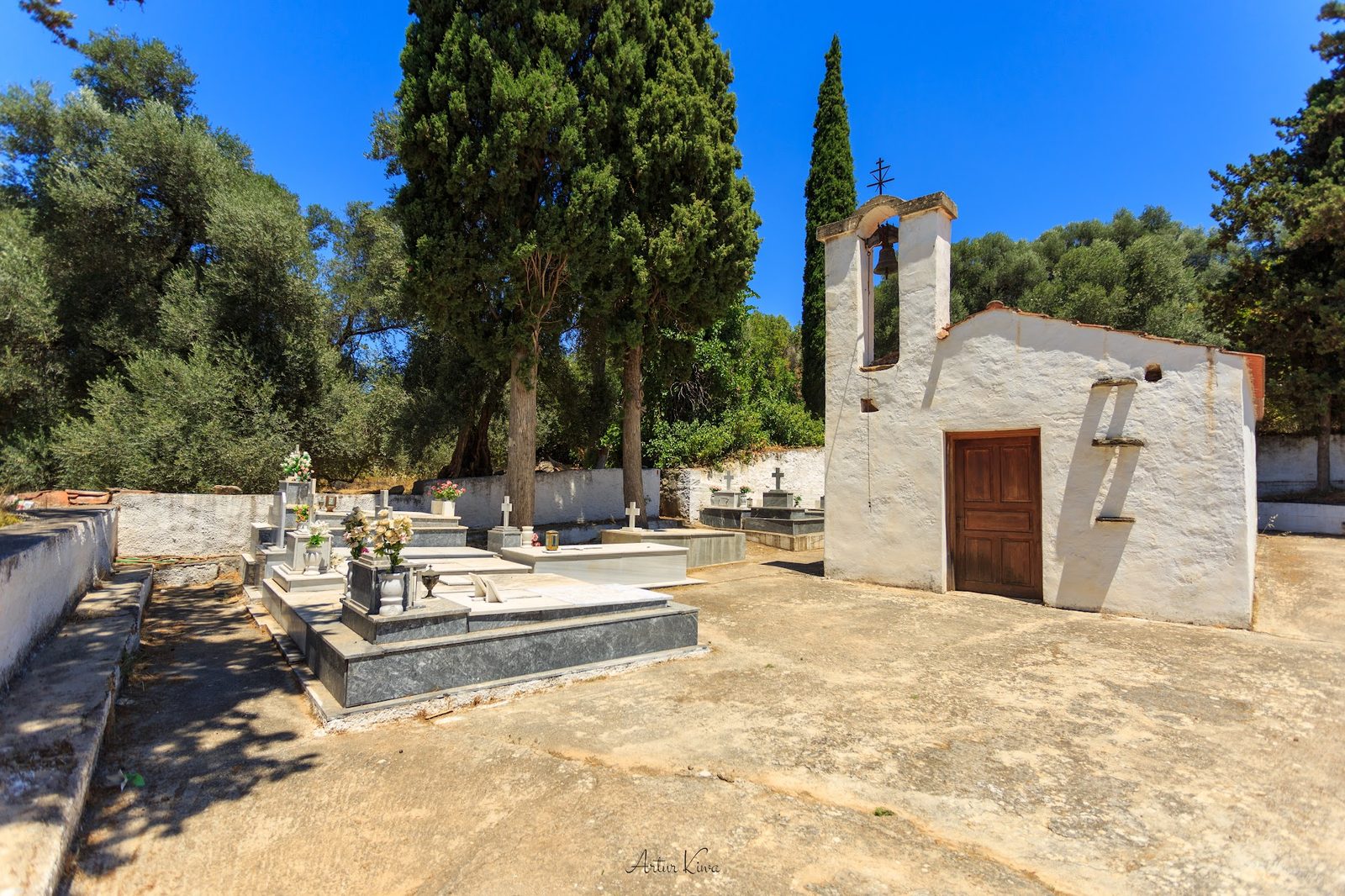
Church · Chania Regional Unit
Church of the Archangel Michael
Kavalariana · Municipality of Kantanos-Selinon · Chania Regional Unit
- Dating
- 1301–1350
- Patron
- Archangel Michael
- Painter
- Ioannis Pagomenos
- Plan
- Single nave
- Condition
- Excellent
- Location
- Confirmed
Description
In 1327 or 1328, four families from the village of Kavalariana — Theotokis Kotzis, Manouel Melisourgos, and Nikitas and Demetrios Sideris — pooled their resources to build and decorate a church. They commissioned a painter we know by name: Ioannis Pagomenos, who signed the dedicatory inscription with characteristic Byzantine modesty as "perhaps also a painter" (τάχα κε ζωγράφου). Pagomenos was the most prolific artist working in fourteenth-century Selino, responsible for churches at Komitades, Anisaraki, Kakodiki, and numerous other villages. At Kavalariana he left one of his finest surviving groups of donor portraits.
Fourteen figures — men, women, children — look out at us from the central blind arches of the north and south walls, seven to each side, arranged in perfect symmetry. Together they form something unparalleled on Crete: a family portrait gallery embedded directly within the church's sacred iconographic programme. The north wall belongs to the Kotzis family — Theotokis, his wife Anna, their children; the south wall to the Melisourgos and Sideris families. Women with covered heads indicate married or widowed status by Byzantine convention; young girls wear their hair loose. Most of the men wear mi-partie garments — fabrics with chequerboard or striped heraldic patterns, a fashion that blended the island's two worlds — while Theotokis Kotzis alone opted for traditional Byzantine dress.
Between the two groups runs a dedicatory inscription unique in Cretan epigraphy: the donors address their Venetian rulers as "great and masters" (μεγάλων κε ἀφέντον). At a time when Veneto-Cretan relations were generally tense, this formula reads as a diplomatic anomaly. Angeliki Lymberopoulou, who devoted her doctoral monograph to this church, suggests it reflects not flattery but pragmatic community strategy: these families were building their burial church, and they had every reason to stay on the right side of those in power.
The interior is single-nave, barrel-vaulted, supported on four sphendonia, with three blind arches on each long wall. The apse retains a damaged Pantokrator surrounded by hierarchs. On the south wall, in a blind arch, Saint George on horseback — gold armour on gold ground: warrior and patron. Lassithiotakis's catalogue records a rich programme including the Annunciation, Transfiguration, Ascension, Betrayal, Christ of Sorrows (Epitafios), and a range of saints — Constantine, Titus, Cyril, Sophia, Photios, Polycarp, Eleutherios.
The church stands within a cemetery. This too was deliberate: the Archangel Michael weighs souls at the Last Judgement. The donors knew where they wanted to end up — and made sure the right patron was close at hand.
Catalogue record
Architecture
- Type
- Church
- Function
- Cemetery church
- Plan
- Single nave
- Vault
- Barrel vault
- Apse
- Semicircular
- Dome
- No
- Masonry
- Rubble stone
- Orientation
- East–west
- Setting
- In a cemetery
State of preservation
- Condition
- Excellent
- Structural risk
- None
Dedication and dating
- Patron
- Archangel Michael (confirmed)
- Painter
- Ioannis Pagomenos (confirmed)
- Dating
- 1301–1350
- Certainty
- Certain
- Basis of dating
- Inscription
- Source
- Gerola II p. 453 n. 28
In the catalogue
- Gerola–Lassithiotakis no.
- 146
- Record no.
- #709
- Location
- Confirmed
- Documented by
- Artur Kiwa
- Last updated
- 4 November 2026
Location
Map configuration missing: set MAP_STYLE_LIGHT / MAP_STYLE_DARK in ConfigMap.
Coordinates35.32899° N, 23.75111° E
Open on the main map