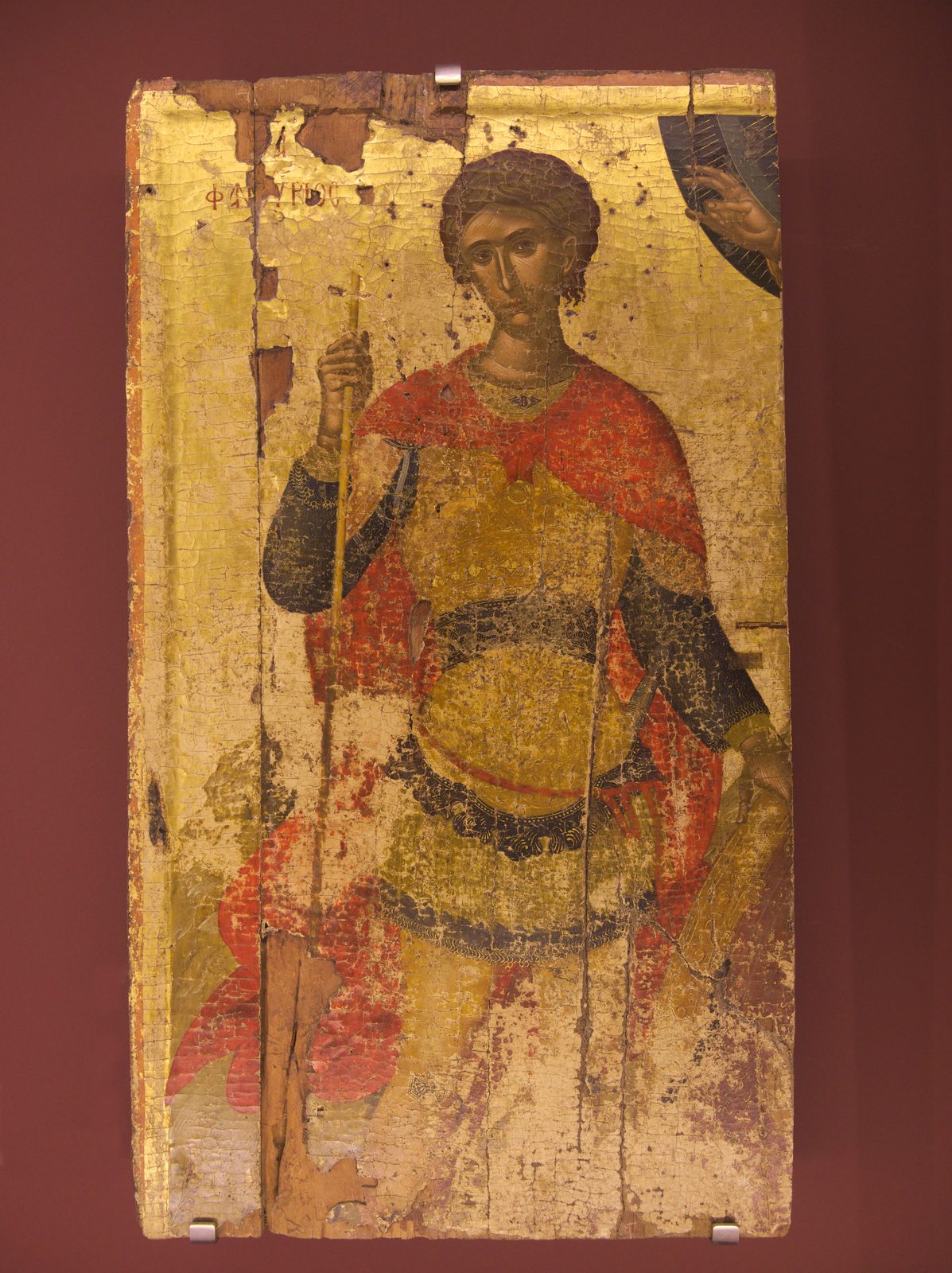
When a true Cretan loses something, he doesn't start by checking the lost property office or posting in a local Facebook group. A true Cretan heads straight to the kitchen and starts baking a cake, a fanouropita. What on earth does a cake have to do with a missing sheep or a lost key? Why a cake, of all things, and where did this strange custom come from? We're about to take a good look at the saint's entire story and try to make some sense of it. For Cretans, this probably won't be anything new, but for readers less familiar with Cretan folk traditions, it might turn out to be quite a curiosity and an interesting journey into the Cretan mindset.
I have to admit that, in my case, the whole story began with a cake I'm particularly fond of. For me, alongside portokalopita, it's the very essence of Crete. Slightly citrusy, often packed with dried fruit, raisins and nuts. Filling and simply delicious. And that's where it all started, with the taste. Fanourios came later and thoroughly messed with my head, because the story of the cake, and of the saint himself, feels like something straight out of the Cretan imagination. The mentality of this region's people, concentrated into one story.
Fanourios is one of those saints we know very little about. We don't know much about his life. In fact, we might as well say it outright: we know absolutely nothing about him. We don't know when or where he was born, where he lived or where he suffered martyrdom. More importantly, Fanourios does not appear in the Synaxarium Ecclesiae Constantinopolitanae, so there is no documented continuity of his cult going back to early Christianity.
So where did this sudden enthusiasm for a saint whose story sometimes sounds a little far-fetched come from? Fanourios was, in a sense, "discovered" on Rhodes. Yes, you read that correctly, because his cult emerged under rather unusual circumstances. According to tradition, an image of a young man dressed as a soldier was discovered among the ruins of an old church on Rhodes. Surrounding him were twelve scenes depicting his martyrdom. The name deciphered from the inscription was "Φανούριος". The discovery is associated with Neilos Diasorenos, the Metropolitan of Rhodes, who was active in the fourteenth century. And no, that's not a mistake. Fanourios was quite literally discovered in the ruins of some old church.
So far, so good. Except that a hypothesis has emerged in academic circles suggesting that there never was a Fanourios at all, and that his name resulted from a misreading of an inscription referring to Saint George. It is worth stressing that this is only a scholarly hypothesis, but a very interesting one nonetheless, supported by some fairly reasonable arguments.
But let's get back to the point. Why is this particular saint so good at finding lost things? There is an interesting folk-etymological explanation linking the name Φανούριος to the Greek verb φανερώνω, meaning to reveal, uncover or make something known. Interestingly, according to folk tradition, the saint helped people find not only lost objects and missing sheep, but also the culprits behind thefts. Around Valsamonero, there was an ethnographically documented custom of bringing suspected thieves before Fanourios. The accused would be taken before the saint's icon to swear an oath. And we really must mention another of Fanourios's magical talents. Apparently, he can reveal to an unmarried woman the man she will one day marry.
All right, but what about the cake? That's where this whole business started, after all. Well, this is yet another piece of folk tradition in an already complicated story. It's fair to say that Fanourios is a rather peculiar saint, made up to a considerable extent of folk tales and beliefs, although there are, of course, well-documented accounts of miracles attributed to him. We'll skip the recipe, because that's not really the point here. The cake is made with seven or nine ingredients, although some sources simply specify an odd number. It must not contain butter, and the only permitted fat is vegetable oil. The seven ingredients are supposedly meant to represent the seven sacraments, while the nine are said to symbolise the nine sins of Fanourios's mother. Yes, you read that correctly. The saint's mother. I'll explain what that's all about in a moment.
Traditionally, the cake is baked on 27 August (some sources say 26 or 27 August, and it can also be made on other occasions when someone makes a vow to the saint). An essential part of the custom is sharing it with family and neighbours. Once baked, the cake is taken to church and blessed by a priest. Only after this ceremony is it divided and shared, often accompanied by the words, "May God forgive the mother of Saint Fanourios" (Ο Θεός να συγχωρέσει τη μάνα του Αγίου Φανουρίου). Are you wondering what on earth is going on, too? A cake, a mother, a saint discovered by accident?
All right, so what about this mother? Well, the mother of Fanourios is one of the most fascinating elements of Greek folk religion, and I am not exaggerating in the slightest. It is a well-documented folktale about sin, hell and an attempt to rescue a soul suffering the torments of damnation, all with the help of an onion skin. I know, it sounds bizarre, but that's exactly how the story goes. The saint's mother was supposedly an extremely miserly, cruel woman, entirely lacking in compassion. In one popular version, she is portrayed as someone who refused to give alms, turned her back on the poor and was unwilling to share anything she owned. Some versions go into greater detail, describing how she refused to let her neighbours use the oven standing in her courtyard. In her entire life, she performed just one act of mercy: she gave a beggar an onion skin. In other versions, it was a whole onion, a leek leaf, garlic or a piece of thread.
After her death, the mother went to hell, where, depending on the version of the legend, she was boiled in pitch, burned in fire or suffered buried up to her neck in mud. When Fanourios, who was in heaven, saw his mother's suffering, he began begging God to save her. And again, depending on the version, he asked Archangel Michael or Saint Peter for help. The sinner was given a chance. She was to be pulled out of hell by means of the one good deed she had performed in her entire life. With an onion skin. Fanourios, or in other versions an angel sent by God, began pulling his mother up from the depths of hell. But then something happened that sealed her fate. Other condemned women's souls saw their chance and began clinging to her clothes, her legs and the onion skin itself. But Fanourios's mother remained true to herself even then. She had no intention of helping anyone. She started pushing the other souls away, and at that moment the onion skin snapped, sending her tumbling back into hell. Even then, she couldn't bring herself to show a little compassion or help anyone else.
According to the legend, Fanourios did not give up fighting for his mother's soul. He asked people not to make offerings to him, but instead to bake a cake and pray for the forgiveness of his mother's sins. In return, he would help them find whatever they had lost.
So what does any of this have to do with Crete? Quite a lot, as it happens. In this story, Rhodes is where the saint's image was discovered, but some of the earliest and most important evidence of his cult comes from Crete. At the Valsamonero Monastery, in the Messara region, a chapel dedicated to Fanourios was built as early as 1426. Scholarly literature also identifies the man responsible for spreading his cult: Ionas Palamas, the monastery's abbot. Another important figure in this story is Angelos Akotantos, one of the most significant Cretan painters of the first half of the fifteenth century. Seven icons of Fanourios are known to have been painted by him or attributed to him. Three are signed, while the remaining four are attributed to his hand.
Let's get back to the cake, because that's where this story began, and I suspect that's where it will end. At first glance, fanouropita looks like a perfectly ordinary cake. Nothing special. A few ingredients, a pinch of cinnamon, olive oil, oranges, perhaps some raisins and nuts. No fancy techniques, complicated procedures or hard-to-find ingredients. And yet, behind this simple recipe lies a story stretching back several hundred years, from Rhodes through medieval Crete, tales of miracles, stolen sheep, a sinful mother, hell and an onion skin. The story has been circulating in the Greek world since the fifteenth century and is still going strong, even today, in the age of smartphones and AI. Even now, on Crete, you can eat a slice of fanouropita and hear the story of the mother of a saint who probably never existed.
Why am I writing all this? After all, it's neither a saint's biography nor a cake recipe. Simply because I want to show you the island from a different perspective. Not just through its beaches and a handful of ruins. I want to show you that, in this place, even a cake has a deep and moving history. It may well be based on a folk legend, but that legend still lives on in the collective memory today.
So the next time you eat fanouropita, spare a quiet thought for the miserly mother of Fanourios. And don't eat the whole cake yourself, because firstly, you might end up in hell clutching an onion, and secondly, your dietitian will have a heart attack.