Candia, December 1566. The Venetian island goes about its daily life as usual. A young painter, twenty-five years old and a resident of the city, decides to sell one of his paintings. Nothing particularly remarkable about that. Quite normal for the time, in fact. Candia was full of painters, good and bad, famous and obscure. And this seemingly insignificant little episode would have disappeared into the mists of history were it not for the fact that it was meticulously recorded in the Venetian archives. Why? Because the young painter chose a rather unusual way of finding a buyer: he decided to organise a lottery. That meant asking the Venetian authorities for permission, and that is precisely why we know so much today about both the painting and its creator. The prize was to be an icon depicting the Passion of Christ, which the Venetian scribe recorded with his customary precision: “un quadro della Passione del nostro Signor Giesu Christo, dorato”. In language we can all understand today: “a gilded painting depicting the Passion of Our Lord Jesus Christ.” 1M. Konstantoudaki, “Dominicos Théotocopoulos (El Greco) de Candie à Venise. Documents inédits (1566–1568)”, Θησαυρίσματα, vol. 12, 1975, pp. 295–298, Document I, dated 26–27 December 1566. The document is preserved in the Archivio di Stato di Venezia, in the Duca di Candia collection. The author publishes a transcription of the original.
The meticulous Venetians left nothing to chance. Two painters, Georgios Klontzas and Ioannis de Frosse, were brought in to appraise the work. The first valued it at 70 ducats, the second at 80. In the end, they settled on 70 ducats, and that was the value assigned to the painting for the lottery. A little digression here: Klontzas was one of the stars of the late Cretan School. Just an interesting little detail, which will become rather more significant as our story unfolds... 2Ibid., pp. 296–299. The painting was appraised by Georgios Klontzas and Ioannis de Frosse on 27 December 1566. The final valuation of 70 ducats was accepted by Theotokopoulos himself.
Seventy ducats. Was that a lot of money? Quite a considerable sum, actually, and that is what makes this whole affair so interesting. It could have exceeded the annual earnings of a master mason, whose income was somewhere in the region of 50–100 ducats a year. We can also look at it another way: in gold. A Venetian ducat weighed 3.545 grams, which gives us roughly 250 grams of coined gold. 3A. Sarti, “The Materiality of Marriage in the Artisan Community of Renaissance Verona”, The Historical Journal, 2019, note 23, citing Paul F. Grendler's estimates of the annual earnings of a master mason in Venice towards the end of the sixteenth century: 50–100 ducats. The original source for these estimates is P. F. Grendler, Aldus Manutius: Humanist, Teacher, and Printer, Providence, 1984, pp. 23–26. The weight of the Venetian ducat is given, among other sources, in From the Black Death to the New World, p. 163. So the price suggested for this gilded painting was a sum that might have represented an entire year's work for a craftsman. Quite a lot by the standards of the day, especially considering the painter's age. I should stress that these are very rough estimates, and we have no precise information about wages in Candia in that particular year. They do, however, give us some idea of the significance of the sum involved. But why on earth would a twenty-five-year-old painter need that much money?
Unfortunately, we do not even know whether the painting was ever sold. The Venetian documents remain stubbornly silent...
For a moment, we lose sight of our main character, but another figure, no less important, enters the scene. In a document dated 12 July 1567, we encounter his elder brother, Manoussos. The record concerns a dispute with the painters' guild in Candia, and Manoussos appears in a rather unflattering role. The Venetian authorities order him and two other men to stop harassing members of the painters' confraternity, the Scuola di Pittori, and to return objects belonging to the organisation. 4M. Konstantoudaki, op. cit., pp. 299–301, Document II, dated 12 July 1567. The document concerns a dispute involving Tzortzis Chortatzis, Manoussos Theotokopoulos and the painter Marco Astras, on one side, and Tzouannes Sclavos, head of the painters' confraternity, on the other. But how did Manoussos, who was not a painter, come to possess objects belonging to the confraternity? We shall return to that question. First, it is worth explaining how we know who Manoussos was in the first place. Once again, our invaluable Venetians come to the rescue, with their habit of recording absolutely everything in their vast archives. Documents preserved in the Archivio di Stato di Venezia, among the records of the Duca di Candia, reveal that between 1566 and 1583 our protagonist's brother worked as a collector or farmer of public taxes. He was also involved with the sailors' confraternity in Candia, which he actually headed in 1570 and 1577. Another surviving document records Manoussos petitioning the Doge for a ship so that he could undertake privateering operations against the Turks, naturally in the interests of Venice. And to complete the picture, our privateer, tax collector and sailor all rolled into one managed to accumulate an enormous debt of 6,000 ducats. 5Ibid., pp. 301–303, commentary on Document II and references to additional documents concerning Manoussos's activities. See also K. D. Mertzios, “Νέαι ειδήσεις περί Κρητών εκ των αρχείων της Βενετίας. Β΄. Μανούσος Θεοτοκόπουλος”, Κρητικά Χρονικά, vol. 2, 1948, pp. 141–152. Konstantoudaki refers to Mertzios in connection with the authorisation for privateering activities issued in 1571. To pay it off, he would have needed to sell more than 85 icons at 70 ducats apiece. And remember, he was not a painter.
So why does he appear in a dispute with the painters' confraternity? Where had his brother disappeared to, and could the two things be connected? One hypothesis suggests that Manoussos was simply acting as his brother's representative. After all, how else would he have come into possession of objects belonging to the guild? It is only a hypothesis, but a fascinating one in the light of what happens next. 6M. Konstantoudaki, op. cit., p. 305. The author considers the possibility that Manoussos represented his brother's interests in the dispute with the painters' confraternity. She emphasises, however, the absence of documentary evidence that would allow the matter to be settled.
The main character of our story, whom we have reluctantly had to abandon for a while, returns to the stage roughly a year later. This time, however, to stick with the theatrical metaphor, the scenery has changed completely. We find a trace of him in Venice, and once again in a Venetian archive, although by now we are probably getting used to that. The young Cretan appears in a document concerning a complaint about an undelivered shipment. According to the record, he had entrusted some drawings to Manolis Dacypris, known as Mazapetas. Manolis was supposed to transport them from Venice to Candia and deliver them to their intended recipient, the Cretan cartographer Georgios Sideros, also known as Calapodas. The cartographer, however, never received the shipment, and that unfortunate fact was the subject of his complaint. The authorities in Candia ordered Dacypris to deliver the missing drawings within three days, under penalty of a fine of 50 hyperpyra and an obligation to pay their value. 7Ibid., pp. 305–306, Document III, dated 18 August 1568; Archivio di Stato di Venezia, Duca di Candia, b. 36, Memoriali, series II, filza 33 (1568), f. 102v. The order required the delivery of the drawings to Georgios Sideros, known as Calapodas.
This document is enormously important to our story. It tells us that our protagonist was already in Venice at the time and was involved in arranging the transfer of some drawings. We do not know exactly what they were, although it is tempting to suppose they were maps, given that the intended recipient was a well-known cartographer. We do not know where they came from, who made them or what they contained. Naturally, as always in such cases, there are various hypotheses, some bolder than others, suggesting that the young painter himself might have been their author. But we have no evidence for this, and such speculation remains just that: speculation. 8Ibid., pp. 306–307. The author's commentary on the unidentified authorship and nature of the drawings. Konstantoudaki allows for a possible connection with cartography but does not present this as an established fact.
So we now know that our Cretan is in Venice, that he is involved in various undertakings and that he is passing documents from one person to another. Perhaps he is even living there. The problem is that this knowledge raises more questions than it answers. We do not know how he got to Venice, exactly when he arrived by sea or what he was doing there. Was the money from the sale of the icon in Candia his starting capital? Did he have other sources of income? Or perhaps his brother helped him, being a man of some means, after all? We have nothing concrete. No evidence, let alone documents.
Our protagonist disappears into the thick fog of history for a little over two years. Then, quite suddenly, as characters in stories like this have a habit of doing, he emerges again on 16 November 1570, in Rome, and in a letter, no less. And as though the story were not dramatic enough already, it is a letter written by Giulio Clovio himself, the brilliant miniaturist associated with the court of Cardinal Alessandro Farnese. The recipient is none other than Cardinal Farnese, and this is what Clovio writes about our protagonist: “È capitato in Roma un giovane Candiotto, discepolo di Titiano, che a mio giuditio parmi raro nella pittura...”. “A young man from Candia has arrived in Rome, a pupil of Titian, who, in my opinion, possesses exceptional talent as a painter...” In the same letter, he adds that the young man had painted a self-portrait which left Roman painters astonished. Not a bad recommendation for someone at the beginning of his career. 9Giulio Clovio, letter to Cardinal Alessandro Farnese, 16 November 1570. Published by A. Ronchini in Atti e Memorie della R. Deputazione di Storia Patria per le Province Modenesi e Parmensi, vol. III, 1865, letter 9. A transcription of the document is catalogued by the National Gallery, London, under reference NG72/77.
Cardinal Farnese deserves a slightly longer digression, because he was an extraordinary figure, and an immensely important one, not only for our story but for the entire period. He was the grandson of Pope Paul III, shared his grandfather's name and surname, and is still sometimes confused with him today. He became a cardinal at the age of fourteen, which was not an especially extraordinary occurrence in those days. In 1545, he assumed the role of Protector of the Kingdom of Poland in Rome, and his ties with the Polish–Lithuanian Commonwealth were particularly strong. It was through his efforts that a permanent apostolic nunciature was established in Poland. 10Protektorat polski przy Stolicy Apostolskiej (1503–1589), a historical study available in the repository of Adam Mickiewicz University, repository identifier: hdl.handle.net/10593/26796. The study confirms Alessandro Farnese's role as Protector of Polish affairs in Rome between 1545 and 1589. Further documentation is required concerning his personal involvement in the efforts to establish a permanent apostolic nunciature in Poland. He was also a patron of the arts through and through, as we might put it today. He was the man who brought Titian to Rome and extended his patronage to Giorgio Vasari and Vignola. The very same Vignola designed his residence at Caprarola and the church of Il Gesù, where the cardinal was eventually buried. 11Information concerning Alessandro Farnese's patronage and his connections with Titian, Vasari and Vignola requires a separate biographical study. His burial place, the church of Il Gesù in Rome, is confirmed by the Catholic-Hierarchy catalogue.
Giulio Clovio does not ask the cardinal for money. He asks that the young artist be allowed to stay for a while at the Palazzo Farnese, until he can find accommodation of his own, and explicitly states that he is asking only for a room, without additional living expenses: “senza spesa altra del vivere, ma solo di una stanza nel Palazzo Farnese”. 12Giulio Clovio, letter of 16 November 1570, as cited in note [9]. The quotation concerning the request for a room in the Palazzo Farnese comes from the same document. But why ask only for accommodation? Could it be that our protagonist already had some means of supporting himself and merely lacked the funds to establish himself in Rome? Another hypothesis to add to the growing collection. One way or another, the man we are dealing with is becoming more and more intriguing.
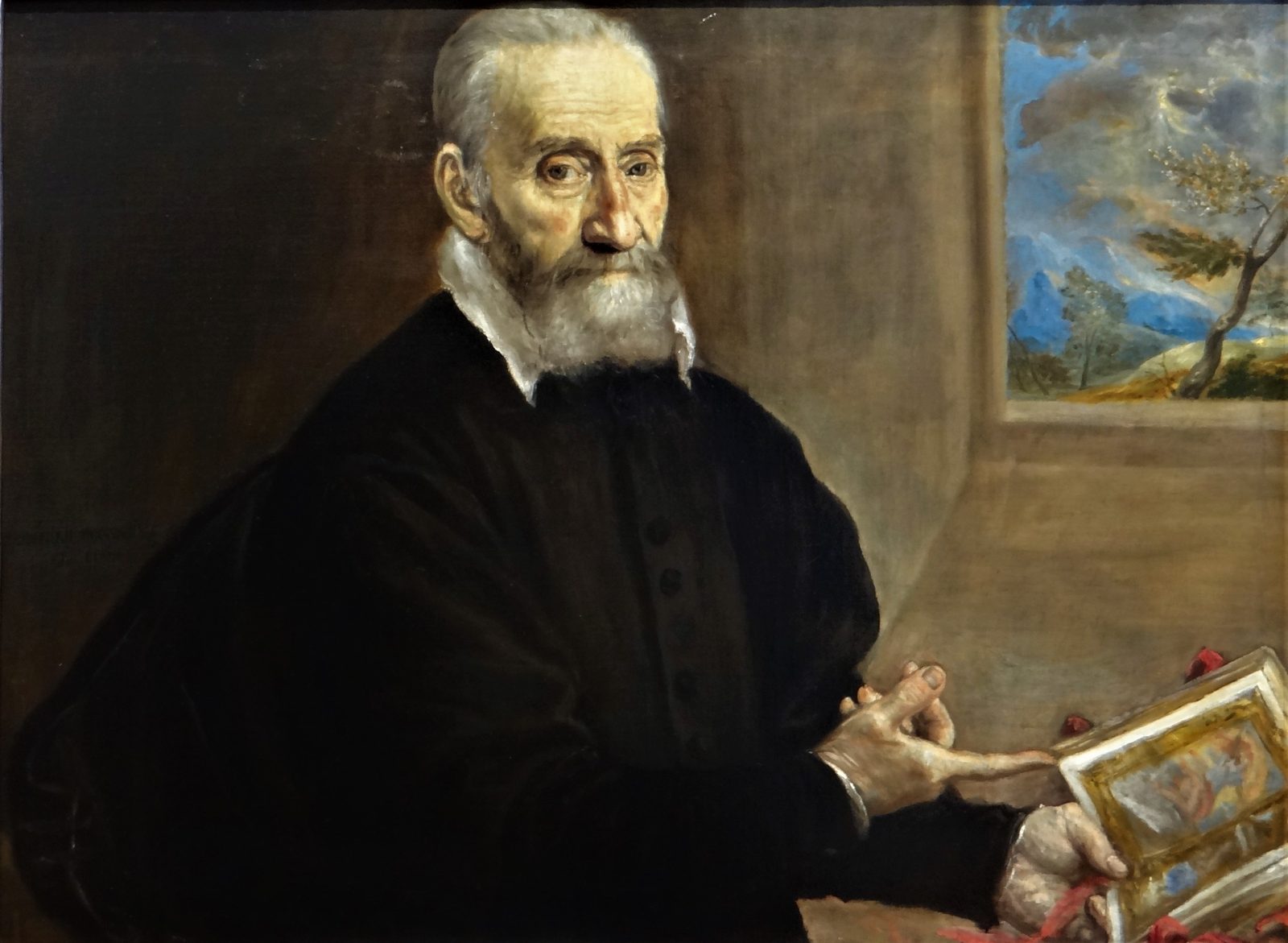
All the more so because, around 1571–1572, the young artist “repays” Clovio by painting his portrait. Strictly speaking, it is more than just a portrait, because the painting also immortalises Clovio's opus magnum, the miniatures for the Office of the Blessed Virgin Mary. Clovio had spent nine years working on these 26 miniatures, also known as the Farnese Hours, since they had been commissioned by the cardinal. And now we see him in a painting alongside his greatest masterpiece. This whole story could easily be turned into a film script, and I do not think that is much of an exaggeration. 13El Greco, Portrait of Giulio Clovio, c. 1571–1572, oil on canvas, Museo di Capodimonte, Naples. Catalogo Generale dei Beni Culturali, catalogue no. 1500625118. The dating to c. 1571–1572 and the identification of the open manuscript are given by the Web Gallery of Art. The Farnese Hours, completed in 1546, are preserved in the Morgan Library & Museum, New York, MS M.69, and contain 26 miniatures.
And now we have reached the moment in our story when it is time to reveal the last of the dramatis personae. The portrait bears the painter's signature, and a reproduction of it is very easy to find online.
ΔΟΜΗΝΙΚΟΣ ΘΕΟΤΟΚΟΠΟΥΛΟΣ ΚΡΗΣ ΕΠΟΙΕΙ 14Catalogo Generale dei Beni Culturali, Ritratto di Giulio Clovio, catalogue no. 1500625118, Iscrizioni section. The catalogue confirms the Greek signature of Domenikos Theotokopoulos, including the reference to his Cretan origin.
Domenikos Theotokopoulos, a Cretan, made this.
Everything has suddenly fallen into place. Fortunately, however, this is only the beginning of the story.
It looks as though Domenikos has finally found a safe haven. He has a wealthy and influential patron and lives in one of his palaces. Things are beginning to look comfortably settled. The trouble is that life has little patience for stability, and it is not long before it shows its claws. In a letter dated 6 July 1572, addressed to Cardinal Farnese, Domenikos complains that he has been ordered to leave the palace. He writes: “Immediately after Your Most Illustrious Eminence's departure, Count Ludovico, the steward of Your household, informed me that I was being dismissed, acting, as he himself claimed, on Your Eminence's orders.”
A few details here deserve our attention. Farnese was not at the palace when Domenikos received the order, and the letter is addressed to Caprarola, where the cardinal was staying at the time. Theotokopoulos also uses a very telling qualification, the phrase “secondo lui dice”, meaning “as he himself claims”. This matters, because the author is not directly accusing the cardinal of having dismissed him. He is merely reporting that the steward claimed to be acting on His Eminence's orders. And then things become even more interesting. Domenikos reminds the cardinal that he had been invited to the Farnese court because of his abilities, and that he had never sought this honour himself.
The letter reads less like a complaint than a request for clarification. Its closing passages are even stronger: “For I did not deserve to be expelled and dismissed in such a manner, through no fault of my own.” The author makes it quite clear that he wants to know the reason for what has happened so that he can clear himself of any accusations, and he emphasises just how much his honour means to him. What the letter does not contain, however, is any request for unpaid wages, any mention of money, or any complaint that he has nowhere to go.
What emerges from the letter is the image of a man with a strong sense of his own worth, deeply concerned with his honour and prepared to defend his good name. Nor should we overlook the identity of its recipient. It was not addressed to a secretary or a steward, but to the cardinal himself, directly at his residence. Farnese was an immensely influential man at the time, and could quite easily have brought Theotokopoulos's career to an end, swiftly and effectively. He was not the sort of person to whom just anyone would dare write a letter. The epistle ends with the customary assurances of loyalty, obedience and devotion to the cardinal and his family. The signature is simple and modest: Domenico Teotocopuli. 15A. Pérez de Tudela, “Una carta inédita de El Greco al Cardenal Alessandro Farnesio”, Archivo Español de Arte, vol. 73, no. 291, 2000, pp. 267–268. The author publishes Domenikos Theotokopoulos's letter to Cardinal Alessandro Farnese dated 6 July 1572, preserved in the Archivio di Stato di Parma, Carteggio Farnesiano, Estero, Roma, busta 367, s.f. The letter records the order to leave the palace, communicated by Ludovico Tedeschi, the painter's protest against the manner in which he was treated, and his demand for an explanation of the decision.
At this point, it is worth putting aside our pursuit of dates and documents for a moment. Let us consider who Domenikos was at this stage of his life. Who was the man who had left Crete? An inexperienced young fledgling, lacking both experience and polish? Or an already accomplished painter, with a body of work behind him and a firm awareness of his own worth? We do not know what happened at Cardinal Farnese's court. Any attempt to reconstruct the sequence of events would merely produce yet more conjecture. Could it be that the feisty Cretan in Domenikos had finally come to the surface? We do not know, but I must admit that, from a storyteller's point of view, I find the idea rather irresistible.
Tempting though the image of a rebellious Cretan may be, it has to give way to a more important question. What kind of painter was it who sailed away from Crete? Was he seeking new artistic challenges, or was he simply looking to earn a living and build a better life? The first thing that catches our attention is the valuation of the icon in Candia, the one Domenikos had entered into the lottery. Remember that one of the appraisers was Georgios Klontzas, an important figure of the late Cretan School. The icon was valued at 70 ducats, a fairly substantial sum. I do not know how far we are justified in drawing conclusions from a single valuation, but it certainly looks as though our protagonist's work already commanded a respectable price. And the fact that the appraisal came from fellow painters, one might even say from the competition, adds a certain flavour to the whole affair.
Two documents provide important clues about Theotokopoulos's professional standing on Crete. The first is a notarial deed in which he appears as a witness. It records his name as: “μαΐστρο Μένεγος Θεοτοκόπουλος, σγουράφος”, meaning “Master Menegos Theotokopoulos, painter”. The second concerns the lottery we have already discussed, and contains the entry: “maistro Domenego Theotocopulo, depentor”, meaning exactly the same thing: “Master Domenego Theotokopoulos, painter”. Neither record proves that he had attained formal guild status, but both are valuable evidence of Domenikos's actual professional standing in Candia. 16M. Constantoudaki, “Dominicos Théotocopoulos (El Greco) de Candie à Venise. Documents inédits (1566–1568)”, Θησαυρίσματα, vol. 12, 1975, p. 292, note 2, and p. 296, Document I. The first entry, “μαΐστρο Μένεγος Θεοτοκόπουλος, σγουράφος”, comes from a notarial deed dated 6 June 1566, cited following the discovery by K. Mertzios. The second, “maistro Domenego Theotocopulo, depentor”, appears in the document dated 26 December 1566 concerning permission to organise the lottery. Both confirm the use of the title maistro, but neither in itself proves formal membership in the painters' guild.
Another piece of the puzzle is Clovio's letter to Cardinal Farnese, in which Theotokopoulos is described as “discepolo di Titiano”, a pupil of Titian. A curious business. Why would a man who enjoyed the status of a professional painter on Crete, and was addressed as maistro, suddenly become Titian's pupil in Rome?
Here I must admit that I feel as though I am treading on the thin ice of academic debate. Minds far greater than mine have grappled with this question, arguments have continued for years and, perhaps unsurprisingly, no definitive conclusion has emerged. So, if you will allow me, I shall follow my usual practice and refrain from delivering any grand verdicts. Let us concentrate on what we know and leave the quarrelling to the academics. We shall stick to the facts, and perhaps permit ourselves the occasional awkward question.
So let us examine together where this description of Domenikos as “Titian's pupil” came from, and how much truth it might contain, as opposed to an attempt to force a connection between the stories of two great painters of their age.
Our first clue is Giulio Clovio's letter of 16 November 1570. We have already encountered the passage in which he describes his protégé: “un giovane Candiotto, discepolo di Titiano”, “a young Cretan, a pupil of Titian”. This is an extremely important testimony from a man who knew Domenikos personally, had assessed his talent and was taking a certain risk by recommending him to his patron. But what exactly did that description mean at the time? How was the word “pupil” understood? In the artistic world of the sixteenth century, it could mean a pupil in the literal sense: someone attached to a workshop, working under the master's supervision. But it could also refer to a painter who had absorbed a particular style, drawn inspiration from another artist's work and developed within the artistic tradition associated with a particular workshop. 17A. R. Casper, Art and the Religious Image in El Greco's Italy, Pennsylvania State University Press, University Park, 2014, Introduction. The author emphasises that the description discepolo di Titiano, used by Giulio Clovio, does not establish whether Domenikos had a formal master–pupil relationship with Titian or studied his works independently. Regardless of this uncertainty, Casper points to the strong influence of Titian's painting on the work of the young Theotokopoulos.
Clovio's letter alone does not settle which meaning was intended. It might refer to working under Titian's direction, to a brief period of contact, to observing his work and learning his techniques, or equally to independent study of his paintings. There is, however, another twist to the story. Cardinal Farnese knew Titian personally. It was he who had brought the master to Rome in the 1540s and acted as his patron. Could Clovio, then, have been making a deliberate promotional move, invoking the name of an artist whom his own patron knew and admired? It would be difficult, however, to accuse Clovio of deliberately misleading the cardinal, because even if the two painters had never enjoyed a direct relationship, such wording might still have been perfectly acceptable in the language of the period. 18L. Puppi, “Apparizioni metagrammatiche e autobiografia per immagini. Allegorie, ammiccamenti e ritratti di spettatori nei racconti evangelici del Greco del periodo italiano”, La Rivista di Engramma, no. 100, 2012. Puppi draws attention to the relationship between Titian and Cardinal Farnese and the significance of the Venetian master's name within the cardinal's circle. He cautions against an overly literal interpretation of the word discepolo, while nevertheless allowing for the possibility of direct contact between Domenikos and Titian's workshop.
Another possible clue comes from Titian himself, in a letter to Philip II dated December 1567. The problem is that it can hardly be considered evidence. At a stretch, we might call it a clue, but only at a stretch. The master mentions a young and talented pupil: “un [...] molto valente giovane, mio discepolo”, “a certain very talented young man, my pupil”. But where is our Cretan in all this? Exactly. He is nowhere to be found. Titian writes about an unnamed pupil, without providing any means of identifying him. I shall spare you the details of this story, which, fascinating though it is, is also long and full of complications. Suffice it to say that this particular trail turned out to be, perhaps not quite a dead end, but certainly rather treacherous ground. It produced no definitive answer, and anyone wishing to explore the matter further will find references to the relevant scholarship in the notes. 19Titian's letter to Philip II, dated December 1567, published in G. B. Cavalcaselle and J. A. Crowe, Tiziano, la sua vita e i suoi tempi, vol. II, Florence, 1878, p. 370. The identification of the anonymous pupil with Domenikos was proposed by C. Justi, “Die Anfänge des Greco”, in Miscellaneen aus drei Jahrhunderten spanischen Kunstlebens, vol. II, Berlin, 1908, p. 206, note 2. This identification was challenged, among others, by H. E. Wethey and E. Arslan; see M. Constantoudaki, op. cit., p. 293, note 3. L. Puppi, op. cit., 2012, proposes Emanuel Amberger instead of Theotokopoulos, referring to his own findings published in 2004, pp. 28–30. The argument supporting this latter identification still requires independent verification.
Notes and references
Notes
- 1.M. Konstantoudaki, “Dominicos Théotocopoulos (El Greco) de Candie à Venise. Documents inédits (1566–1568)”, Θησαυρίσματα, vol. 12, 1975, pp. 295–298, Document I, dated 26–27 December 1566. The document is preserved in the Archivio di Stato di Venezia, in the Duca di Candia collection. The author publishes a transcription of the original. ↩
- 2.Ibid., pp. 296–299. The painting was appraised by Georgios Klontzas and Ioannis de Frosse on 27 December 1566. The final valuation of 70 ducats was accepted by Theotokopoulos himself. ↩
- 3.A. Sarti, “The Materiality of Marriage in the Artisan Community of Renaissance Verona”, The Historical Journal, 2019, note 23, citing Paul F. Grendler's estimates of the annual earnings of a master mason in Venice towards the end of the sixteenth century: 50–100 ducats. The original source for these estimates is P. F. Grendler, Aldus Manutius: Humanist, Teacher, and Printer, Providence, 1984, pp. 23–26. The weight of the Venetian ducat is given, among other sources, in From the Black Death to the New World, p. 163. ↩
- 4.M. Konstantoudaki, op. cit., pp. 299–301, Document II, dated 12 July 1567. The document concerns a dispute involving Tzortzis Chortatzis, Manoussos Theotokopoulos and the painter Marco Astras, on one side, and Tzouannes Sclavos, head of the painters' confraternity, on the other. ↩
- 5.Ibid., pp. 301–303, commentary on Document II and references to additional documents concerning Manoussos's activities. See also K. D. Mertzios, “Νέαι ειδήσεις περί Κρητών εκ των αρχείων της Βενετίας. Β΄. Μανούσος Θεοτοκόπουλος”, Κρητικά Χρονικά, vol. 2, 1948, pp. 141–152. Konstantoudaki refers to Mertzios in connection with the authorisation for privateering activities issued in 1571. ↩
- 6.M. Konstantoudaki, op. cit., p. 305. The author considers the possibility that Manoussos represented his brother's interests in the dispute with the painters' confraternity. She emphasises, however, the absence of documentary evidence that would allow the matter to be settled. ↩
- 7.Ibid., pp. 305–306, Document III, dated 18 August 1568; Archivio di Stato di Venezia, Duca di Candia, b. 36, Memoriali, series II, filza 33 (1568), f. 102v. The order required the delivery of the drawings to Georgios Sideros, known as Calapodas. ↩
- 8.Ibid., pp. 306–307. The author's commentary on the unidentified authorship and nature of the drawings. Konstantoudaki allows for a possible connection with cartography but does not present this as an established fact. ↩
- 9.Giulio Clovio, letter to Cardinal Alessandro Farnese, 16 November 1570. Published by A. Ronchini in Atti e Memorie della R. Deputazione di Storia Patria per le Province Modenesi e Parmensi, vol. III, 1865, letter 9. A transcription of the document is catalogued by the National Gallery, London, under reference NG72/77. ↩
- 10.Protektorat polski przy Stolicy Apostolskiej (1503–1589), a historical study available in the repository of Adam Mickiewicz University, repository identifier: hdl.handle.net/10593/26796. The study confirms Alessandro Farnese's role as Protector of Polish affairs in Rome between 1545 and 1589. Further documentation is required concerning his personal involvement in the efforts to establish a permanent apostolic nunciature in Poland. ↩
- 11.Information concerning Alessandro Farnese's patronage and his connections with Titian, Vasari and Vignola requires a separate biographical study. His burial place, the church of Il Gesù in Rome, is confirmed by the Catholic-Hierarchy catalogue. ↩
- 12.Giulio Clovio, letter of 16 November 1570, as cited in note [9]. The quotation concerning the request for a room in the Palazzo Farnese comes from the same document. ↩
- 13.El Greco, Portrait of Giulio Clovio, c. 1571–1572, oil on canvas, Museo di Capodimonte, Naples. Catalogo Generale dei Beni Culturali, catalogue no. 1500625118. The dating to c. 1571–1572 and the identification of the open manuscript are given by the Web Gallery of Art. The Farnese Hours, completed in 1546, are preserved in the Morgan Library & Museum, New York, MS M.69, and contain 26 miniatures. ↩
- 14.Catalogo Generale dei Beni Culturali, Ritratto di Giulio Clovio, catalogue no. 1500625118, Iscrizioni section. The catalogue confirms the Greek signature of Domenikos Theotokopoulos, including the reference to his Cretan origin. ↩
- 15.A. Pérez de Tudela, “Una carta inédita de El Greco al Cardenal Alessandro Farnesio”, Archivo Español de Arte, vol. 73, no. 291, 2000, pp. 267–268. The author publishes Domenikos Theotokopoulos's letter to Cardinal Alessandro Farnese dated 6 July 1572, preserved in the Archivio di Stato di Parma, Carteggio Farnesiano, Estero, Roma, busta 367, s.f. The letter records the order to leave the palace, communicated by Ludovico Tedeschi, the painter's protest against the manner in which he was treated, and his demand for an explanation of the decision. ↩
- 16.M. Constantoudaki, “Dominicos Théotocopoulos (El Greco) de Candie à Venise. Documents inédits (1566–1568)”, Θησαυρίσματα, vol. 12, 1975, p. 292, note 2, and p. 296, Document I. The first entry, “μαΐστρο Μένεγος Θεοτοκόπουλος, σγουράφος”, comes from a notarial deed dated 6 June 1566, cited following the discovery by K. Mertzios. The second, “maistro Domenego Theotocopulo, depentor”, appears in the document dated 26 December 1566 concerning permission to organise the lottery. Both confirm the use of the title maistro, but neither in itself proves formal membership in the painters' guild. ↩
- 17.A. R. Casper, Art and the Religious Image in El Greco's Italy, Pennsylvania State University Press, University Park, 2014, Introduction. The author emphasises that the description discepolo di Titiano, used by Giulio Clovio, does not establish whether Domenikos had a formal master–pupil relationship with Titian or studied his works independently. Regardless of this uncertainty, Casper points to the strong influence of Titian's painting on the work of the young Theotokopoulos. ↩
- 18.L. Puppi, “Apparizioni metagrammatiche e autobiografia per immagini. Allegorie, ammiccamenti e ritratti di spettatori nei racconti evangelici del Greco del periodo italiano”, La Rivista di Engramma, no. 100, 2012. Puppi draws attention to the relationship between Titian and Cardinal Farnese and the significance of the Venetian master's name within the cardinal's circle. He cautions against an overly literal interpretation of the word discepolo, while nevertheless allowing for the possibility of direct contact between Domenikos and Titian's workshop. ↩
- 19.Titian's letter to Philip II, dated December 1567, published in G. B. Cavalcaselle and J. A. Crowe, Tiziano, la sua vita e i suoi tempi, vol. II, Florence, 1878, p. 370. The identification of the anonymous pupil with Domenikos was proposed by C. Justi, “Die Anfänge des Greco”, in Miscellaneen aus drei Jahrhunderten spanischen Kunstlebens, vol. II, Berlin, 1908, p. 206, note 2. This identification was challenged, among others, by H. E. Wethey and E. Arslan; see M. Constantoudaki, op. cit., p. 293, note 3. L. Puppi, op. cit., 2012, proposes Emanuel Amberger instead of Theotokopoulos, referring to his own findings published in 2004, pp. 28–30. The argument supporting this latter identification still requires independent verification. ↩