5 September 2026 · Artur Kiwa
The Icon of the Transfiguration of Christ
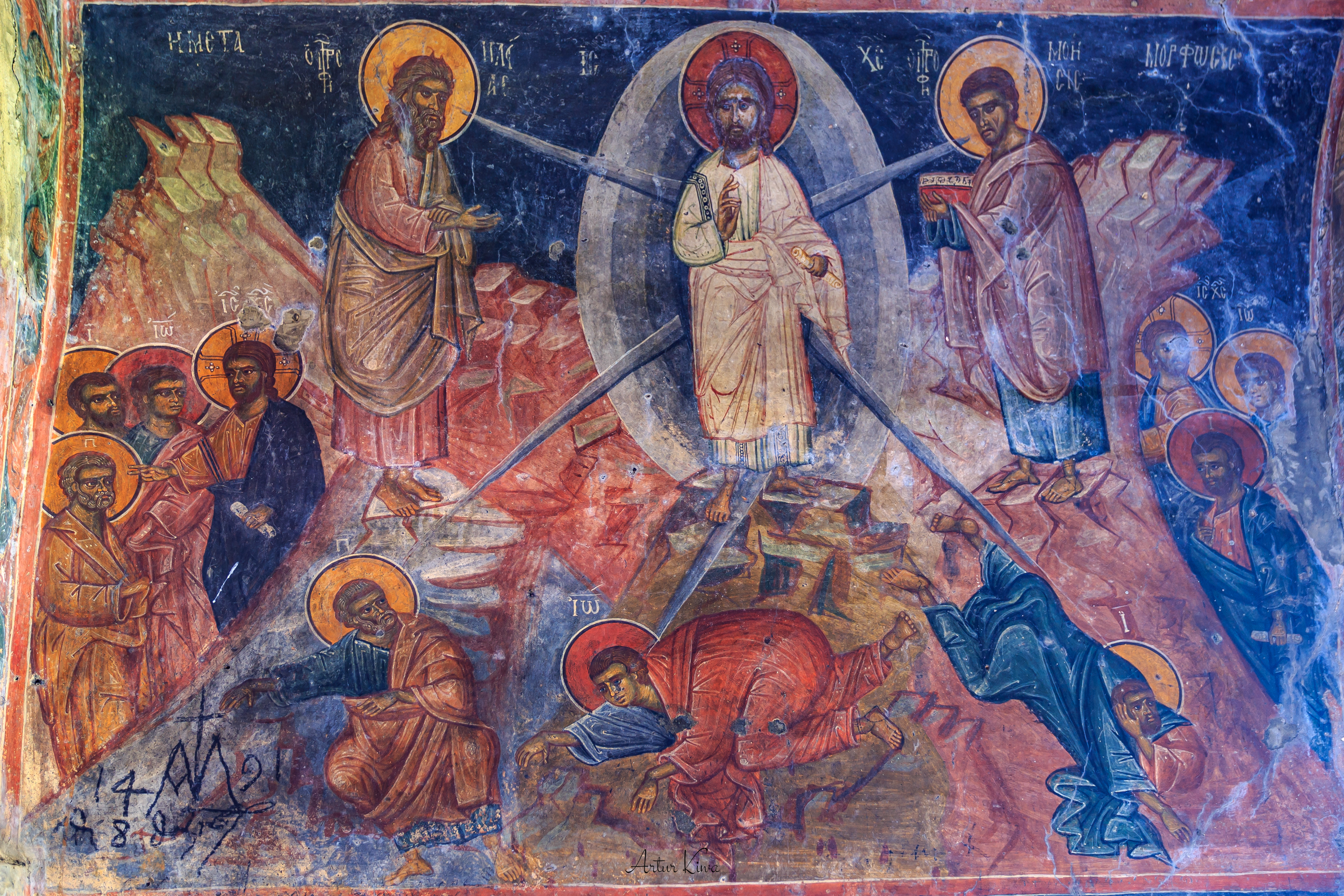
There is a moment when looking at an old fresco when the eye already knows more than the mind has managed to name. At first, all you see is an oval — bright, blazing, unmistakably central — and a figure in white standing within it so calmly, as though standing in the middle of an explosion of light were the most natural thing in the world. Only after a moment does recognition come: this is not one scene but three scenes at once, played out on the same wall, by the same brush, among the same figures — only at three different moments in time, which the painter, without the slightest hesitation, has folded into a single image.
There is a moment when looking at an old fresco when the eye already knows more than the mind has managed to name. At first, all you see is an oval — bright, blazing, unmistakably central — and a figure in white standing within it so calmly, as though standing in the middle of an explosion of light were the most natural thing in the world. Only after a moment does recognition come: this is not one scene but three scenes at once, played out on the same wall, by the same brush, among the same figures — only at three different moments in time, which the painter, without the slightest hesitation, has folded into a single image.
This is Μεταμόρφωσις — the Transfiguration of Christ — in the form most commonly encountered on Crete: not an illustration of a single sentence from the Gospel, but a small, densely packed story.
The mountain climbed three times
The Evangelists agree on the core of the event — Peter, James and John are taken apart from the others, up a mountain, where they see something they will later struggle to put into words (Mt 17:1–9; Mk 9:2–9; Lk 9:28–36) — but they differ in details that are pure gold for a painter. Luke alone adds that Jesus went up the mountain to pray, that Moses and Elijah spoke with Him about His exodos — literally His “departure”, meaning the Passion that still awaited Him in Jerusalem — and that the disciples were “heavy with sleep” (Lk 9:32). That sentence explains more than it might seem. Those huddled, fallen figures at the foot of the mountain, which at first glance we read as overwhelmed by the brilliance, may just as well have been painted as waking from sleep — and Byzantine iconography liked to keep both possibilities open at once.
A painter faced with this scene did not have to choose between “before” and “after”. He could paint Christ three times: once in the centre, in glory, at the summit — and then on either side, smaller, without the mandorla, yet still identified by the same letters ΙΣ ΧΣ and still bearing the cross-halo — as He ascends the mountain and as He comes down again. It is a technique art historians call continuous narrative: the same figure, the same inscription, but a different moment in the story. And there was nothing strange about it, because the Byzantine viewer did not look at a fresco the way we look at a photograph. He looked at it the way one reads a text, from beginning to end — except that here the text was laid out in space rather than in time.
The Law, the Prophets, and the boundary between the living and the dead
The presence of Moses and Elijah on either side of Christ has its obvious meaning: they represent the Law and the Prophets, the entire Old Testament bowing before its fulfilment. But there is another, quieter layer that is mentioned less often. Moses died and was buried in a place no one knows (Deut 34:5–6), whereas Elijah never died — he was taken up alive in a chariot of fire (2 Kgs 2:11). So on the mountain, quite literally, the dead and the living meet — and between them stands the One who has authority over both. These are not simply two famous Old Testament figures chosen at random. It is a theological statement made without a single word.
The horns that never existed on Crete
And now to the thing that, really, made this whole text worth writing.
Anyone who has travelled around Western Europe looking at old religious art will sooner or later have encountered Moses with horns. The most famous — and the one most likely to bewilder first-time visitors — stands in the Roman church of San Pietro in Vincoli: Michelangelo’s Moses, with two unmistakable goat-like horns growing from his forehead. And this was not some eccentric invention of a single sculptor. It was the culmination of a tradition that endured in Latin art for more than a thousand years.
The source of the problem lies in a single word. The Hebrew text of Exodus (34:29–30, 35) says that Moses’ face, as he came down from Sinai, was radiant. The verb used there, qaran, comes from the same root as qeren, meaning “horn”. The root is shared because in Hebrew animal horns and rays of light can be metaphorically close: both “project” or “shoot out” from a surface. When Saint Jerome translated this passage into Latin for his Vulgate in the fourth century, he chose the word cornuta — “horned”. Et ignorabat quod cornuta esset facies sua — “and he did not know that his face had become horned”. This translation functioned as the authoritative text of the Western Church for centuries, until scholars began to recognise the problem around the sixteenth century. In art, however, the horned Moses survived much longer, because visual traditions have an inertia of their own, independent of philology.
Did Jerome simply get it wrong? Not necessarily — at least, it is not quite that simple. Some biblical scholars defend his linguistic competence and suggest that his choice was deliberate, an attempt to preserve the ambiguity of the Hebrew root qrn when Latin offered no equally ambiguous equivalent. But what remains a nuance in philological debate became a fact of artistic life for generations.
And this brings us to the reason this particular thread belongs here, on Crete, on the wall of a Byzantine church. The Eastern Church never went through this problem — not because Byzantine scholars were more alert than Jerome, but because from the beginning they worked with a different text. The Septuagint, the Greek translation of the Old Testament that underlies the Byzantine tradition, uses no word for horns in this passage of Exodus. It uses δεδόξασται — “has been glorified”. Moses’ face shone with glory; it did not grow horns. Full stop.
That is why you will not find a horned Moses on a Cretan fresco, no matter how many villages you search from Selino to Amari. This is not a question of style or of the painter’s skill. These are two entirely separate textual traditions that diverged in the fourth century and never came together again — one flowing through Latin, through the Vulgate, through medieval bestiaries and eventually to Michelangelo’s chisel; the other flowing through Greek, through the Septuagint, all the way to this wall, where the rays emerging from Moses’ head are exactly what they are supposed to be: light, not horns.
Light that is not a metaphor
There is one more reason why this scene means more on Crete than it perhaps could anywhere in the Western Christian world. In the fourteenth century, Byzantium was consumed by a controversy we now call the Hesychast controversy — and at the centre of it stood precisely this light from Mount Tabor. Gregory Palamas defended the view that the radiance seen by Peter, James and John was not a created phenomenon, a metaphor or a poetic image. It was the real, uncreated energy of God Himself, accessible to human experience if a person opened himself to it through prayer. The controversy was ultimately settled in favour of Palamas, and his theology became a permanent part of Orthodox spirituality — and, more importantly for us, of the painter’s visual language.
When a painter on Crete surrounded Christ with an intense, geometric mandorla, with rays cutting through the composition like blades, he was not decorating the scene. He was painting theology — theology over which, only a few generations earlier, people had been prepared to argue, write treatises and convene councils.
The disciples at the foot of the mountain are not handling the experience particularly well. They lie sprawled, curl up, cover their faces; one is almost upside down, as though the light itself had physically knocked him over. And perhaps that is precisely the point — that an encounter with something genuinely divine is not a contemplative scene, but something that turns a person upside down.
Literally.
This depiction of the Transfiguration somehow “turned me upside down” too — but that is a story for another time.
Postscript
The fresco also bears a later votive inscription with a date (provisional reading: 1891) in the lower part of the composition. Its nature, and its possible connection — if any — with the foundation or renovation history of the church, requires separate investigation and is not resolved here.