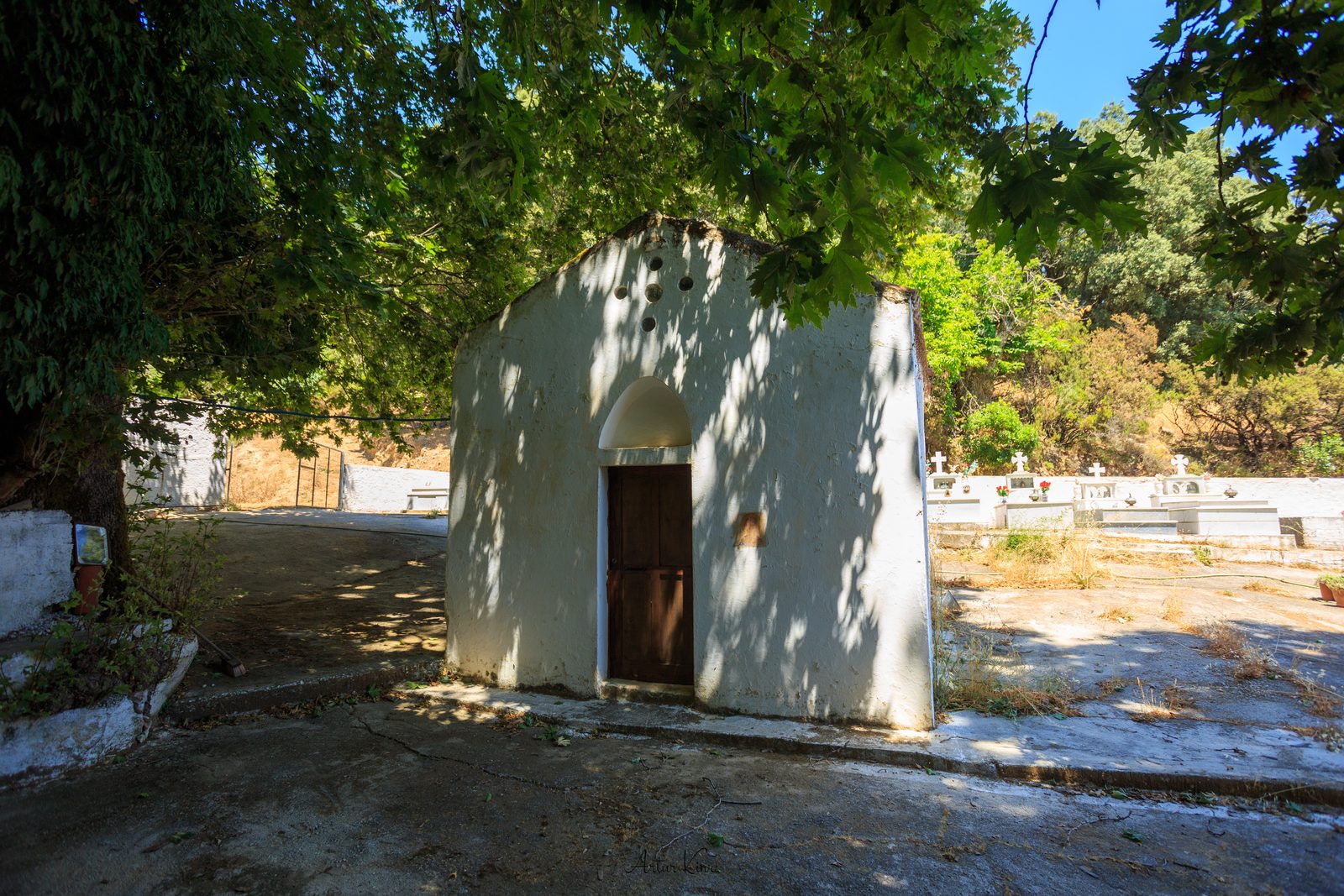
Ι.Ν. Αγίων Πατέρων
Φλώρια · Δήμος Καντάνου-Σέλινου · Περιφερειακή Ενότητα Χανίων
- Αφιέρωση
- Άγιοι Πατέρες
- Ζωγράφος
- Ξένος Διγενής
- Κατάσταση
- Καλή
- Εντοπισμός
- Επιβεβαιωμένο
In volume IV of I monumenti veneti dell'isola di Creta (p. 449), Giuseppe Gerola records the church at Apano Floria as a monument whose significance rests primarily on its epigraphic evidence rather than on architectural or decorative features alone. The preserved inscription, placed on the southern part of the vault within rectangular framed panels measuring approximately 68 × 76 cm and executed in black letters on a white background, is described by Gerola with particular care as to its location, layout, and legibility. The inscription identifies the church as dedicated to Saint John the Hermit (τοῦ ὁσίου πατρὸς ἡμῶν Ἰωάννου τοῦ Ἐρημήτου), a wezwanie that differs from the current dedication to the Holy Fathers (Αγίων Πατέρων). Gerola himself notes that the founder deliberately chose a patron saint whose name corresponded to his own family name. This discrepancy between the original and present dedication is historically significant and suggests a later shift in the liturgical identity of the monument. The founder is identified as Manouel Eremioioannis (Μανουὴλ τοῦ Ἐρημοιωάννη), who, together with his wife Kali and their children Georgios, Ioannis, Theotokousa, and Stamata, records both the construction and the painted decoration of the church. A distinct role is played by Alvise Cocco, identified by Gerola as a descendant of a Venetian patrician family present among the colonizers of 1211, who appears in the inscription not as the founder of the building but as the donor of the landed endowment. The goods transferred to the church are enumerated with legal precision: twenty goats, ten beehives, and the entirety of an enclosed estate described "as it is found," extending from boundary ditch to boundary ditch and comprising houses, trees, and vineyards, together with a vineyard known as "del Gelso" and its corresponding field. Owing to the precision and legal phrasing of this text, Gerola classifies the inscription as an iscrizione documentaria, comparable in function to a formal legal deed rather than to a conventional dedicatory inscription — an exceptionally rare feature in ecclesiastical inscriptions of the period. He further remarks that although the text contains several orthographic errors, it ranks, for the fifteenth century, among the more correct inscriptions from an orthographic point of view, suggesting a relatively high level of written culture within the milieu in which it was produced. Of particular importance for the history of the monument is the explicit identification of the painter responsible for the wall paintings. According to the inscription itself, the artist was Xenos Digenis, originating from the village of Moklio in Arcadia of the Morea. This identification does not depend on stylistic attribution but derives directly from the epigraphic text, providing rare and secure evidence for the presence of a Peloponnesian painter active on Crete during the late Venetian period. The inscription also preserves a precise date, recorded according to the Byzantine era as the year 6970 from the Creation of the world, which Gerola converts to July 1462. Thanks to this convergence of securely documented elements — the original dedication, the identity and legal act of the founder, the role and patrician lineage of the donor, the explicit naming and geographical origin of the painter, and the exact date of execution — the church at Apano Floria constitutes an exceptional case within the corpus of Venetian-period monuments on Crete. Its significance extends beyond local history to illuminate broader questions of fifteenth-century patronage practices, legal consciousness in ecclesiastical endowment, and the movement of individual painters between the Peloponnese and Crete.
Εγγραφή καταλόγου
Αρχιτεκτονική
- Τύπος
- Εκκλησία
- Λειτουργία
- Κοιμητηριακός
Κατάσταση διατήρησης
- Κατάσταση
- Καλή
Αφιέρωση και χρονολόγηση
- Αφιέρωση
- Άγιοι Πατέρες
- Ζωγράφος
- Ξένος Διγενής (επιβεβαιωμένο)
Στον κατάλογο
- Αρ. Gerola–Λασσιθιωτάκη
- 139
- Αρ. εγγραφής
- #895
- Εντοπισμός
- Επιβεβαιωμένο
- Τεκμηρίωση
- Artur Kiwa
- Τελευταία ενημέρωση
- 4 Νοεμβρίου 2026
Θέση
Συντεταγμένες35.37765° N, 23.73975° E
Άνοιγμα στον κύριο χάρτη