Church · Chania Regional Unit
Church of the Transfiguration of Christ
Meskla · Municipality of Platanias · Chania Regional Unit
- Dating
- 1301–1350
- Patron
- Christ the Savior
- Painter
- Θεοδωρος και Μιχαηλ Βενερης
- Plan
- Single nave
- Condition
- Excellent
- Location
- Confirmed
Description
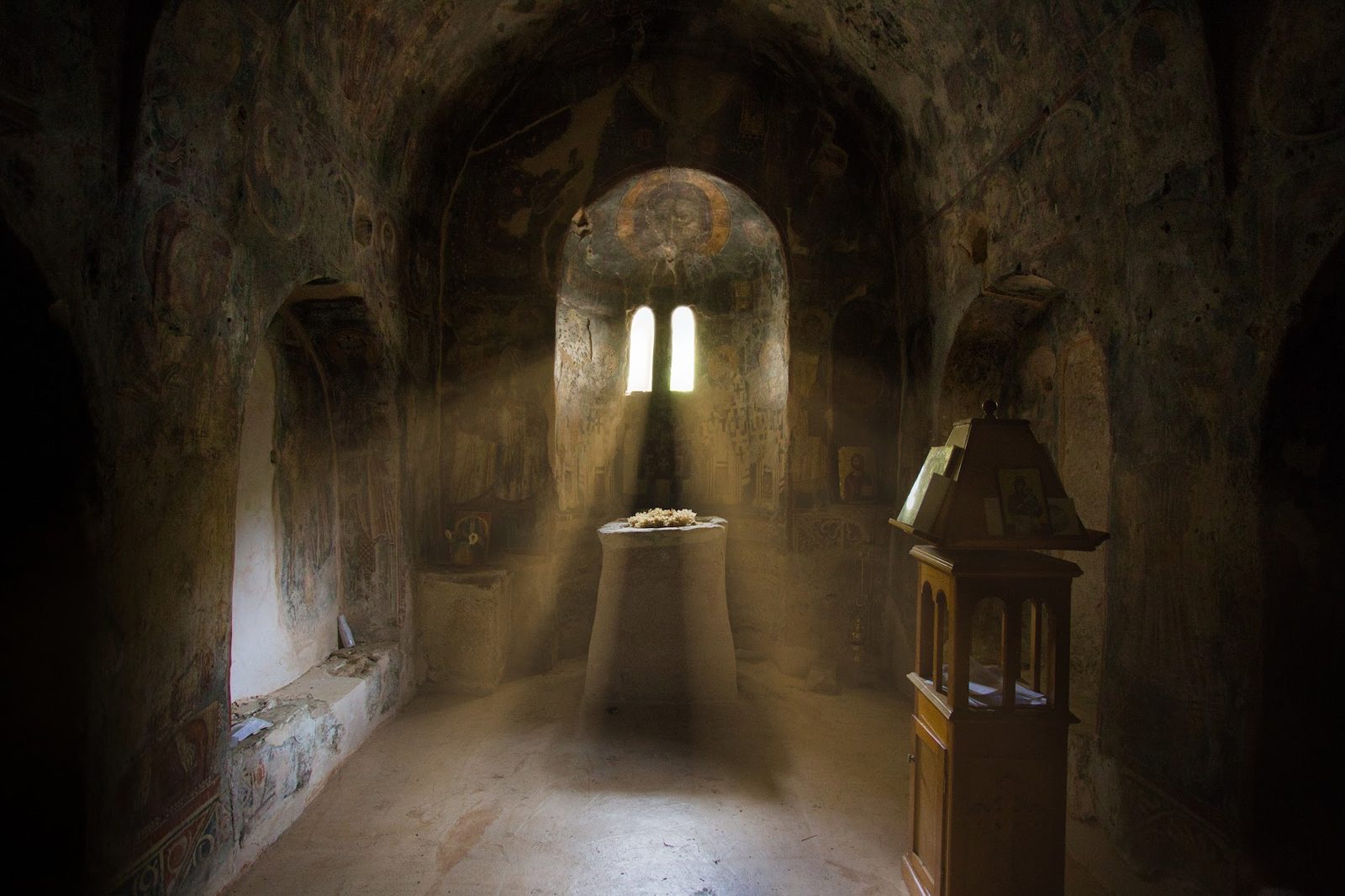
The Church of Christ the Saviour (Ναός του Σωτήρα Χριστού) in the village of Meskla, set in a green valley at the foot of the White Mountains in western Crete, is a small but exceptional church from the Late Byzantine period. Built most likely in the 14th century, the church is distinguished by a valuable ensemble of frescoes attributed to the Cretan painter Michael Veneris. The painted decoration includes scenes from the life of Christ, images of saints, and the traditional Pantokrator in the dome. Despite the passage of time, the frescoes have retained vivid colours and precise detail, making them an important source of knowledge about the local iconographic school. The church is built on a rectangular plan, single-naved, with a characteristic apse. Hidden among olive and cypress trees, it is a quiet place of contemplation and a valuable point on the map of Crete's sacred monuments, combining spirituality, history and art in an intimate, rural setting.
The Church of Christ the Saviour in Meskla (Ναός του Χριστού του Σωτήρα) is one of the most valuable examples of late-medieval rural sacred architecture in western Crete. Located in a picturesque valley at the foot of the Lefka Ori (White Mountains), in the municipality of Therisso near Chania, the church bears witness to the spiritual and artistic flourishing of the region during the Venetian period.
It was most likely built in the first half of the 14th century as a small, single-nave church with a semicircular apse and barrel vault. The interior is covered almost entirely with frescoes, which have survived in surprisingly good condition despite the centuries and the effects of weather. The painted decoration is of great significance for the history of Cretan art — it is attributed to the renowned painter Michael Veneris (Μιχαήλ Βενέρης), active in the 14th century in western Crete. Veneris was a representative of the so-called "provincial Cretan school," which combined the influences of Byzantine tradition with a local artistic idiom.
The church's iconographic programme follows the standard layout for Byzantine churches: the dome bears an image of Christ Pantokrator, while the side walls contain scenes from the life of Christ, including the Annunciation, the Nativity, the Baptism, the Crucifixion and the Resurrection. The lower sections of the apse and the side nave present figures of saints — among them the Archangels, St. Nicholas, St. George, St. John the Baptist — in the frontal arrangement typical of Byzantine painting.
Of particular interest are the local decorative elements — for instance, details of dress that recall the realities of Venetian Crete, and the expressive faces of the figures, in which the painter conveys emotion rather than mere liturgical convention. The colour palette of the frescoes is dominated by ochre, red and blue tones, with well-preserved contour lines and ornamentation.
Although modest in appearance from the outside and not easy to access, this church is a key point of reference for scholars of Cretan art. It also bears witness to the deep rootedness of faith in the everyday life of the inhabitants of Venetian Crete. Today the church is usually kept closed, but access can be arranged through local caretakers. It is a place worth visiting not only for its art, but for the sense of silence and contemplation offered by its mountain setting.
Catalogue record
Architecture
- Type
- Church
- Plan
- Single nave
- Vault
- Barrel vault
- Apse
- Semicircular
- Dome
- No
- Masonry
- Mixed
- Orientation
- East–west
- Setting
- In a village
State of preservation
- Condition
- Excellent
- Structural risk
- None
- Note
- No visible structural instability observed. Masonry walls and vaults appear stable, with only minor surface weathering.
Dedication and dating
- Patron
- Christ the Savior
- Painter
- Θεοδωρος και Μιχαηλ Βενερης (confirmed)
- Dating
- 1301–1350
- Certainty
- Hypothetical
- Basis of dating
- Hypothesis
In the catalogue
- Gerola–Lassithiotakis no.
- 58
- Record no.
- #657
- Location
- Confirmed
- Documented by
- Artur Kiwa
- Last updated
- 12 November 2026
Location
Map configuration missing: set MAP_STYLE_LIGHT / MAP_STYLE_DARK in ConfigMap.
Coordinates35.40551° N, 23.95798° E
Open on the main map