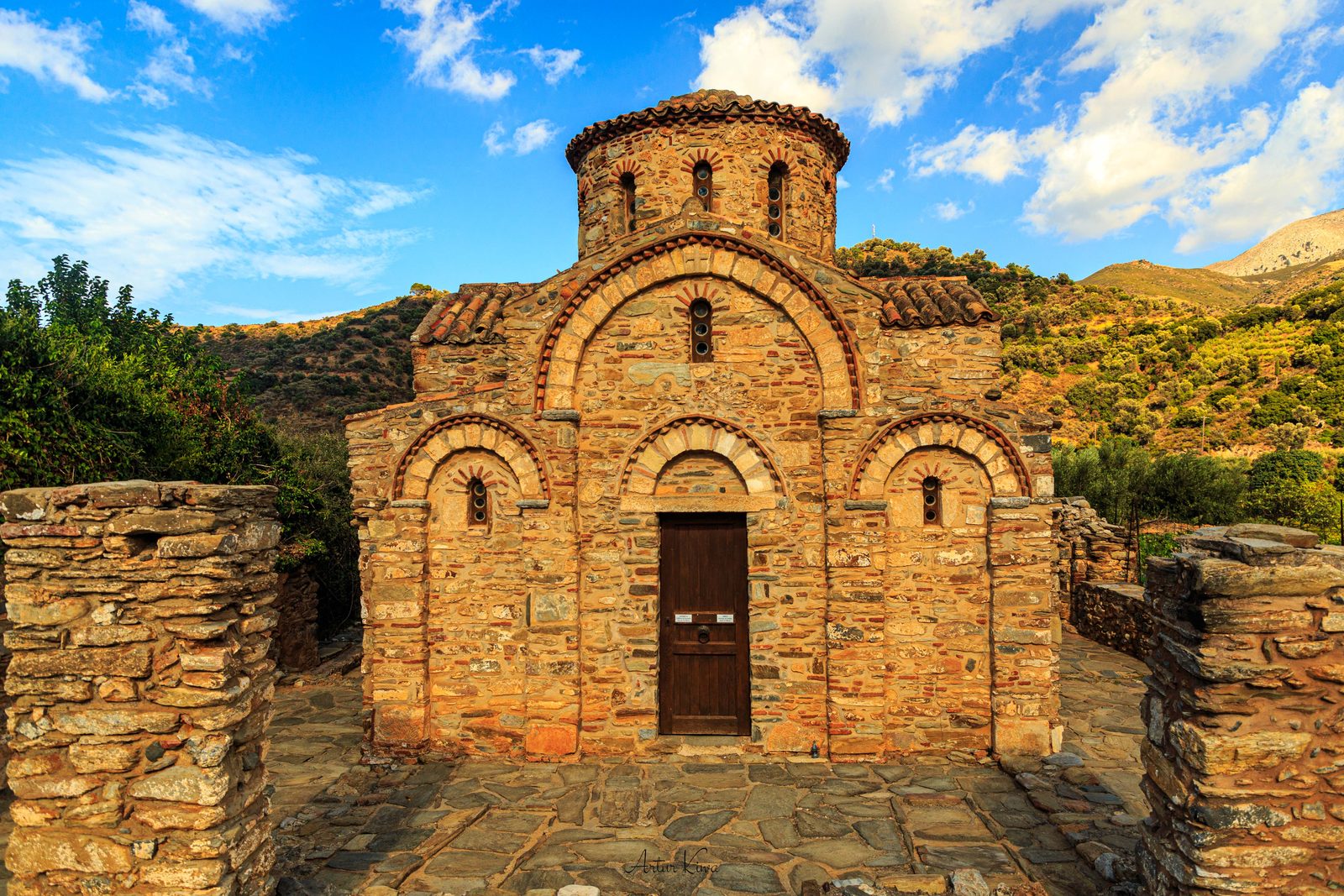
Church · Heraklion Regional Unit
Church of the Panagia
Fodele · Municipality of Malevizi · Heraklion Regional Unit
- Patron
- Panagia / Theotokos
- Condition
- Excellent
- Location
- Confirmed
Description
Panagia Fodele — older than you think
A few kilometres inland from the northern coast of Crete, hidden among orange groves, stands one of the island's best-preserved Byzantine churches. Panagia Fodele was built in the 11th century — roughly the same era in which the Crusaders were raising the Church of the Holy Sepulchre in Jerusalem.
But the site is older still. Beneath the current church lie the foundations of an Early Christian basilica from the 6th century. Two of its original pillars were absorbed into the later walls, still visible if you know where to look.
The interior is covered in frescoes layered across centuries. The oldest date to the 11th century; the most recent bears an inscription from 1323. During the Ottoman period, the images were whitewashed — which, paradoxically, sealed the pigments and preserved them perfectly. When the lime was eventually removed, the colours emerged as vivid as the day they were painted. Not everything survived intact, however: on many of the saints' faces, the eyes have been gouged out. Ottoman soldiers believed the spiritual power of an icon resided in its gaze — and destroyed it accordingly.
Look up at the upper walls and you'll notice small circular recesses. These are built-in ceramic jars — a Byzantine acoustic system. Positioned to resonate with a cantor's voice, they carried sound across the stone interior long before anyone imagined a loudspeaker.
Outside, stone-framed rectangles in the ground mark the positions of ancient graves. The church and its cemetery were never separated — the proximity of the living and the dead remains tangible here.
Fodele is best known as the birthplace of El Greco. Domenikos Theotokopoulos grew up in the shadow of this church, and though he later worked in Venice and Toledo, the austere Byzantine aesthetic never fully left his painting.
Catalogue record
Architecture
- Type
- Church
- Orientation
- East–west
- Setting
- In a village
State of preservation
- Condition
- Excellent
Dedication and dating
- Patron
- Panagia / Theotokos
In the catalogue
- Gerola–Lassithiotakis no.
- 291
- Record no.
- #660
- Location
- Confirmed
- Documented by
- Artur Kiwa
- Last updated
- 4 November 2026
Location
Map configuration missing: set MAP_STYLE_LIGHT / MAP_STYLE_DARK in ConfigMap.
Coordinates35.38573° N, 24.95175° E
Open on the main map