Church · Chania Regional Unit
Church of the Panagia Zerviotissa
Stylos · Municipality of Apokoronas · Chania Regional Unit
- Patron
- Panagia Zerviotissa
- Plan
- Cross-in-square
- Condition
- Good
- Location
- Confirmed
Description
Church of Panagia Zerviotissa
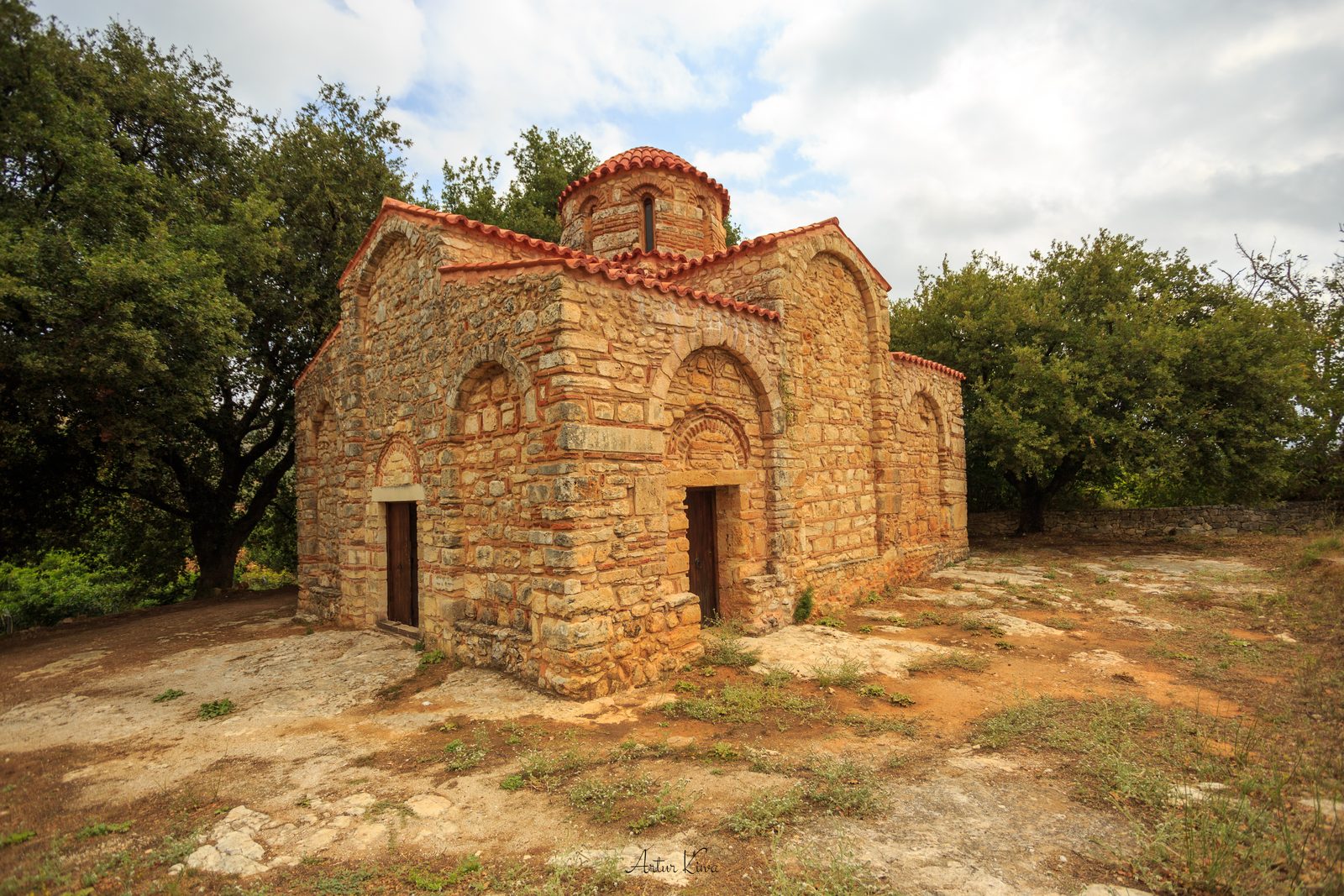
Among the olive groves surrounding the village of Stylos, in the Apokoronas region, stands one of the most interesting monuments of Byzantine architecture in western Crete: the Church of Panagia Zerviotissa, also known as Monastira. The church probably dates from the 11th–12th centuries, during the period of restored Byzantine rule over the island. Unlike the numerous small, single-nave churches found throughout rural Crete, it is a considerably more elaborate and architecturally distinguished building.
The church follows a cross-in-square plan, with a central dome supported by four structural supports. Its octagonal dome drum, three semicircular apses and carefully articulated façades give the building its distinctive appearance. Particularly noteworthy is the decorative stone-and-brick masonry, incorporating blind arcades and architectural features associated with the Byzantine tradition of Constantinople. The building represents a level of architectural refinement rarely encountered in ordinary rural churches on Crete.
The history of the church has traditionally been associated with the Monastery of Saint John the Theologian on Patmos. During the reign of Emperor Alexios I Komnenos, the monastery received estates on Crete, and documents from the 12th and 13th centuries confirm the existence of a dependency, or metochion, in the Stylos area. Panagia Zerviotissa has traditionally been identified with this establishment, although scholars have pointed out that the precise relationship between the surviving church and the original monastic foundation has not been conclusively established. The alternative name Monastira reflects the site's monastic tradition, while the name Zerviotissa is sometimes associated with an image of the Virgin holding the Christ Child on her left side.
Over the centuries, the church underwent several phases of reconstruction. Architectural studies indicate alterations to its northern section around the 13th century and to the southern section during the 15th century. Wall paintings were also executed during different periods, although only fragments survive today. Kostas Lassithiotakis recorded the church as number 59 in his catalogue of Crete's frescoed churches, noting only the remains of its painted decoration. Archaeological investigations of the cemetery surrounding the building have also uncovered numerous burials and objects that document the site's long history of use.
Panagia Zerviotissa is particularly significant for its architecture. Its imposing form, exceptional in the context of rural Crete, recalls a period when the island formed part of the Byzantine Empire and local religious foundations maintained connections with major centres of Eastern Christianity. Even though much of its original painted decoration has been lost, the church remains a remarkable witness to the medieval history of Crete.
The name of the church itself, Zerviotissa (Ζερβιώτισσα), is also of interest. It is traditionally derived from the Greek word *ζερβός*, meaning “left”, a vernacular equivalent of the standard Modern Greek *αριστερός*. According to local tradition, the name refers to a depiction of the Virgin Mary holding the Christ Child on her left arm, known as Panagia Aristerokratousa (Παναγία Αριστεροκρατούσα). The alternative form Serviotissa (Σερβιώτισσα) also appears in the literature. Although the meaning of *ζερβός* is well documented, the derivation of the church's name from this particular iconographic type remains a traditional explanation rather than a historically established fact.
Photographs · 2
Photographs: their authors. Rights to the depiction of the monuments: the Greek State (Law 4858/2021). Legal Notice
Catalogue record
Architecture
- Type
- Church
- Plan
- Cross-in-square
- Vault
- Dome
- Apse
- 3 × semicircular
- Dome
- Yes
- Masonry
- Mixed
- Orientation
- East–west
- Setting
- Isolated
State of preservation
- Condition
- Good
Dedication and dating
- Patron
- Panagia Zerviotissa
In the catalogue
- Gerola–Lassithiotakis no.
- 59
- Record no.
- #684
- Location
- Confirmed
- Documented by
- Artur Kiwa
- Last updated
- 14 November 2026
Location
Map configuration missing: set MAP_STYLE_LIGHT / MAP_STYLE_DARK in ConfigMap.
Coordinates35.44476° N, 24.12973° E
Open on the main map