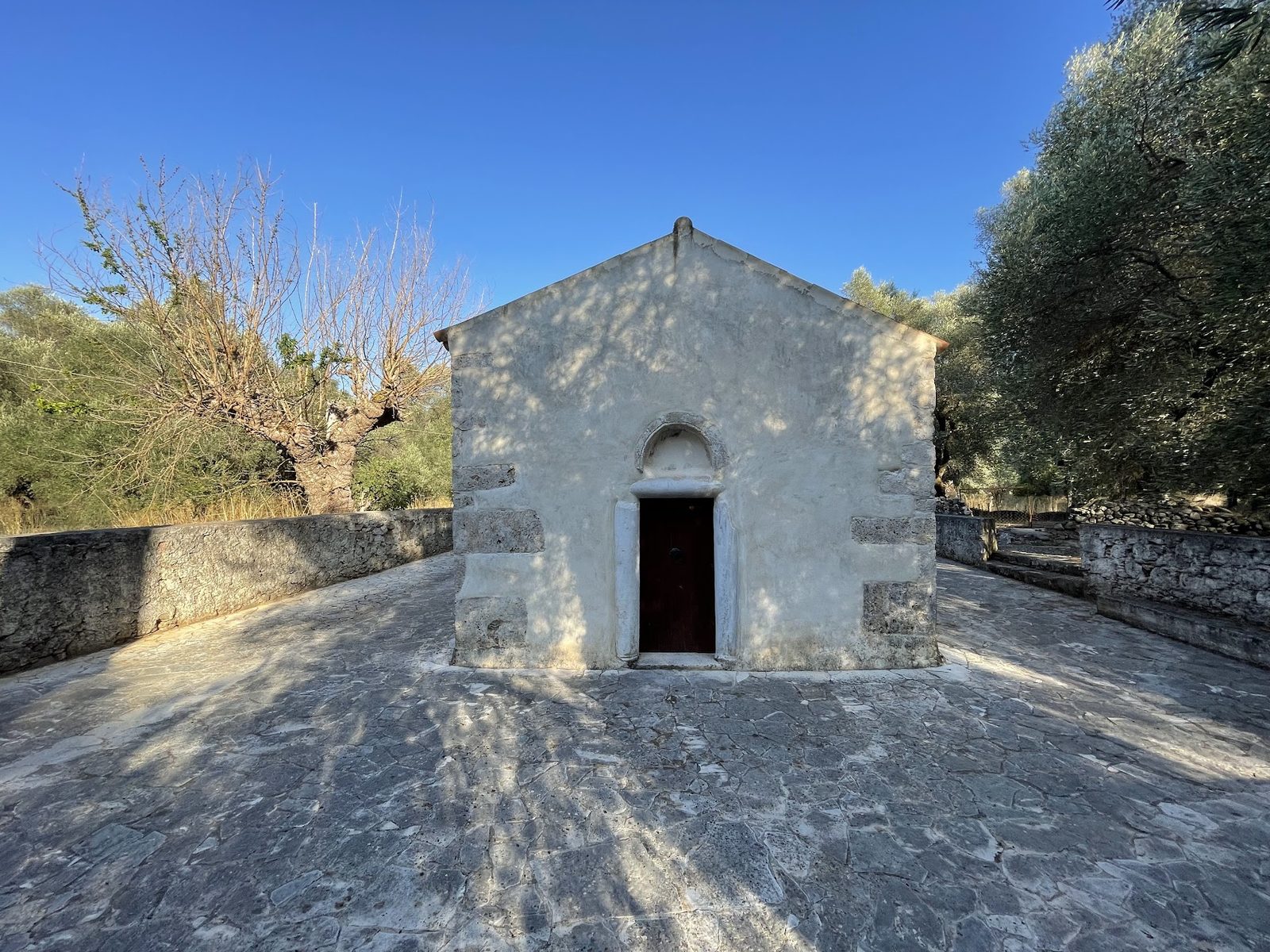
Church of the Panagia Myrtidiotissa
Plemeniana (Tzevremiana) · Municipality of Kantanos-Selinon · Chania Regional Unit
- Patron
- Panagia Myrtidiotissa
- Plan
- Single nave
- Condition
- Excellent
- Location
- Confirmed
Description
Photographs · 4
Interior of the Church of Panagia Myrtidiotissa — View from the Entrance
Nave, looking east
View of the single-nave interior of the Church of Panagia Myrtidiotissa in Tzevremiana, near Kandanos. The church is covered by a barrel vault reinforced with transverse arches. Its walls and vault are decorated with medieval frescoes depicting biblical scenes and figures of saints. At the far end, the apse features a bust of Christ, with figures of holy hierarchs below. Despite extensive damage and losses, the interior preserves a substantial part of its historic painted decoration, complemented by modern liturgical furnishings.
Dormition of the Virgin (Koimesis)
Blind arcade, on the south wall of the nave
The fresco depicts the Dormition of the Virgin. Mary lies on an ornamented funeral bier, surrounded by apostles and holy hierarchs who lean towards her body in mourning. Behind the bier stands Christ, holding a small figure symbolising the soul of his Mother. The participants are gathered on either side, with stylised buildings forming the background. Despite some damage, the painting preserves a wealth of detail, including the figures' faces, decorated garments and the ornamentation of the bier.
Archangel and Warrior Saint — Dedicatory Inscription
North wall of the nave, blind arcade with a window
The blind arcade on the north wall of the church contains two figures: an archangel on the left and an armoured warrior saint on the right. Above them, surrounding a small window, is an extensive Greek dedicatory inscription. Giuseppe Gerola, who documented it in the early 20th century, noted its unusual arrangement, with the text repeatedly changing direction and some letters written in reverse. The inscription commemorates the renovation of the church from its foundations and the execution of its painted decoration through the efforts and at the expense of Manuel Skoulikanthes and his family. Based on the surviving fragment of the date, Gerola assigned the inscription to the 14th century.
Photographs: their authors. Rights to the depiction of the monuments: the Greek State (Law 4858/2021). Legal Notice
Catalogue record
Architecture
- Type
- Church
- Plan
- Single nave
- Vault
- Barrel vault
- Apse
- Semicircular
- Dome
- No
- Masonry
- Mixed
- Orientation
- East–west
- Setting
- In a village
State of preservation
- Condition
- Excellent
Dedication and dating
- Patron
- Panagia Myrtidiotissa
In the catalogue
- Gerola–Lassithiotakis no.
- 141
- Record no.
- #700
- Location
- Confirmed
- Documented by
- Artur Kiwa
- Last updated
- 14 November 2026
Location
Coordinates35.32639° N, 23.72807° E
Open on the main map