Church of Saint George
Sklavopoula · Municipality of Kantanos-Selinon · Chania Regional Unit
- Patron
- Saint George
- Painter
- Nikolaos, lector and rural painter
- Plan
- Single nave
- Condition
- Fair
- Location
- Confirmed
Description
Photographs · 5
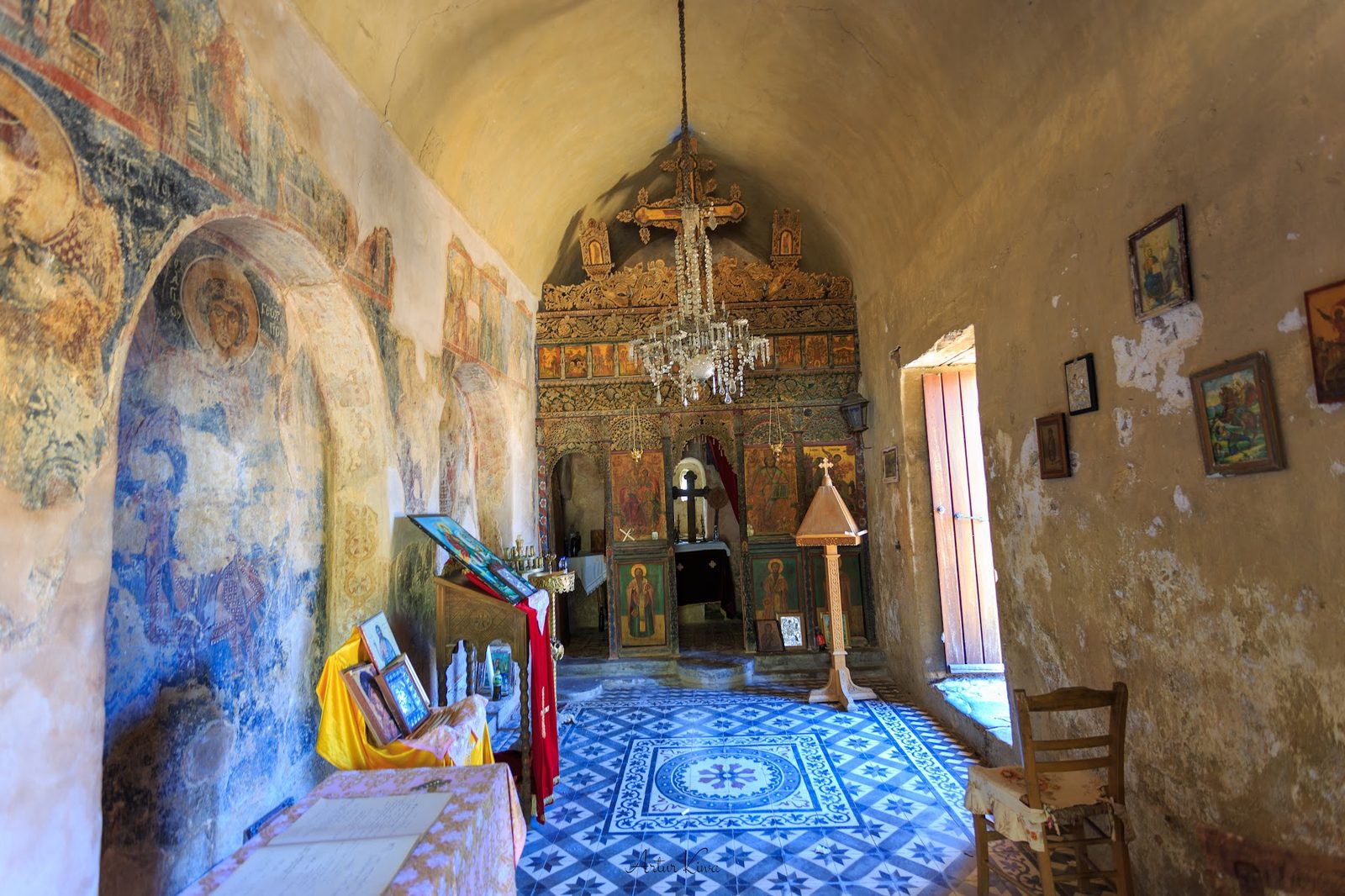
Interior of the Church of Agios Georgios — View towards the Iconostasis
Nave, looking from the entrance towards the sanctuary
View of the interior of the Church of Agios Georgios in Sklavopoula, covered by a barrel vault. Fragments of medieval frescoes survive on the left wall, including depictions of saints within blind arcades and figures of mounted warrior saints. Much of the opposite wall and the vault is covered with plaster, reflecting the later reconstruction of damaged sections of the church. At the far end stands an elaborately decorated wooden iconostasis separating the nave from the sanctuary. The interior also features a distinctive floor of blue-and-white tiles with geometric patterns.
Saint Theodore and Saint George — Frescoes in Blind Arcades
North wall, western section
Fragment of the medieval painted decoration on the northern wall of the Church of Agios Georgios in Sklavopoula. The blind arcades contain representations of mounted warrior saints: Saint Theodore on a reddish horse and Saint George, whose painting survives only in part. A damaged figure of another saint is visible between the arcades. The frescoes have suffered extensive losses, some of which have been filled with plaster. The western section of the north wall also preserves historical graffiti, including a Latin inscription dated 1360 recorded by Lassithiotakis.
Saint George and Warrior Saints — Decoration of the North Wall
North wall, eastern section
Fragment of the medieval painted programme on the northern wall of the Church of Agios Georgios in Sklavopoula. The central blind arcade contains a partially preserved depiction of Saint George on horseback. To the right stands another warrior saint, shown frontally in richly decorated armour. Between the arcades is a damaged representation of a warrior saint with a shield on his back. The accompanying inscription is largely illegible, and the surviving ending of the name does not allow a secure identification. Fragments of additional saints are visible above the arcades. Large sections of the original paintings have been lost and replaced by later plaster repairs.
Photographs: their authors. Rights to the depiction of the monuments: the Greek State (Law 4858/2021). Legal Notice
Catalogue record
Architecture
- Type
- Church
- Plan
- Single nave
- Vault
- Barrel vault
- Apse
- Semicircular
- Masonry
- Mixed
- Orientation
- East–west
- Setting
- In a village
State of preservation
- Condition
- Fair
- Structural risk
- Low
Dedication and dating
- Patron
- Saint George
- Painter
- Nikolaos, lector and rural painter (confirmed)
In the catalogue
- Gerola–Lassithiotakis no.
- 86
- Record no.
- #742
- Location
- Confirmed
- Documented by
- Artur Kiwa
- Last updated
- 14 November 2026
Location
Coordinates35.29988° N, 23.61417° E
Open on the main map