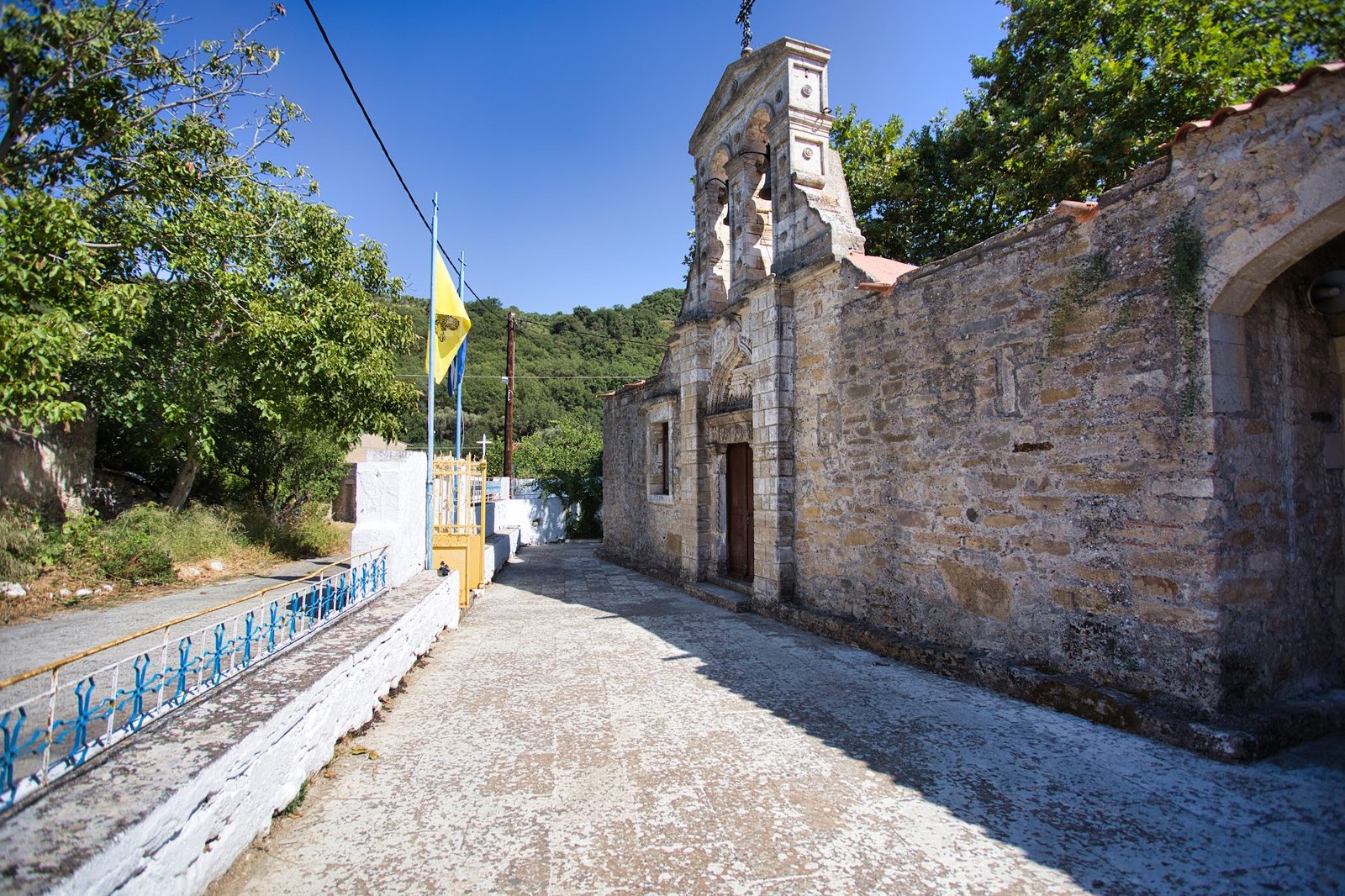
Church of Saint John the Forerunner
Deliana · Municipality of Platanias · Chania Regional Unit
- Patron
- Saint John the Forerunner
- Plan
- Single nave
- Condition
- Excellent
- Location
- Confirmed
Description
Photographs · 12
North façade with portal and bell tower
North façade, main entrance
A full view of the church's north façade, showing the two-arched, Venetian-style bell tower crowning the gable, and the richly decorated main portal with its late Gothic heraldic arch and the foundation inscription of Dominico Venier. Below, a second, smaller decorated archivolt is visible, bearing an additional inscription along with floral motifs. The wooden, double-leaf entrance doors are adorned with a cross motif. The whole illustrates the stylistic syncretism typical of sacred architecture on Crete under Venetian rule — a Byzantine building mass combined with Western, Renaissance-Gothic stone decoration on the façade.
Entrance portal — late Gothic decoration
North façade, lintel of the main portal
A richly decorated arch above the main entrance portal, executed in a late Gothic style with Renaissance elements, characteristic of sacred architecture on Crete under Venetian rule. The central part of the composition features a heraldic shield flanked by two lions, above which a winged figure (putto) riding a dolphin or dragon is depicted. On the ribbon beneath the shield, a legible inscription survives: "D[OMI]NI DOMINICI VENERIO..." — referring to Dominico Venier, a member of a well-known Venetian family, likely the donor or the person responsible for the construction or reconstruction of the portal. Below, on a second, smaller arch, another inscription is visible, bearing a date (1891?) along with floral motifs and two winged cherub heads — most likely evidence of a later renovation or commemoration.
Church interior — view towards the iconostasis
Interior of the naos, view along the east-west axis
A view along the axis of the church towards the iconostasis, showing the barrel vault covered with a dense painted program. On the north wall (left), the scene of the Dormition of the Virgin (Koimisis) is visible; on the south wall (right), a fragment of a scene from the Second Coming (Last Judgment) cycle. The colourful wooden iconostasis and modern liturgical furnishings contrast with the austere stone architecture and the medieval painted layer of the walls, testifying to the church's uninterrupted liturgical function across the centuries.
Photographs: their authors. Rights to the depiction of the monuments: the Greek State (Law 4858/2021). Legal Notice
Catalogue record
Architecture
- Type
- Church
- Function
- Parish church
- Plan
- Single nave
- Apse
- Semicircular
- Dome
- No
- Masonry
- Mixed
- Orientation
- East–west
- Setting
- In a village
State of preservation
- Condition
- Excellent
- Structural risk
- None
Dedication and dating
- Patron
- Saint John the Forerunner
In the catalogue
- Record no.
- #746
- Location
- Confirmed
- Documented by
- Artur Kiwa
- Last updated
- 13 November 2026
Location
Coordinates35.44649° N, 23.73760° E
Open on the main map