 Church in the catalogueChurch of Saint GeorgeView catalogue entry →
Kouneni has two churches and, as it turns out, two completely different stories to tell. I have already written about the Archangel Michael. A workshop with a name attached to it, father and son, and a date recovered only in 2018 from the remains of a destroyed inscription. Now it is time for the other one, the less spectacular neighbour, which happens to be half a century older and, in my opinion, no less interesting — even if today it takes a little more goodwill to appreciate it.
This church resisted me for years. I no longer remember when I first tried to visit it, but it must have been around ten years ago. Closed. In the following years, the same story: closed, and nobody knew where the key was. End of discussion. The key was in Chania, nobody knew exactly with whom, and that was that. This year I happened to be driving past, with no plan at all, on my way home. I thought: I’ll stop for a moment, I won’t even bother taking the equipment. And bang. The church was open. Which meant I ended up doing quite a few extra kilometres because I had to go back for the camera, but it was worth it. I have no idea what happened, why, or who made sure the church was open. What matters is that, finally, I got inside.
We have to be honest with ourselves: what Lassithiotakis described in 1962 and what I found there are, to a large extent, two different churches. His description was written more than sixty years ago, when the paintings were clearly in much better condition. Today, some of what he was able to read and identify step by step is difficult to decipher. As it turns out, however, not everything has been lost.
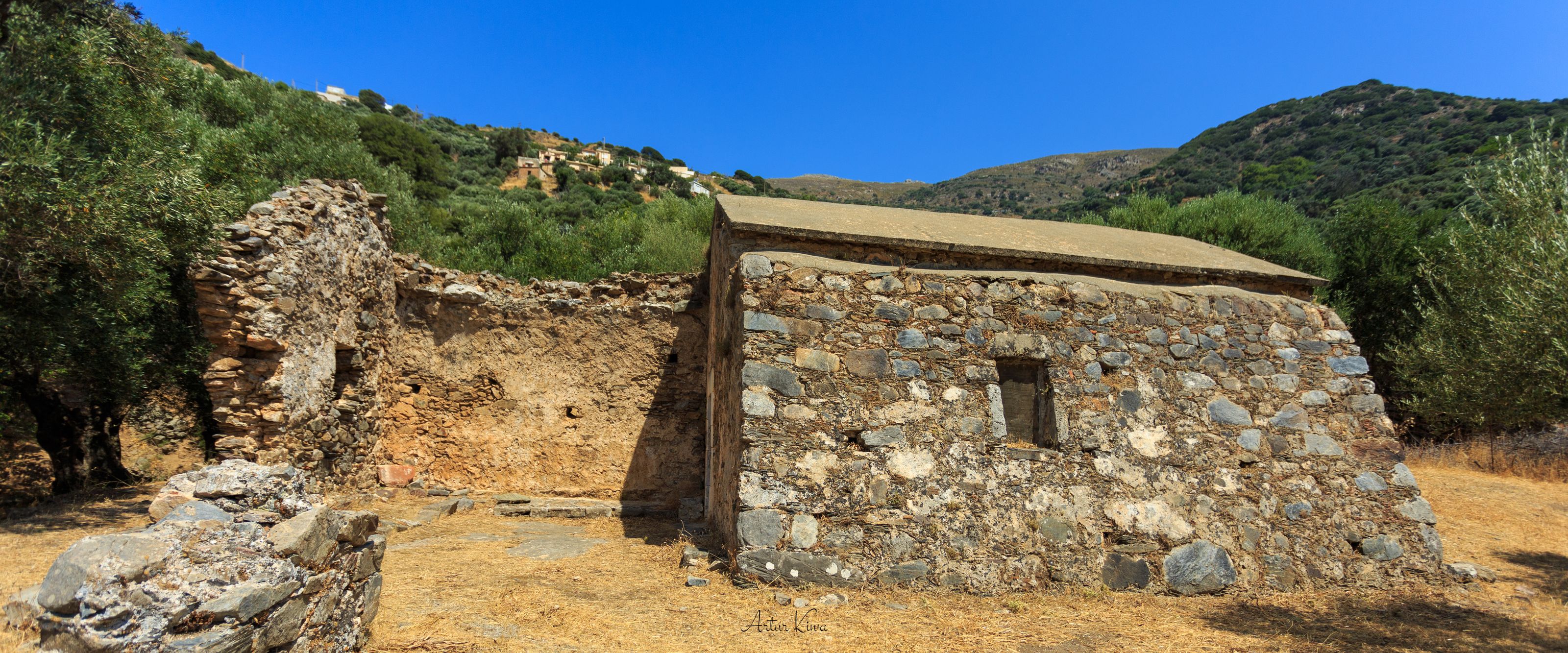
Agios Georgios stands in the Vaïdiana quarter, just a stone’s throw from the church of the Archangel Michael. The building is elongated, slightly crooked, and its axis deviates by roughly 35° towards the north. That is considerably more than its neighbour, as though whoever built this one cared even less about geometry. At some point the vault collapsed and was rebuilt using the same stone, and this is still plainly visible today, without any specialist knowledge whatsoever. Fragments of the old painted decoration survive on individual stone blocks, built back into the structure more or less at random. Inside, they create something like a puzzle. A sad puzzle, to be honest.
The hall-type form represented by this church has quite an old pedigree. Lassithiotakis traces it back to northern Mesopotamia, to the Tur Abdin mountains, where such buildings are common and form, as he beautifully put it, “a compact architectural core of homogeneous character”. He also cites the example of Armenian Ani, where buildings of a similar type are dated as early as 622. That in itself is fascinating: how a technical architectural detail — an arrangement of niches, a type of construction — can travel halfway across the world and then turn up in some God- and man-forgotten village deep in the Cretan interior.
Inside the church we are faced with a painted programme that is difficult to classify unequivocally. Above the niches are busts of saints whom Lassithiotakis identified as the “five martyrs” from Asia: Akindynos, Pegasios, Aphthonios and the others. Today they are less visible and difficult to read. Everything is more worn, more faded and clearly in worse condition. You get the distinct impression that Lassithiotakis was describing a church that had survived considerably better. Unfortunately.
The scene of the Betrayal described by Lassithiotakis, showing only the moment of the kiss and not the arrest of Christ, surprised me very much — in a good way. Yes, the painting is heavily worn, but the fresco still tells the story with full force, and the composition remains legible. The one jarring element is the wooden iconostasis, which someone brutally “incorporated” more or less into the middle of the scene, irreversibly destroying its central part. It is a sad sight, and one we encounter in many Cretan churches. A complete lack of sensitivity: an iconostasis literally driven into the middle of a wall painting, grooves brutally cut through frescoes for electrical wiring, or a nail hammered straight into the forehead of a hierarch so that someone could hang an icon.
The biggest surprise was the apse. The conch itself, with the Virgin in the Orans type, the medallion of Christ Emmanuel on her breast and two archangels on either side, has survived quite well; the colours and outlines are still clear. And the zone below, with four hierarchs holding unrolled liturgical scrolls, is actually the best-preserved part of the entire church: the texts on the scrolls can still be read, the faces remain sharp, and there is no doubt about who is who. The complete opposite of what I had expected after seeing the rest of the building.
I was not as lucky with the Annunciation on the reveals of the apse — the very scene Lassithiotakis described as one of the most beautiful in the church. Of the entire composition, only the Archangel Gabriel has survived, still clearly visible, his wings spread as if he were about to take flight. On the other side, where Mary should be, barely half a figure remains — and even that half is in poor condition. A beautiful scene has been mutilated almost exactly down the middle.
And now we come to the crux of the whole story, because this, remarkably, has survived intact. In the church of the Archangel Michael, the dedicatory inscription was brutally destroyed during some repair to the lintel, and its date was lost forever. Here, the date survived. In the conch of the apse, directly beneath the Virgin, there is a small panel measuring 30 by 17 centimetres, with black letters on a white background: the year 6792 from the Creation of the World, which means 1284. Gerola called it “sicuramente databile” — securely datable — and one of the oldest inscriptions of this type on the whole of Crete. The founder was the hieromonk Jacob, who paid out of his own pocket for both the construction of the church and its decoration.
Half a century before Pagomenos and his son came to Kouneni to paint the neighbouring church with all the splendour of the Palaiologan style, some unknown provincial painter was working here for a monk who simply wanted to build his little church and have it decorated. Today, the state of preservation is exceptionally uneven, as though time and damp had treated each part of the building according to a different set of rules. The naos is worn, but still readable. The apse with the hierarchs has survived better than anything else in the building. Half of the Annunciation is gone. And in the middle of it all there remains that precise inscription, which has yielded to neither man nor time and stubbornly preserves the name of the man who once built something here.
In 1284 Dante is nineteen years old. Marco Polo has not yet returned from his journey to Asia. Columbus will make his discovery more than two hundred years later. At the very same time, somewhere in the Cretan interior, an anonymous painter is mixing pigments and painting the first frescoes in this church. Almost 750 years have passed, and a man whose life was only a brief episode in the thirteenth century is still alive on the wall of this church.