Church of Saint George
Vathi · Municipality of Kissamos · Chania Regional Unit
- Patron
- Saint George
- Plan
- Single nave
- Condition
- Fair
- Location
- Confirmed
Description
Photographs · 12
View of the church entrance.
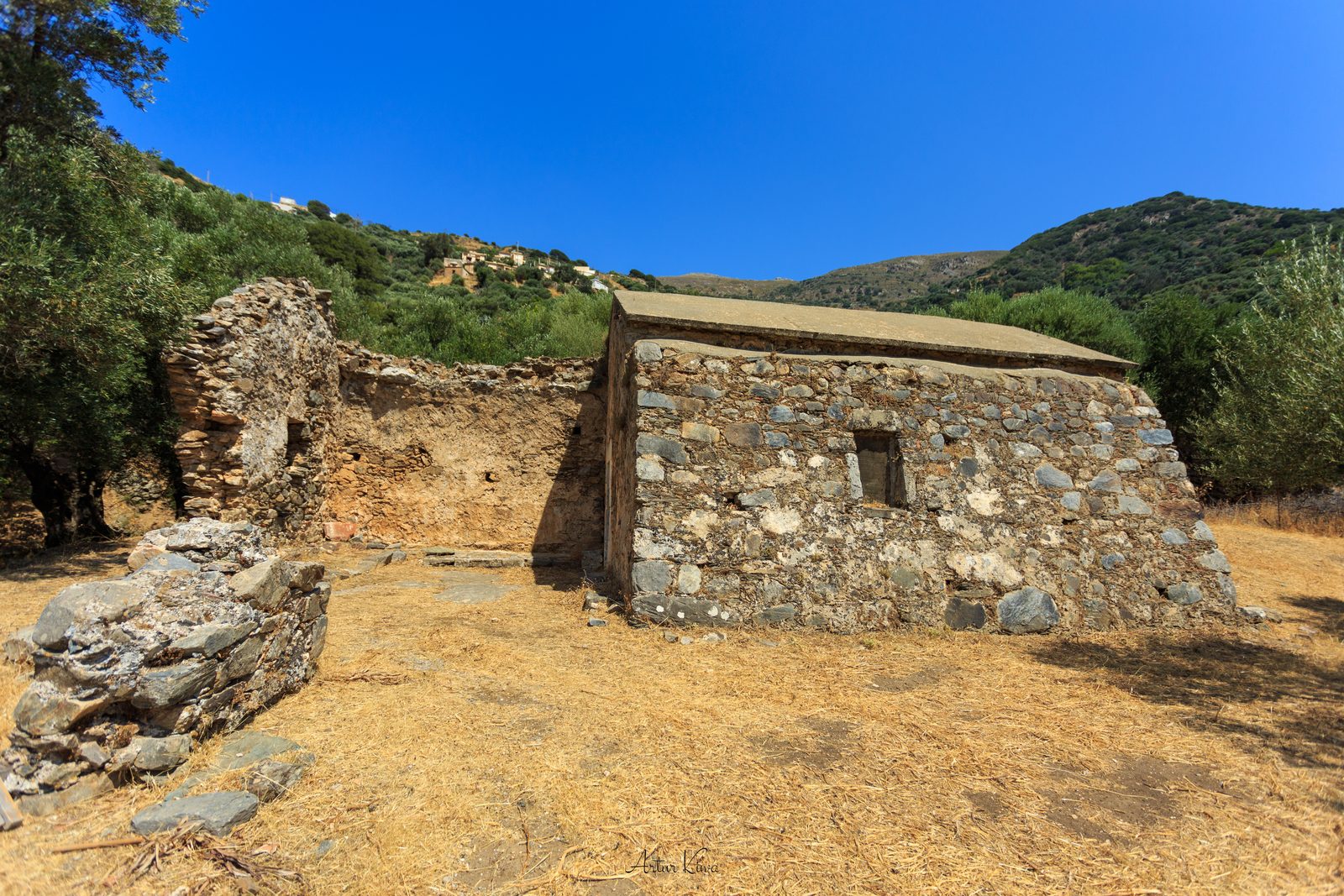
Exterior view of the Church of Saint George in Kouneni (Vathi). The small church has a simple, compact form built of irregular stone masonry. A narrow rectangular window opens in the side wall. Immediately beside the church are the remains of stone walls, now preserved in a ruined state; their function and chronology cannot be determined from the photograph alone. The church stands among olive groves in the mountainous landscape of western Crete. A surviving dedicatory inscription records that the church was rebuilt and decorated with wall paintings in 1284.
View of the church from the east
View of the Church of Saint George in Kouneni (Vathi) from the east. In the foreground is the projecting semicircular apse, built of irregular stone masonry. In its upper part, a decorative brick band survives, forming a distinctive frieze below the cornice. Above the apse, the eastern gable wall of the main body of the church is visible. The church stands on a hillside among olive groves and low stone-built field walls. The view clearly shows the small scale of the building and its setting within the surrounding landscape.
View of the apse.
Wall paintings in the apse of the Church of St George in Kouneni (Vathi), dated to 1284. In the semi-dome of the apse, the Virgin Mary is depicted in the Blachernitissa (Orans) type, with her hands raised in prayer and a medallion of Christ Emmanuel on her chest. The Annunciation scene extends across both sides of the composition, with the Archangel Gabriel on the left and Mary on the right. Above the window is a well-preserved dedicatory inscription. Below, on the wall of the apse, four holy hierarchs are depicted, two on either side of the central window. The bishops, dressed in liturgical vestments decorated with crosses (polystavria), hold unfurled scrolls bearing Greek texts of liturgical prayers. Their figures are turned towards the centre of the apse, forming a composition that evokes the concelebration of the Eucharist. The paintings survive in varying states of preservation. The depiction of the Mother of God with Emmanuel and the figures of the hierarchs on the left side of the apse are particularly well preserved and legible. On the right side, extensive losses of the paint layer are visible.
Photographs: their authors. Rights to the depiction of the monuments: the Greek State (Law 4858/2021). Legal Notice
Catalogue record
Architecture
- Type
- Church
- Function
- Parish church
- Plan
- Single nave
- Vault
- Barrel vault
- Apse
- Semicircular
- Dome
- No
- Masonry
- Rubble stone
- Orientation
- East–west
- Setting
- In a village
State of preservation
- Condition
- Fair
- Structural risk
- Low
Dedication and dating
- Patron
- Saint George
In the catalogue
- Gerola–Lassithiotakis no.
- 45
- Record no.
- #674
- Location
- Confirmed
- Documented by
- Artur Kiwa
- Last updated
- 12 November 2026
Location
Coordinates35.35961° N, 23.59263° E
Open on the main map