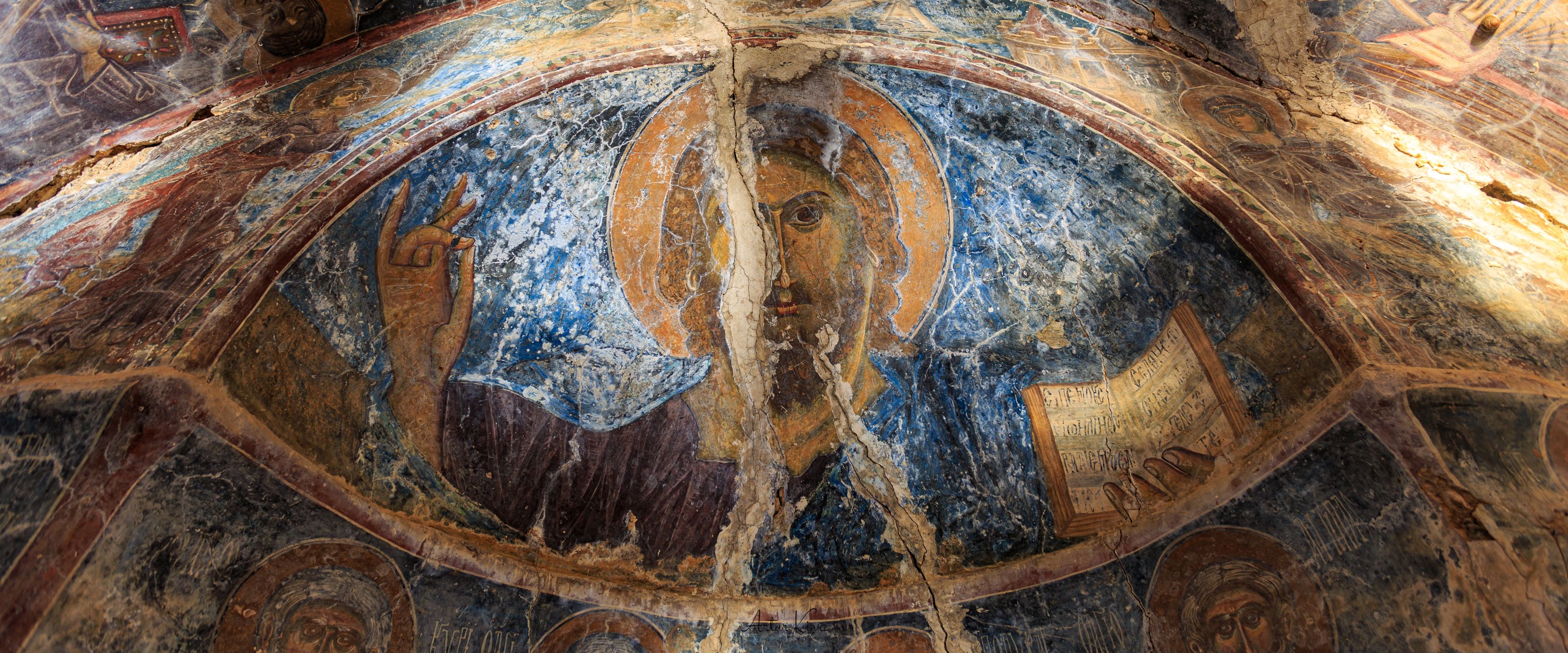
 Church in the catalogueChurch of the Archangel MichaelView catalogue entry →
This church is well hidden, I’ll give it that. You pass it when driving from Plokamiana to Vathi, on the left-hand side. The problem is that there is absolutely no chance of seeing it from the road, and there is no clearly visible path either. I have lost count of how many times I drove past it. As for how many words of various calibres were uttered in the process, I would rather not mention either the calibre or the words themselves. You have to stop on the roadside, press yourself against the scrub, then force your way through another stretch of undergrowth before, after a moment, the body of the church finally appears. It stands hidden beneath a large, spreading tree.
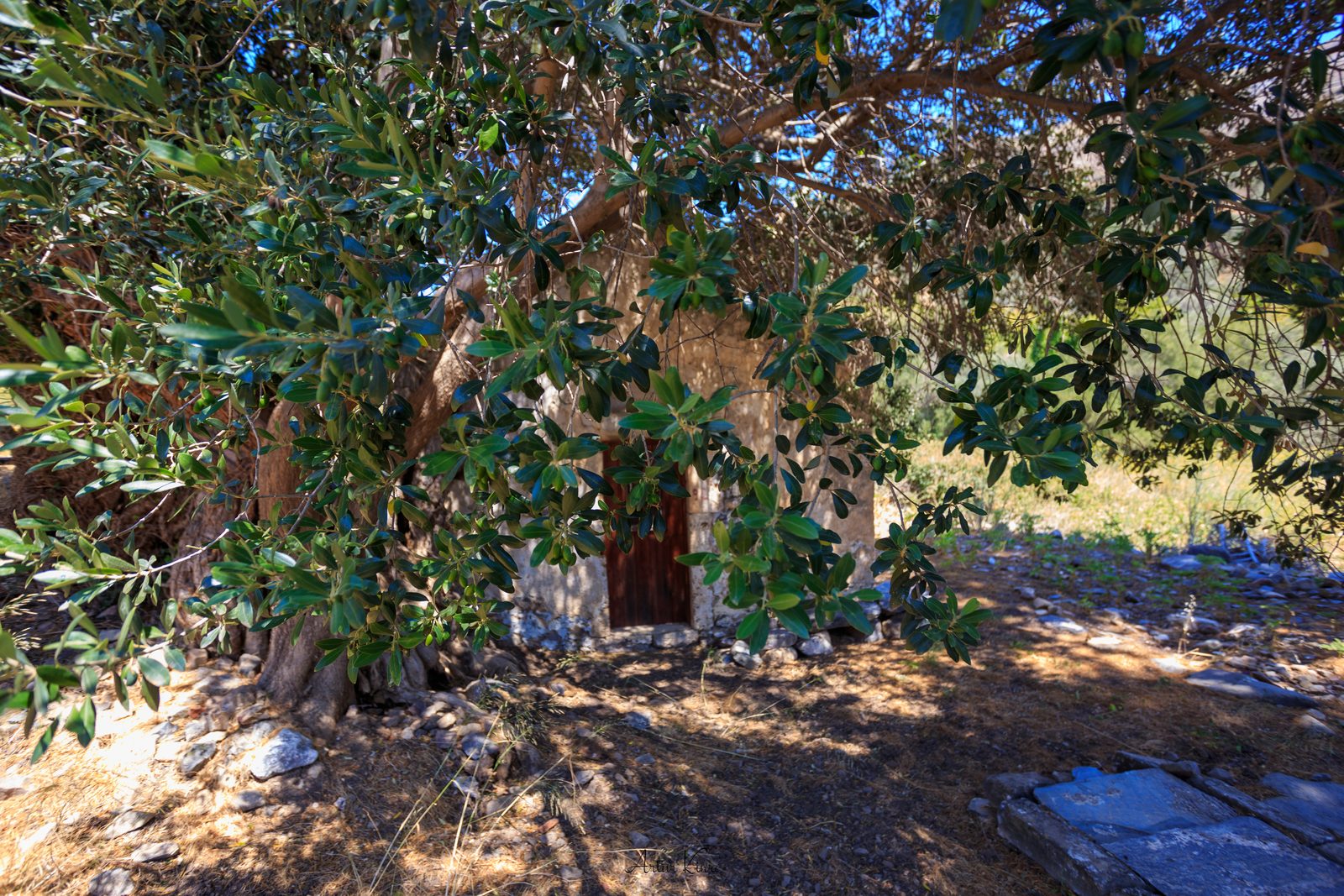
The locals still say “Kouneni”, not “Vathi”. The name was officially changed in 1957, but, as Lassithiotakis already noted in his 1962 article, the old name disappeared neither from people’s memory nor from maps. They also call the church “tou Astratigou” — “of the Commander”, that is, the Commander of the Heavenly Hosts.
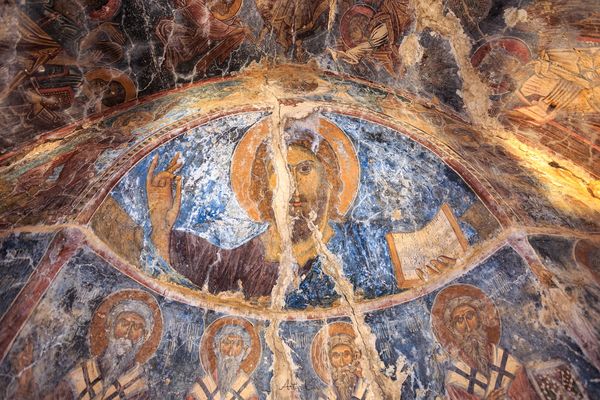
From the outside, there is nothing remarkable. A single simple chamber, just under 6 by 3 metres, with its axis slightly skewed to the north by about 20° — less than in the neighbouring Agios Georgios, but still enough to make you wonder whether the builder had a measuring cord at hand at all. The walls and vault are built of rubble stone. All the beauty is inside, and quite literally from the threshold onwards. The barrel vault carries thirteen scenes: from the Nativity, through the Baptism, Transfiguration, Raising of Lazarus, Entry into Jerusalem, to the Crucifixion, Resurrection and Ascension. The whole festal cycle, compressed into one cramped room that could easily be mistaken for a tool shed, were it not for what it has above your head.
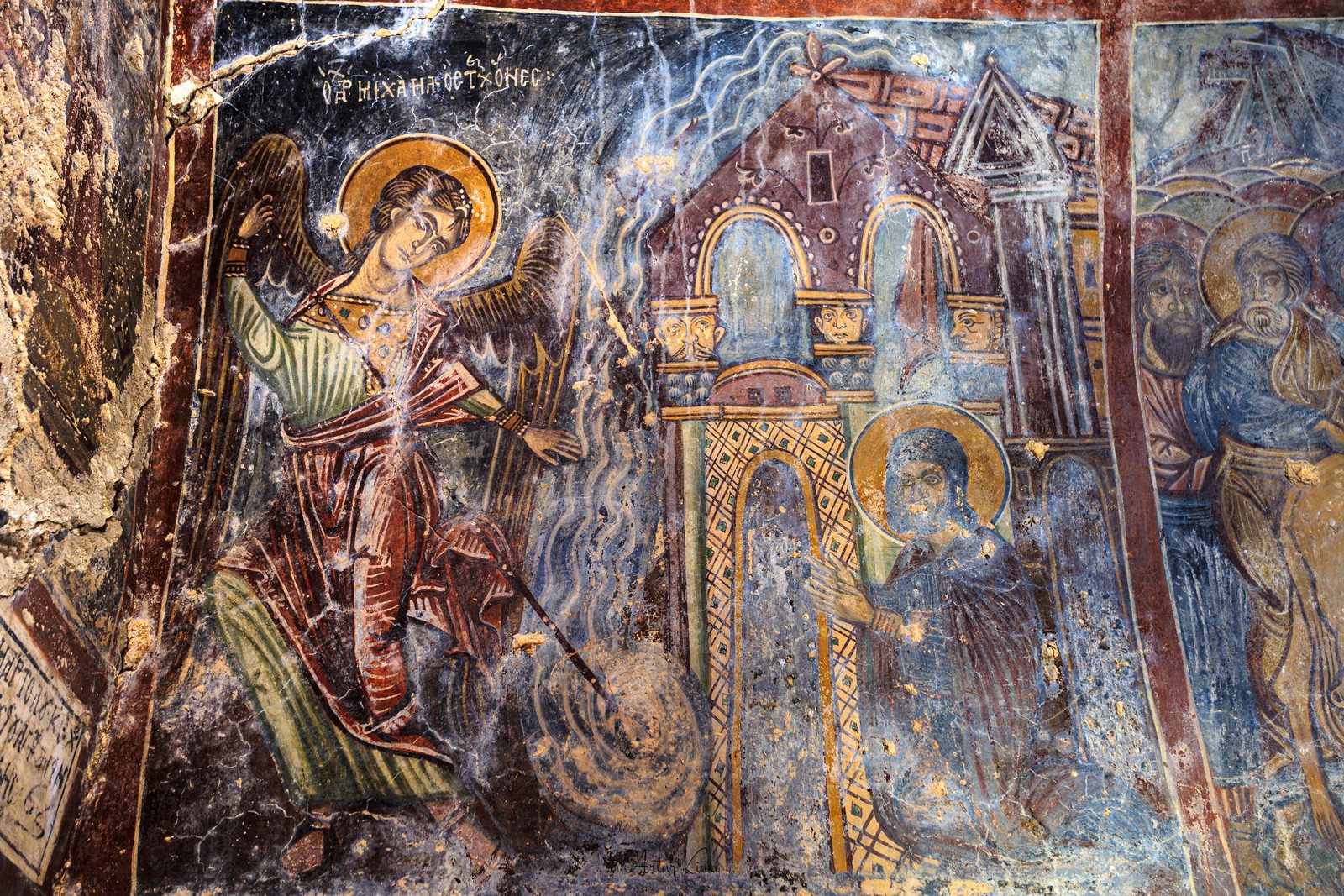
And among those thirteen scenes there is one genuinely rare image: the Miracle of Archangel Michael at Chonae, in Colossae in Phrygia. According to the legend, there was a sacred spring there which pagans attempted to flood by diverting the waters of two rivers towards it. Michael struck the rock with his staff, opening a cleft and sending the waters underground, thereby saving the sanctuary. The painter from Kouneni depicted only one river instead of two. The same simplification appears in the painting at Gračanica from 1321 and on an icon from the Loverdos Collection dating from the turn of the thirteenth and fourteenth centuries. So this was not some random shortcut taken by a careless craftsman, but a variant circulating through the Byzantine world at a particular moment and in a particular form — and this very variant happened to reach this tiny village in western Crete.
Above the entrance door there once ran a large dedicatory inscription across the full width of the western wall, and that was precisely where the date was located. During some repair of the wooden lintel, that particular section was destroyed — the most important part of the entire inscription. For decades, the church therefore had to be dated comparatively: the iconographic type of the Hypapante, still showing Christ in the arms of Mary, which according to Xyngopoulos’ classification does not occur after the fourteenth century; the same variant of the Miracle at Chonae as in Gračanica; and a painting technique similar to that of dated monuments in western Crete, including works by Pagomenos himself from the years 1313–1331. Lassithiotakis therefore placed the paintings, broadly speaking, in the first quarter of the fourteenth century, without a more precise date, because there simply was nowhere to get one from.
And that is how things would have remained, had it not been for Theodora Ioannidou, who in 2018, while re-reading the remains of the damaged inscription, found something no one had noticed before. The signature: “Παγωμένου καὶ τοῦ υἱοῦ αὐτοῦ Νικολάου” — “of Pagomenos and his son Nikolaos”. This is the only known case in which the workshop of Pagomenos explicitly declares a father–son relationship in the signature, rather than merely naming two painters working together. The year, reconstructed from the surviving indiction and a graffito on the exterior lintel: 1336/37.
So half a century of speculation about “the first quarter of the fourteenth century” ended with a single precise reading, and at the same time revealed something Lassithiotakis had no idea about: that this is the work of a family workshop, not merely of some anonymous “circle of Pagomenos”. Father and son, painting a little church together for a village that had already built itself another church half a century earlier. I will write about that second one here as well — older, and today much more heavily damaged — because it has a story of its own, and one that is no less interesting.