 Church in the catalogueChurch of Saint GeorgeView catalogue entry →
I'd like to take you today on a long journey — a journey not only in the geographical sense. It will be a kind of journey through time, one that traces a full circle.
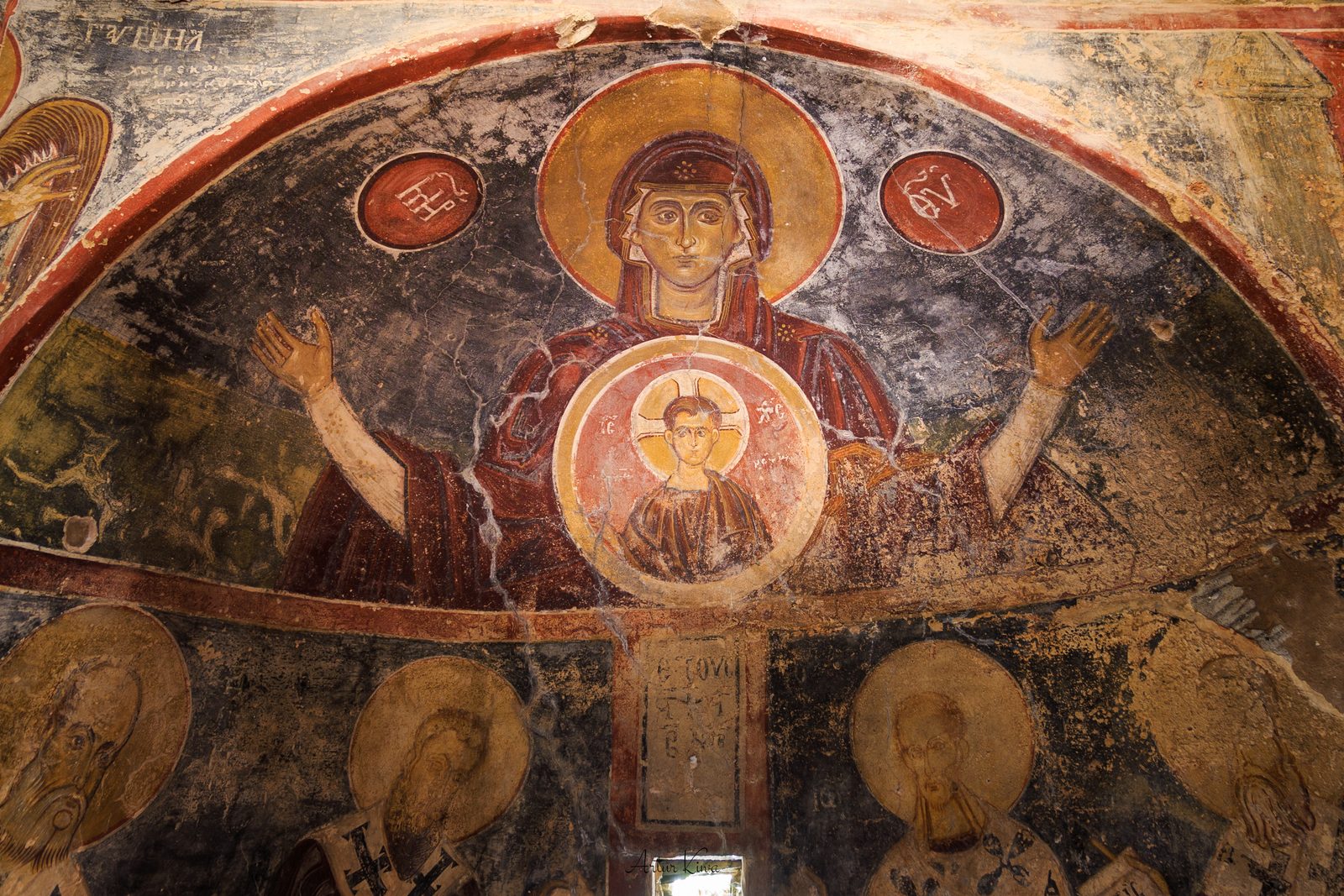
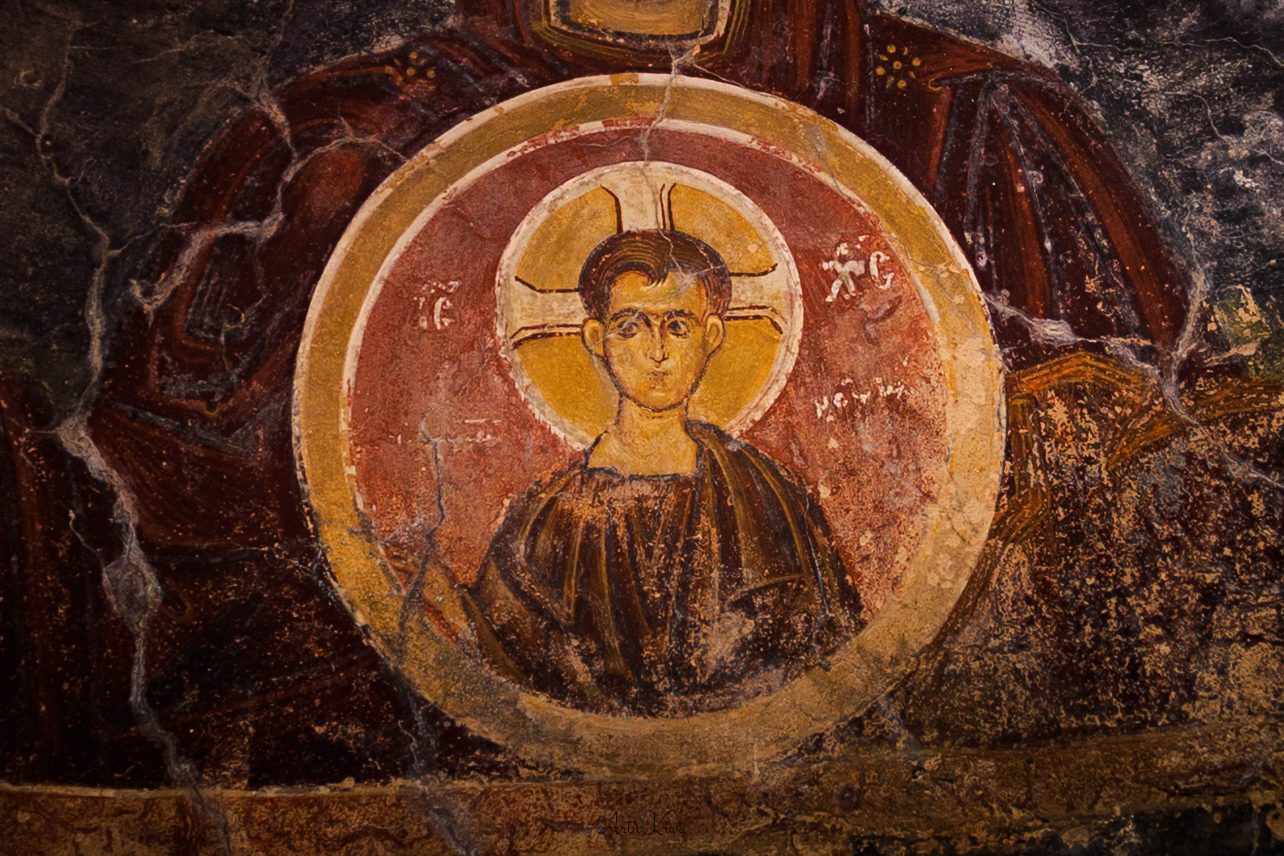
It all begins in a small church in a forgotten corner of the Cretan interior. In an apse where the image of the Mother of God in the Orant type has survived in excellent condition. In the small roundel on her chest, an image of a young man. I won't keep you in suspense — it's Christ, but not an ordinary one. He is called Emmanuel, and the name alone is, in essence, half of the story I want to tell today.
Before we turn to the name itself, though, it's worth saying what this figure in the medallion actually is — because without that, the whole later journey through Isaiah and the Septuagint hangs in a void. Yes, it's Christ — he's even labelled, with nomina sacra and a cruciform halo. But...
This isn't simply a "little Jesus" painted as an ornament on the Mother of God's chest. It is a visual representation of the mystery of the Incarnation and of Christ's divine identity — the Word spoken of in the Prologue of John's Gospel: "In the beginning was the Word, and the Word was with God, and the Word was God" (John 1:1), and further on: "And the Word became flesh and dwelt among us" (John 1:14).
The Greek term Logos (Λόγος) carries far more than "word" in its everyday sense. It came with a long philosophical history behind it — from Heraclitus to the Stoics, who used it, among other things, to denote the rational principle ordering the cosmos — but John's Prologue also grows out of the Jewish tradition: out of the idea of God's creative Word, out of biblical Wisdom, sometimes portrayed almost as a person, and out of the whole world of Hellenistic Judaism. The author of the fourth Gospel weaves these traditions into something new: the Logos is not an impersonal principle of the world. He is a Person — the eternal Son, who existed "in the beginning," before anything had yet been created, and who at a particular moment in history became flesh.
And this is precisely the heart of what we see in the medallion on Mary's chest. We are not looking at a portrait of a child in the womb, nor is this an attempt to depict some specific stage of pregnancy. It is a theological shorthand rendered in image. The one Mary carries is the same Logos who, according to John's Prologue, was "in the beginning."
The face is young, but not childlike in the sense of an infant. This isn't about biological realism, but about a theological message: "The one you carry existed before you began to carry him." Emmanuel on the chest of the Theotokos is thus not an illustration of pregnancy, but a visual theological statement, of exactly the same kind as the name itself, "God with us" — only translated from language into image.
Let's begin, then, with the name — and it is no ordinary proper name. What we have here is a grammatical construction, directly translatable: the Hebrew עִמָּנוּ אֵל (immanu El), literally "with-us God."
And here is the first thing worth pausing over: this is a theophoric name — one that, in its very structure, carries the name of God. The ending -el (אֵל, El) is one of the oldest Semitic theonyms, used both as a general term for "god" and as the name or title of a deity. In the Canaanite world, El was the supreme god of the pantheon, while in the Hebrew tradition the term became one of the designations for the God of Israel.
Hence the whole family of biblical names containing this element, names that sound familiar to us today mainly as the names of archangels and biblical heroes, but which are, at bottom, theological statements sealed inside a single word: Michael — "who is like God?", Gabriel — "by the strength of God" or "man of God," Raphael — "God has healed," Daniel — "God is my judge," Israel — "he struggled with God" or "God struggles." Theophoric names were no exception in ancient Israel. They were part of ordinary naming practice, in which a person's name could simultaneously be a brief confession of faith.
But Emmanuel is exceptional even against this backdrop, because it appears not as an ordinary name given to a real child at birth, but as a prophetic sign.
The context in the Book of Isaiah, chapter 7, is very concrete historically. King Ahaz of Judah, facing the threat of a coalition of Aram and Israel during the so-called Syro-Ephraimite War, around 734 BC, receives from Isaiah a promise-as-sign: before the child who is to be born of an almah (עַלְמָה) manages to "know how to refuse the evil and choose the good," the political situation will change radically, and the threat from the two hostile kingdoms will cease to exist.
The child's name is to be precisely Immanu-El — "God with us." In the original context of the prophecy, this is above all a sign for people living through a specific political crisis: an assurance that God has not abandoned Judah.
And here we arrive at one of the most fruitful — and most contested, in the history of exegesis — moments of translation.
The Hebrew almah means a young woman of an age suitable for marriage and motherhood; it does not in itself necessarily mean a virgin in the strict sense. Hebrew also had the word betulah, whose meaning is much more strongly tied to virginity.
Yet when, in the Hellenistic period, Jewish translators rendered Isaiah into Greek, in the Septuagint they used the word parthenos (παρθένος). Its primary meaning is bound up precisely with virginity, and in the Greek version of the text the emphasis on virginity becomes considerably clearer than in the Hebrew almah.
Whether this was a conscious theological choice, or simply, for the translator, the most natural Greek equivalent of the Hebrew term — this we cannot determine with certainty today.
And since we're already on the subject — I must make this digression, because without it the picture would be incomplete — it's worth noting how far, within the Christian tradition, the consequences of this reading of Isaiah reached.
The Greek parthenos became one of the important textual foundations of the Christian interpretation of Christ's virginal conception, and through that, one of the elements of the later Marian tradition. It does not, of course, explain the whole of Mariology, and one cannot derive all the later dogmas from a single word — but its significance for the development of the Christian way of reading Isaiah is hard to overstate.
The three stars on the Mother of God's maphorion, which we see on countless icons — one on the forehead, two on the shoulders — are not decoration, but an encoded record of the tradition of Mary's threefold virginity: ante partum, in partu, post partum — before birth, during birth, and after birth.
The title Theotokos, literally "She who gave birth to God," which found its dogmatic confirmation at the Council of Ephesus in 431, in dispute with Nestorius and the advocates of the term Christotokos, arose above all from the question of Christ's own identity. If Jesus Christ is one person and is truly God, then Mary did not give birth merely to a human being with whom the divine Logos was later, somehow, joined. She gave birth to the One who is God.
It is the same mode of thought, only transposed from the Son onto the Mother: if Christ is the eternal God, then she who bore him bore God, not merely a man.
And Byzantine painters, with their customary freedom regarding chronology, sometimes labelled Mary with this very title already in scenes of her own birth — before she had yet given birth to anyone at all. But that is another story, for another evening.
Let us return, then, to Isaiah himself.
The consequences of the translation decision are enormous: it is the Greek version of the text, not the Hebrew almah, that became the foundation on which the author of Matthew's Gospel builds his reading of Christ's birth as the fulfilment of Isaiah's prophecy.
In Matthew 1:23, he quotes Isaiah 7:14 precisely in its Greek wording, with parthenos, and applies an old sign, rooted in the political realities of the 8th century BC, to an entirely new Christological context.
So before we even reach the painting itself — that young, beardless face in the conch of the apse at Vathi — we already have a dense theological knot assembled: a name that is a sentence; a sentence that is a political promise; a promise that, through translation, is opened up to a new reading; and a text that, eight hundred years later, will be read by the author of Matthew's Gospel as a foretelling of Christ's birth.
And many centuries later still, all of this will be sealed into a single face, painted on the wall of a Cretan church.
This is precisely the thing that fascinates me most about iconography. It is the trail that leads me from a Cretan backroad, through the meanders of history, all the way to the very beginning. It leads to the prophets, to the Septuagint, to the nuances of translation — only to return, in the end, to the simple image of a young man, hidden somewhere in the apse of a forgotten village church.
This painting waited for me for more than 700 years. Now I can stand before it and, literally, physically, touch history with my finger.
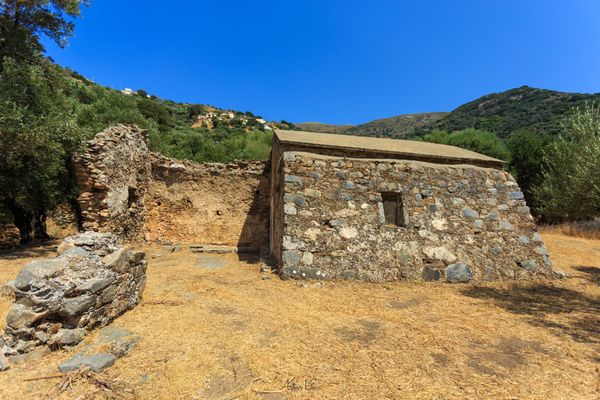
The fresco is located in the Church of Saint George in Vathi.
Bibliography Biblia Hebraica — Book of Isaiah, ch. 7 Septuagint (LXX) — Book of Isaiah, ch. 7 Gospel of Matthew 1:23 Ouspensky, Leonid — Lossky, Vladimir. The Meaning of Icons. Crestwood, NY: St. Vladimir's Seminary Press, 1982. Schiller, Gertrud. Iconography of Christian Art, vol. I–II. London: Lund Humphries, 1971–1972.