7 September 2025 · Artur Kiwa
Anisaraki, Church of Saint Anna
One of the most remarkable churches in Selino in terms of its iconographic programme.
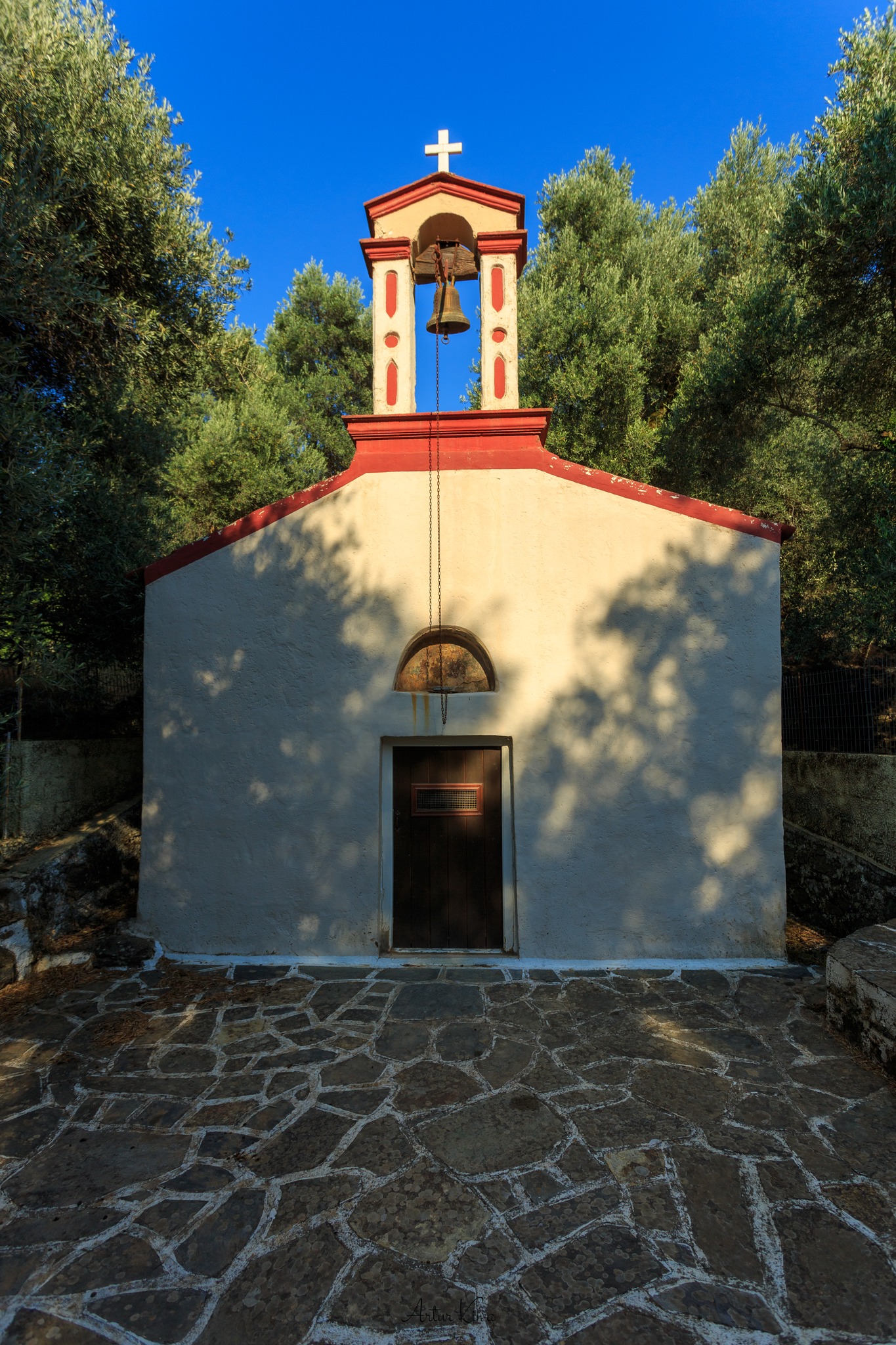
When this church was being built, Europe was facing one of the greatest catastrophes in its history. The Black Death, which reached Sicily in 1347 on Genoese ships from Crimea, swept through the continent with a speed and ferocity that no one could have predicted or understood. Within a few years, a third of Europe's population had perished. In Poland, Casimir the Great was consolidating his kingdom and codifying its laws, building a state that would endure for centuries. In France, the Hundred Years' War was already underway — the English and the French bleeding each other dry, while the plague killed on both sides without distinction. In Byzantium, John VI Kantakouzenos was fighting a civil war against John V Palaiologos, not yet knowing that the empire he was struggling to preserve had barely a hundred years left. In the Balkans, Stefan Dušan was building a Serbian empire that at its peak stretched from the Danube to the Peloponnese — and which would collapse as swiftly as it had risen.
Across the ocean, the Maya and the Aztecs were developing their calendars, temples and rituals, unaware of Europe's existence. In China, the Ming dynasty had yet to displace the Mongol Yuan, while in Persia the tradition of Rumi's mystical poetry — the poet had died barely a century earlier — was still very much alive. And here, on Crete — an island that had been under Venetian rule for over a hundred years — a small church was being built, plain and stone, in the tiny settlement of Anisaraki, among fields and olive groves. It was the year 1352.
Frescoes and iconographic programme
Looking at the interior today, we see a space that is small — less than twenty square metres — but filled with extraordinary consistency. The church is single-nave, barrel-vaulted, with no dome and no side aisles. Two blind arcades in the north and south walls slightly widen the interior, giving it a sense of breadth one would not expect from so modest a structure. The altar screen commands attention — built of masonry and painted, one of the very few surviving examples of this type on the whole of Crete.
The iconographic programme is exceptional. The western half of the vault is given over entirely to the childhood of the Virgin Mary — seven scenes, from her birth to the Presentation in the Temple, with no interruption for Gospel subjects. The sole exception is a Crucifixion in the tympanum of the western wall. This is a rare, almost unparalleled choice for a single-nave Cretan church — and it is not accidental. Because here, the protagonist is not Mary. It is Anna.
Every scene in this cycle is composed so that Anna occupies the central position. It is she who leads the procession at the Presentation in the Temple, walking ahead of everyone else. It is she who dominates the Nativity scene — so completely that the painter inscribed it Η ΓΕΝΗΣΙΣ ΤΗΣ ΑΝΗΣ, the Birth of Anna, not the Birth of Mary. The exile of Joachim bears the title Η ΕΞΟΡΙΑ ΤΟΥ ΙΩΑΚΕΙΜ — a formula unattested elsewhere in monumental painting, most likely the painter's own invention, dramatising the pain of separation and preparing the viewer for the joy of return. Even in scenes where Anna plays a secondary role in the liturgical order, she is visibly placed higher than the other figures — literally, in paint — as if the church itself were her portrait.
The frescoes were executed by two painters, established through stylistic and technical analysis. Both belonged to the school or circle of Ioannis Pagomenos, a fourteenth-century painter whose signed works survive in a dozen or so churches of western Crete. The first, the more accomplished and mature of the two — probably one Nikolaos, a close associate of Pagomenos — was responsible for the altar screen and the sanctuary. His figures are harmonious, well-proportioned, modelled with an almost naturalistic precision. The second painter, more vernacular in character, executed the Anna cycle and the Galaktotrophousa fresco. His seated figures can be almost cubist in their solidity; his standing ones are flat and somewhat ungainly, as if balancing on disproportionately large feet. This is not a criticism: it is a recognisable, coherent style with its own expression and its own tension.
Anna Galaktotrophousa
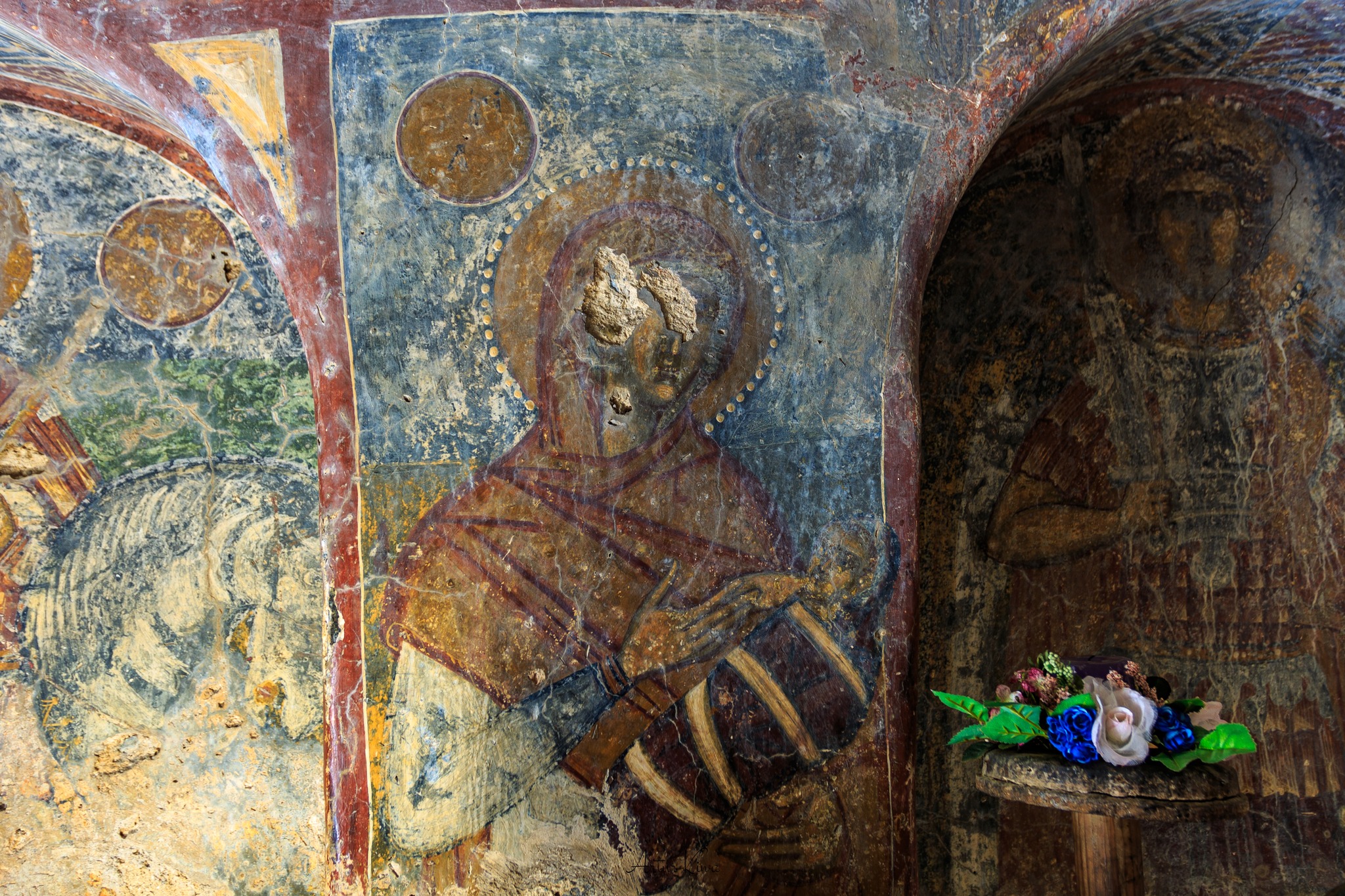
Yet Anisaraki contains something further — a fresco that makes this church remarkable even by the standards of the wider Byzantine world. Placed low on the north wall, opposite the Christ Pantokrator, we see a depiction of Saint Anna nursing her daughter, the Mother of God, at the breast.
The motif of Anna Γαλακτοτροφούσα is among the rarest in the entire iconographic tradition of the Christian East. Hirofumi Sugawara, who catalogued the surviving images of Anna created in the iconography of the Virgin and Child, counted just five certain realisations of this subject in monumental painting across the entire Byzantine world — from the Macedonian church at Kurbinovo in 1191, through the Bulgarian Veliko Tărnovo of 1230, the chapel of Saint Stephen in Kastoria, the Macedonian Bogorodica Zaumska, and finally Anisaraki. Each of these frescoes is different; each resolves the same theological problem in its own way.
The problem is a real one. Anna nursing Mary is a motif with no foundation in any canonical text. Its source is the Protoevangelion of James, an apocryphal text that describes how the six-month-old Mary took her first steps and returned to her mother's breast, whereupon Anna sang a hymn of thanksgiving. Here lies the theological weight of the image: miraculous milk from aged, barren breasts is proof of divine action — a visible sign that heaven has answered prayer. This is not an image of maternal tenderness as such. It is an image of miracle made flesh in a gesture.
The Anisaraki fresco is distinguished from all other surviving examples by the posture of the child. In every earlier example, Mary is seated or held upright. Here she lies horizontally in her mother's arms, settled peacefully and comfortably, nursing with her face turned towards Anna. This is an iconographic novelty, unattested elsewhere — and, as Thetis Xanthaki has observed, most likely reflecting the painter's direct observation: this is simply what a nursing infant looked like in a fourteenth-century Cretan village. The sacred and the everyday meet in a single gesture.
Anna is depicted in a red maphorion, with a face younger than on the altar screen, where the same painter showed her as a middle-aged woman with pronounced wrinkles. This is a deliberate contrast within a single programme: the different images of Anna correspond to different moments in her life. Anna's eyes have been deliberately scratched out at some point in the past — a gesture repeated in many Cretan churches and whose reasons remain a matter of discussion.
In the same church, Anna appears twice more: as Vrephokratousa, holding the infant, on the altar screen inside — and in the same role on the blind arch above the entrance, on the outside. Three images in one small chapel. A concentration found nowhere else in Greek ecclesiastical painting.
Knowledge and the world
While the painter in Anisaraki was mixing pigments with lime, the learned world still believed the Earth to be the centre of the cosmos and the human body to be governed by Galen's theory of the four humours. The Black Death, then ravaging Europe, was understood in common belief as divine punishment — no one yet knew of bacteria, of Yersinia pestis, of fleas and rats as vectors of disease. Gutenberg had not yet been born, so all books were made by hand, in monastic scriptoria. Copernicus would not be born for another hundred years, Galileo for over two hundred. The telescope, the microscope, the printing press — all of it still lay in an unimaginable future. Yet what seems to us like darkness was for them a fullness: images, song, liturgy — an entire world of symbols that bound the community together and gave meaning to life, death and plague.
Endurance
Agia Anna still stands today — a small stone church in which the silence carries the weight of centuries. Its frescoes, faded as they are, bear within them the echo of voices from seven hundred years ago. Looking at them, it is worth remembering that when they were painted, Columbus would not sail west for another hundred and forty years, Copernicus had yet to be born, and the circumnavigation of the globe — completed by Magellan only in 1522 — lay entirely beyond imagination.
And yet this church endures. As if to say: life passes, powers fall, plagues burn out, empires rise and crumble — but the trace left by a person who laid stone upon stone and painted a saint may remain for centuries.
We are — if not the last, then one of the last generations that can see these frescoes in person, in the half-light of small churches. The lime cracks, the colours fade, the walls subside in silence, and time is without mercy. What was the everyday world for people of the fourteenth century is for us already almost a miracle — fragile and impermanent. Every visit to such a church is an encounter with a past that is dying before our eyes.
These are not merely stones and paintings. They are witnesses to history, silent though they saw everything: the Venetians, the Turks, wars, uprisings, and finally contemporary indifference. Every flake of fallen plaster, every forgotten chapel is the loss of something that cannot be recovered.
And so today, standing before Agia Anna in Anisaraki, one must be aware that we are looking at something unique, unrepeatable. Something that dissolves in time like a dream — and yet for a moment we can be part of it. Perhaps that is precisely why it has been given to us: so that we might manage to see it and remember it, before it disappears for ever.