4 July 2026 · Artur Kiwa
The Stranger. Eight Foundations That Left Their Mark on Crete
The story of a saint who did not build churches and did not perform miracles. He built communities that survived for a thousand years.
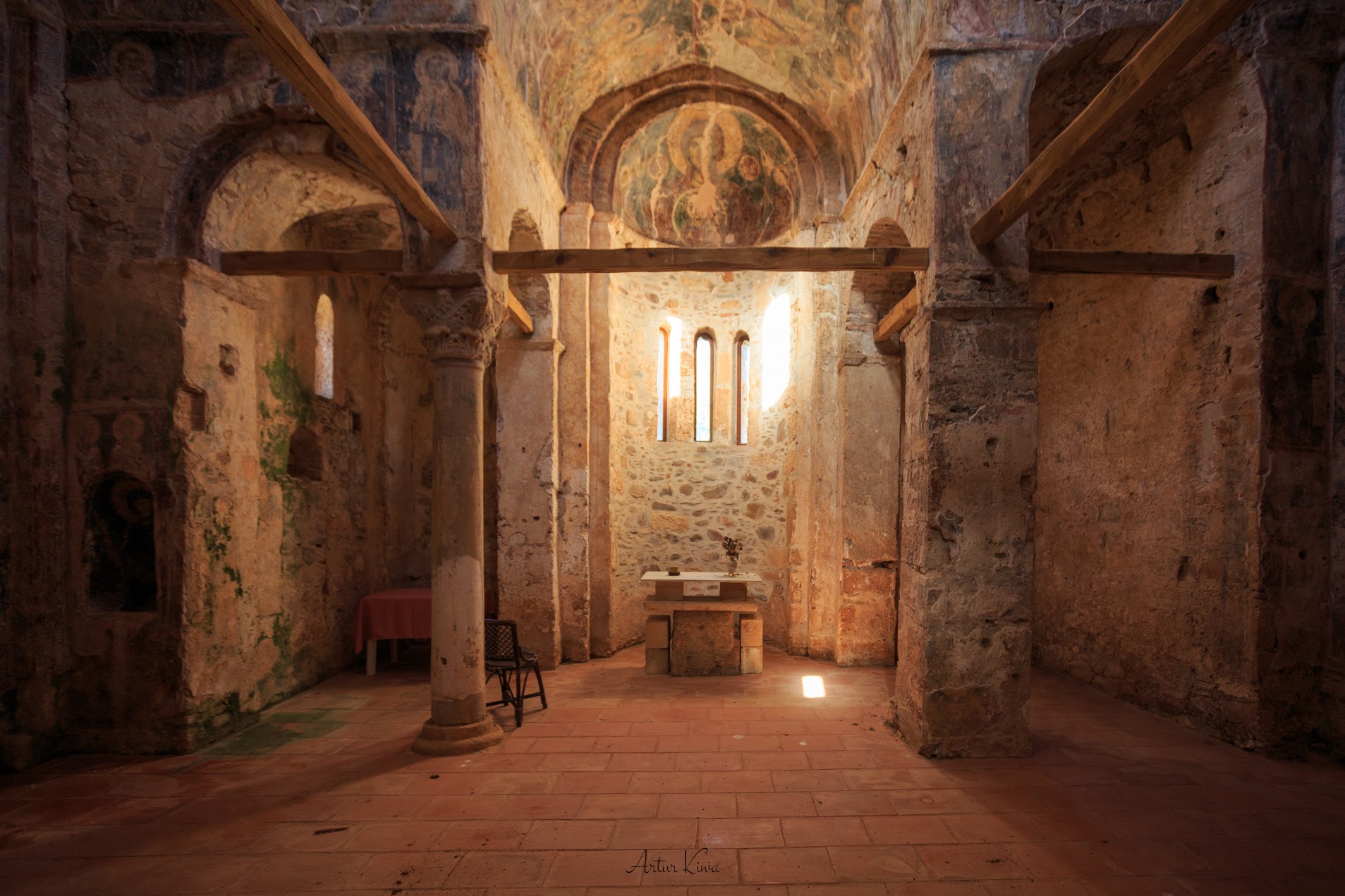
Before I can even begin the story of the man, I have to tell you about the island. Because this is where everything began.
You are driving along a road that seems as though it will never end. It snakes between the rocks, slowly climbing the mountainside. Somewhere among the boulders, goats are watching you, glaring from under lowered brows and saying nothing. At the end of that road, where the map shows nothing but empty space, untouched even by the thinnest lines marking roads, there stands a church. Or rather, what remains of its former glory. There is nobody around. No village, no settlement, no sign. Maybe five people live here during the season.
A mundane question comes to mind: who built this?
No. That is too polite. Those are the kinds of questions you ask in a museum. Our question is rather different.
Why are there so many churches on Crete?
Not three — you only have to stick your nose outside the hotel to know that is not true. Not thirty, either. Hundreds upon hundreds. In fact, the number is closer to a thousand. Lassithiotakis counted exactly 865 in his catalogue — Byzantine and Venetian combined. And those are only the ones that survived long enough for someone to record them before they crumbled away or disappeared beneath the vegetation. Scattered across mountain slopes, built in inaccessible gorges, on mountain passes, on the seashore. In places that today require a decent off-road vehicle to reach, while a thousand years ago you had to walk. And walk for a long time.
The obvious answer suggests itself: because Greeks are religious.
And yes. They are. Except that this answer does not actually answer the question. Worse still, it gives rise to another hundred questions, because why are they? Poles are religious too. So are the Irish. But that tells us nothing beyond stating a fact.
Religiosity alone does not explain why, a thousand years ago, someone decided to build a tiny church in the middle of nowhere. And, for good measure, chose a location so inaccessible that even today you cannot get there by car, no matter how good the car is. I know, someone is about to say that you can walk there. Of course you can. But why is it there? Why, in such distant times, would anyone build a church on a rocky ledge or by the sea, kilometres from the nearest human settlement? Why right here, rather than a little farther away, somewhere more convenient, closer to water, closer to a road? Something — or someone — must have decided otherwise.
The year is, let us say, 970. Crete is a wound only just beginning to heal. Less than a decade earlier, Nikephoros II Phokas had recaptured the island from the Arabs — one hundred and thirty years of Islamic rule had ended in blood spilled beneath the walls of Chandax. The island is half empty, half burned, forgotten by an empire that is only now beginning to remember it again.
Around this time, in the village of Siva (Σίβα) in the south of the island, a boy is born into a wealthy family. They will call him Ioannis. But history will remember him by another name: Xenos. The stranger. Someone who is not from here. The outsider.
We know nothing about his education — the sources are silent, and where they do suggest anything, they point more towards simplicity than erudition. What we do know is what he did: he left everything he had and began to wander.
Xenos kept away from people. He did not seek company. He wanted mountains, silence, a cave, solitary prayer. In the course of his wanderings he eventually reached the area around Rethymno, where — as he would later record in his own account of his life — two saints, Eutychios and Eutychianos, appeared to him in a dream and told him to build a church for them. He did. It was the first of his churches, his first foundation. The first of many.
And this is where something begins that makes this story worth telling.
People find him anyway.
He calls them φιλόχριστοι — philochristoi, “those who love Christ”. It is the term he himself uses in his testament for the nameless crowd that surrounds him wherever he stops. He wants to be alone. To pray in silence. And they come. First two. Then ten. They buy land for him. They bring animals. They help him build. They will not leave him alone — he himself would later write that they did not even let him rest.
This is the heart of the story: a man who spends his entire life fleeing from community, while community follows him like a shadow he cannot shake off.
You might be thinking, dear reader: big deal, the guy built churches. Thank you, goodbye, nice story, but I have some paint drying that I need to watch.
Well, no.
Building things is the least important part of this story. I mean sacred architecture, of course, because John was building something far more important, something monumental. You cannot see it yet, but in a moment we will see it together.
There is surprisingly little romance in any of this. He does not begin with a church. He begins with land. Then he leaves a man behind to remain there. Then comes a garden. A vineyard. At one of his foundations, his philochristoi bring him one hundred and fifty beehives. One hundred and fifty. Not bees. Beehives. I admit I went back to the Greek text because I was convinced I had misread it. But no. Then he puts up buildings for the monks so that — as he writes without the slightest trace of pathos — “they would have somewhere to sleep”. Only at the end does the church appear. Almost as though it were merely the crowning element of something that had already been living a life of its own for quite some time.
And only at the very end, once the foundation is alive, feeding itself and working on its own — then, and only then, does Xenos finally set out for Constantinople.
He wants a privilege. He gets more than he asks for.
From Emperor Romanos III Argyros he receives a chrysobull — annual support in gold and liturgical vestments. From Patriarch Alexios Stoudites he receives something more important: a document making Myriokephala a stauropegion. It sounds like a dry piece of bureaucratic terminology, but in practice it means one thing — the monastery ceases to be subject to the local bishop or metropolitan. From that moment on, neither the bishop, nor any local church official, nor an imperial governor has the right to demand anything from it. All that remains to the patriarch is a formal commemoration in prayer. Apart from that, the monastery governs itself — autonomous, independent, answerable only to itself.
Xenos did not ask for a protector. He asked for his community to be left alone — exactly the same thing he had fought for throughout his life, only now translated into the language of ecclesiastical law.
The church is not the project. The church is what remains once the community has already begun to live according to its own rhythm — once there are people to work the land, tend the hives, milk the goats, look after the vineyard, cook for twelve monks. Xenos did not build churches. He built communities. The church came at the end, like a signature beneath something that had already taken on a tangible form.
I am not going to describe Myriokephala. Not this time. This is not about architecture.
Myriokephala is the heart of this network — the place Xenos returns to whenever he sets out elsewhere, and from which he departs again as soon as he regains his strength. It is here, on this mountain, that he has a vision of the Virgin Antiphonetria, “She Who Responds” — and it is her name that the main church of the foundation bears. It is here, towards the end of his life, that he dictates his testament, dying and surrounded by his disciples, and it is from here — as he himself wrote — that all his other foundations are henceforth to be administered.
But what Myriokephala truly binds together is not stone. It is people. Twelve monks here, a handful somewhere else, entire villages of philochristoi who, generation after generation, sustain this network, repair its roofs, bring oil for its lamps. A network of communities, not a network of buildings — the buildings are merely what happens to remain visible today.
I do not want to turn this into a list of foundations. That is not the point. If you want to see — to feel — what this is really about, visit two places.
One is the church of Agios Pavlos on Selouda beach, near Agia Roumeli. I have written about this place before, so I will refer you to that text.
The other is the church of Zoodochos Pigi in Alikianos. The road is straightforward, access is easy, and the place is strange in every possible way. A solitary church in the middle of nowhere, surrounded by nothing but open space, orange groves and olive trees. This church is exceptional among all of Xenos’ foundations — very Byzantine in form, and large by his standards.
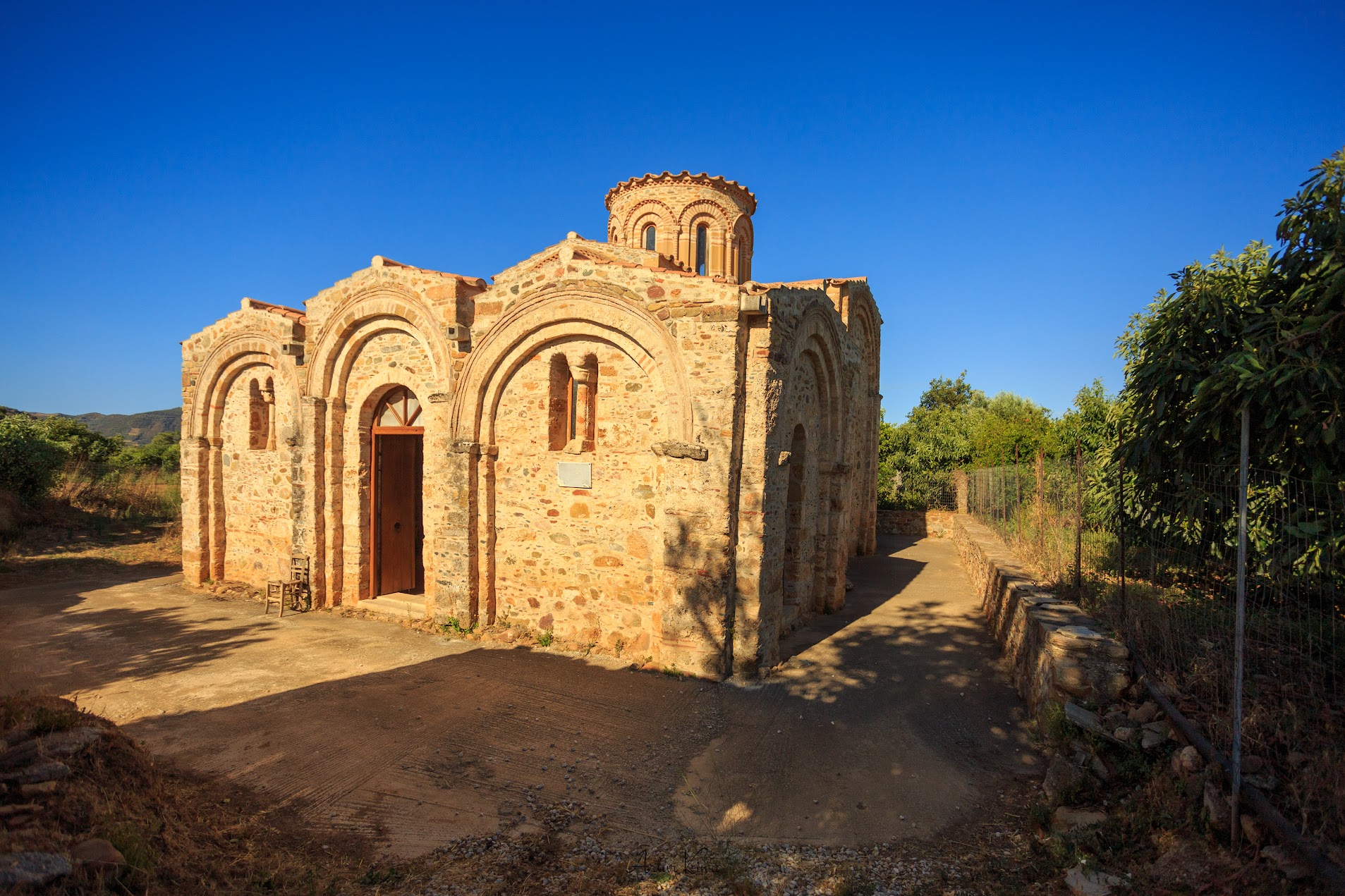
And this is a good moment to say plainly what I have only been suggesting until now: Xenos is an exceptional saint.
He does not perform miracles. There are no choirs of angels accompanying him. There is nothing in his story resembling the mysticism or fairy-tale atmosphere you know from the lives of Saint George or Saint Pelagia. And yet he left behind a work that has survived for a thousand years and remains inscribed in the landscape of Crete to this day.
The next time you find yourself driving along a road that seems as though it will never end, and at the end of it you see a solitary church, perhaps you will ask yourself a different question.
Not: who built it?
But: what kind of community must once have existed here, if a thousand years later its trace is still standing in the wilderness?
And if that is the question you ask, sooner or later you will find Xenos.
The stranger.