21 June 2026 · Artur Kiwa
A Wall Full of Names. The Monastery of Saints Peter and Paul at Cape Spatha
For nearly a hundred years, sailors, merchants and officials carved their names into the plaster of this church. Sixty-six inscriptions between 1514 and 1608. A document of movement, not of piety.
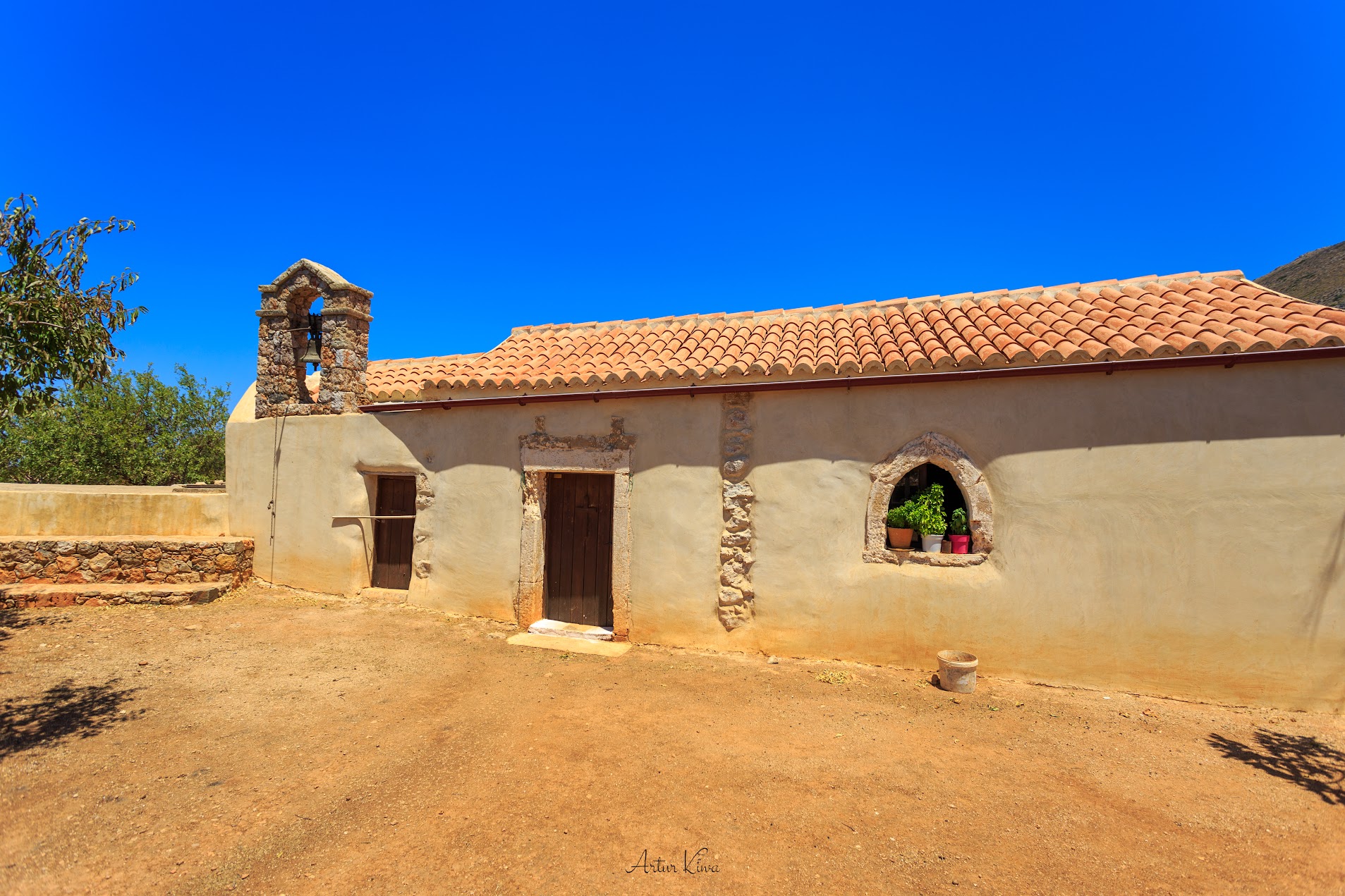
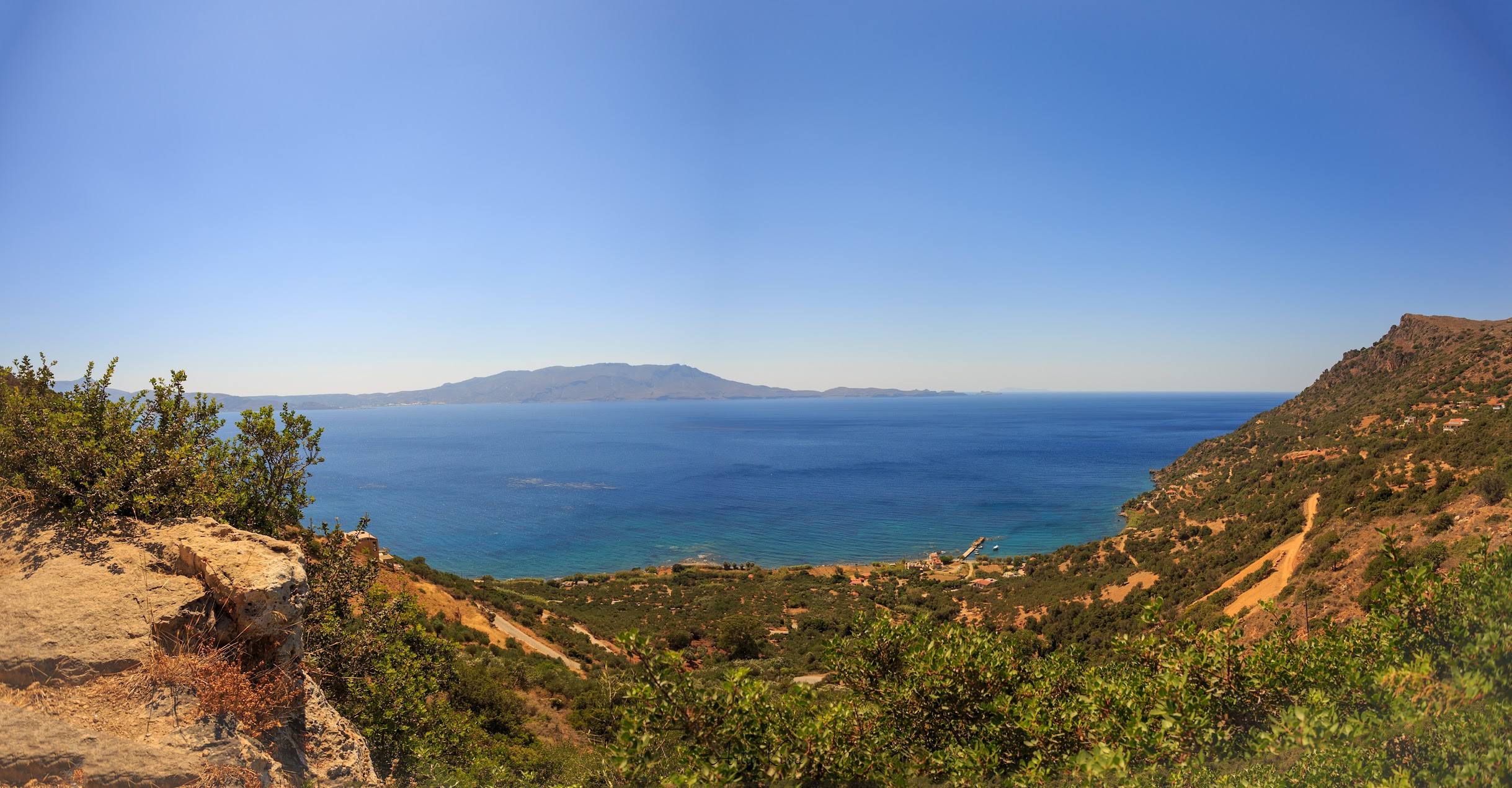
The Monastery of Saints Peter and Paul at Cape Spatha does not lie on a road, because no road leads there — at least not one you could call a road without a guilty conscience. The Spatha peninsula, that finger of land thrust into the Mediterranean to the northwest of Chania, is one of those places on Crete that successfully defend themselves against tourism. The gravel track from Rodopos does its work — after a few kilometres, most ordinary cars begin making sounds their manufacturers never intended. But if you persist, if the car survives, something awaits you that you will find in no tourist brochure. A wall full of names.
Let us start from the beginning. The monastery — for it was a monastery, though today it looks more like an abandoned farmstead — was founded somewhere in the late Middle Ages, together with the neighbouring monastery of Agios Ioannis at Gionas, a few kilometres further north. Both formed a single monastic complex that functioned throughout the Venetian period. That the monastery at Spatha was well known to seafarers, we know not from chronicles or administrative documents, but from the walls themselves. For nearly a hundred years, sailors, merchants, officials and travellers left their names here, along with dates and brief accounts of their journeys. After the Ottoman conquest of Crete in 1669, both monasteries came under the care of the powerful Gonia Monastery at Kolimbari. In the catalogue of churches and monasteries drawn up by the Venetians in 1637, the monastery at Spatha does not appear at all. Perhaps by then it was already too small, too forgotten, too far away. Or perhaps no one had bothered to make the journey with the census form.
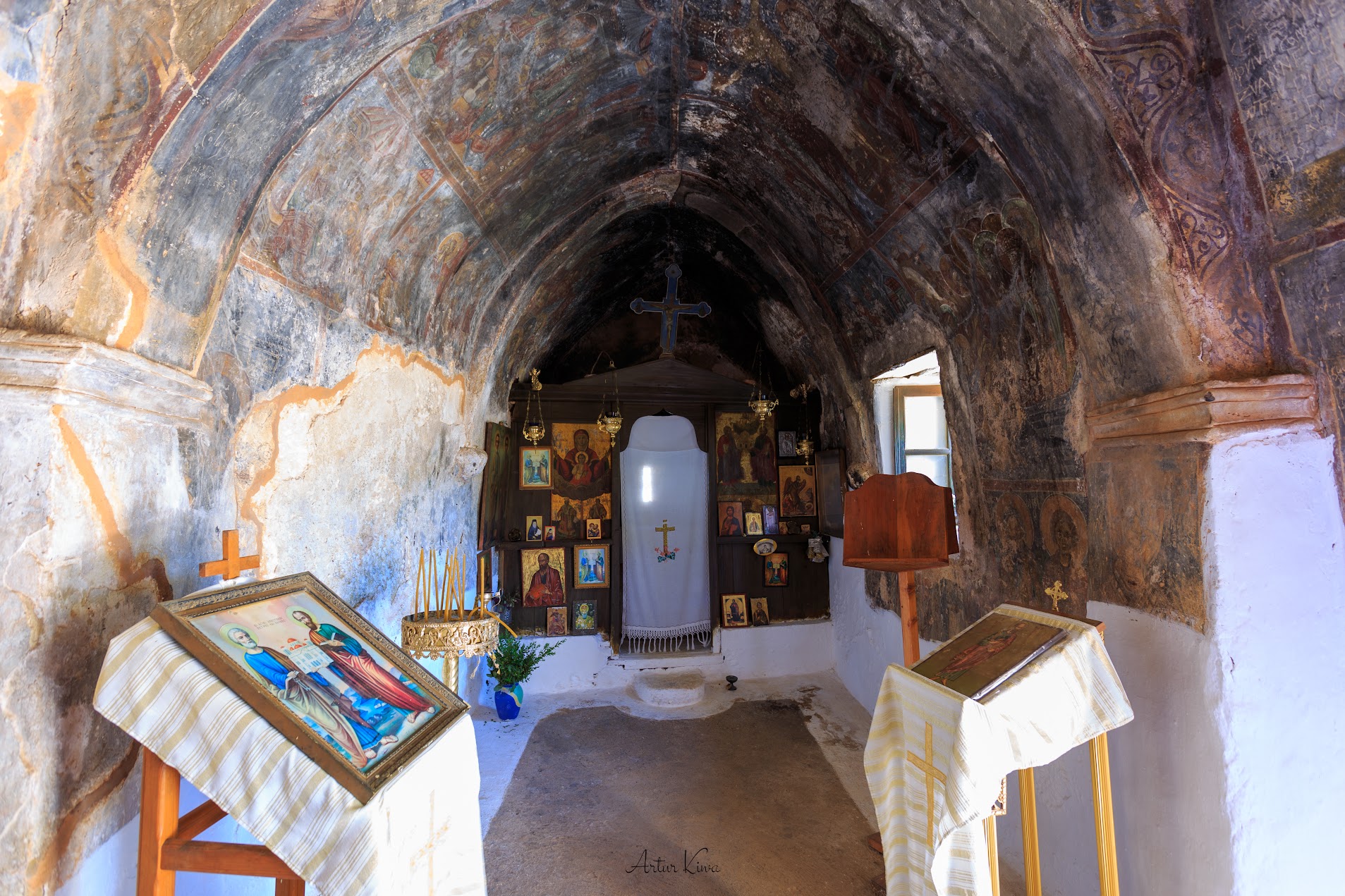
The church — the catholicon, as the main church of a monastery is called — is single-naved and covered with a vault decorated with Byzantine ceramic tiles. The frescoes survive in two layers, from two periods and in two distinct styles. The older section, in the eastern part of the church, dates from the late fourteenth century. It was painted by an anonymous artist working in the tradition of the Macedonian school. He was probably not among the most celebrated masters of his era, but he left an iconographic programme typical of late medieval Crete. The younger layer, associated with the western annex, was executed around the middle of the fifteenth century. It shows a more assured hand, greater compositional freedom and a richer repertoire of scenes.
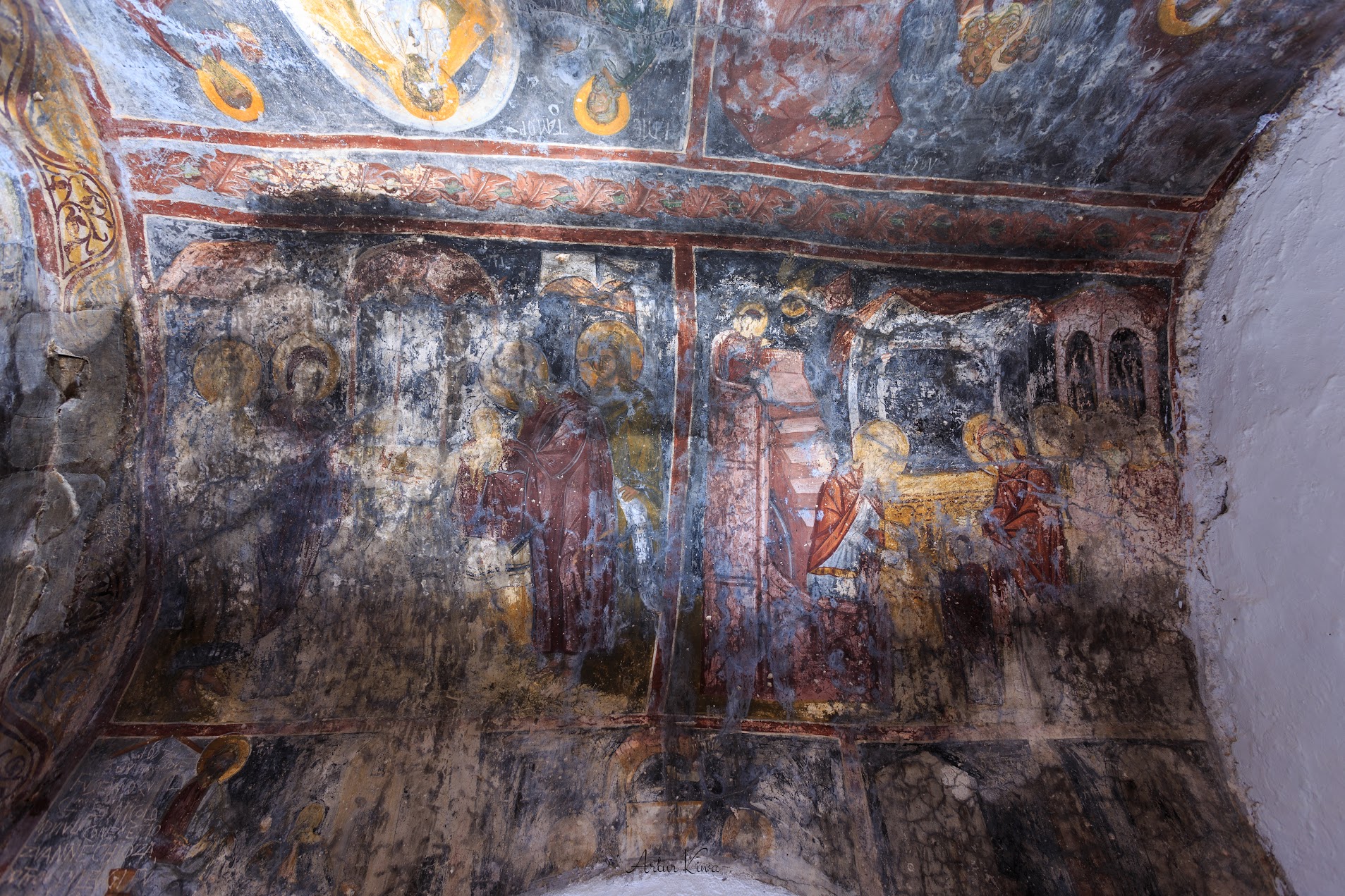
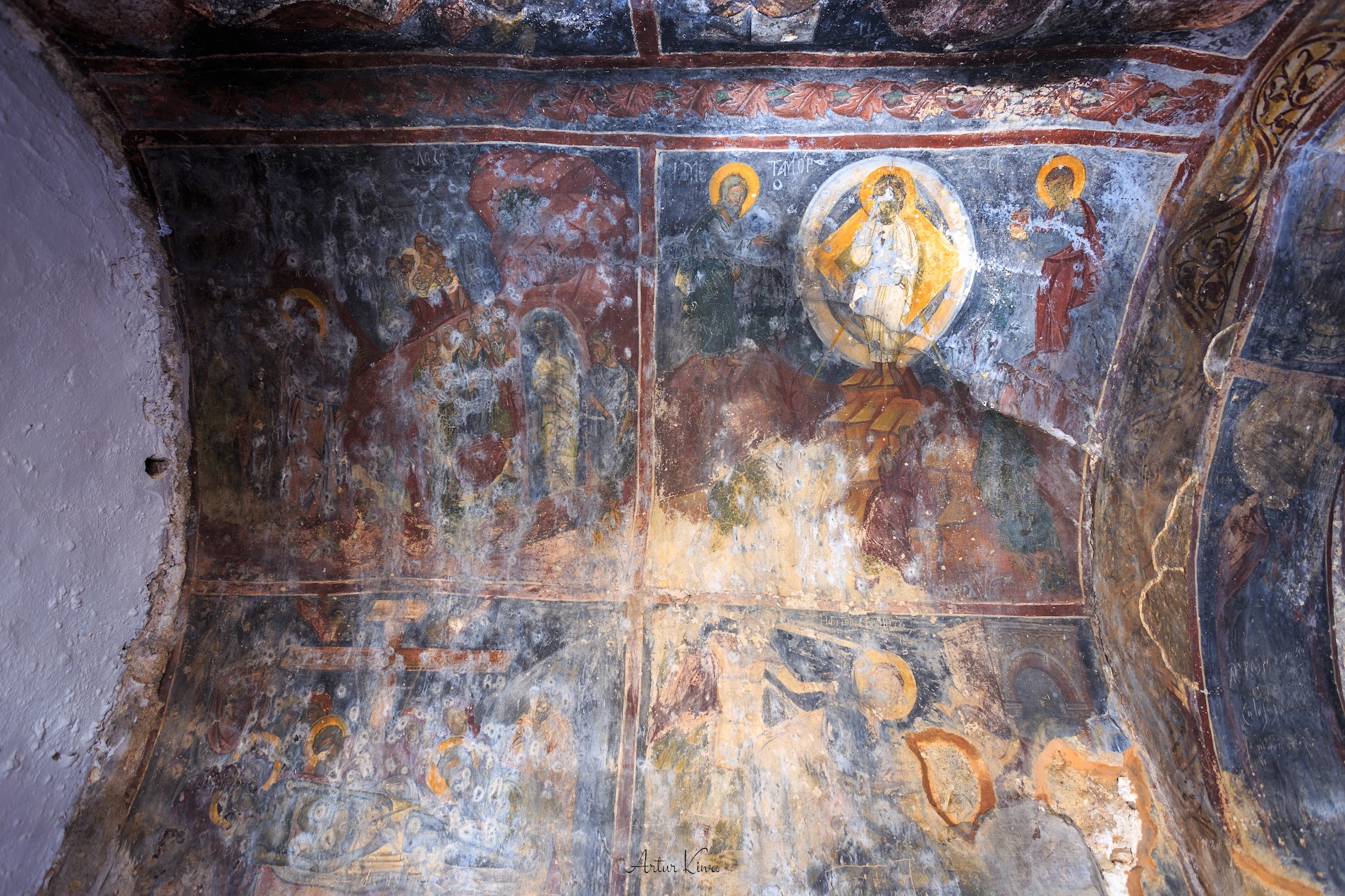
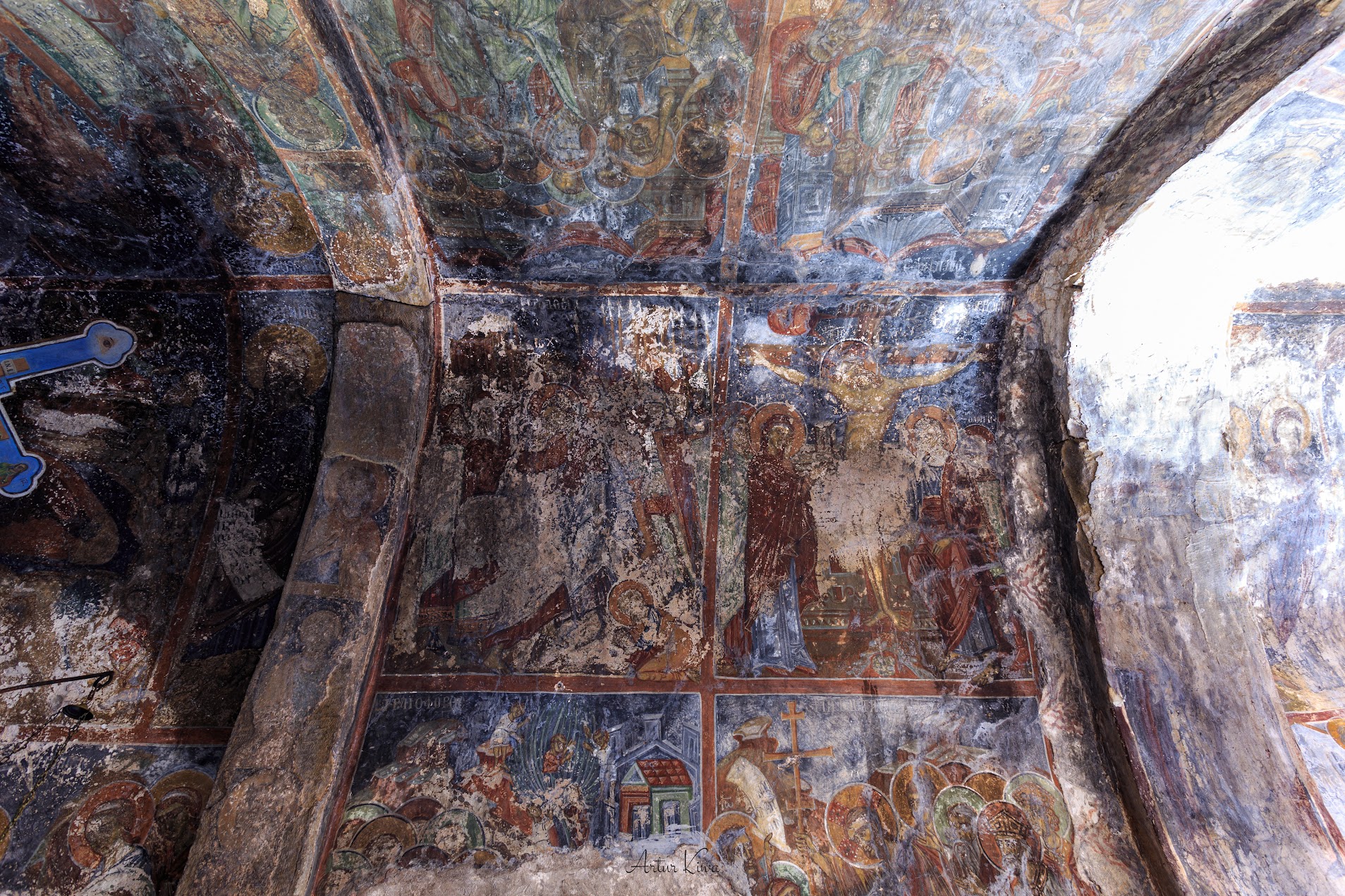
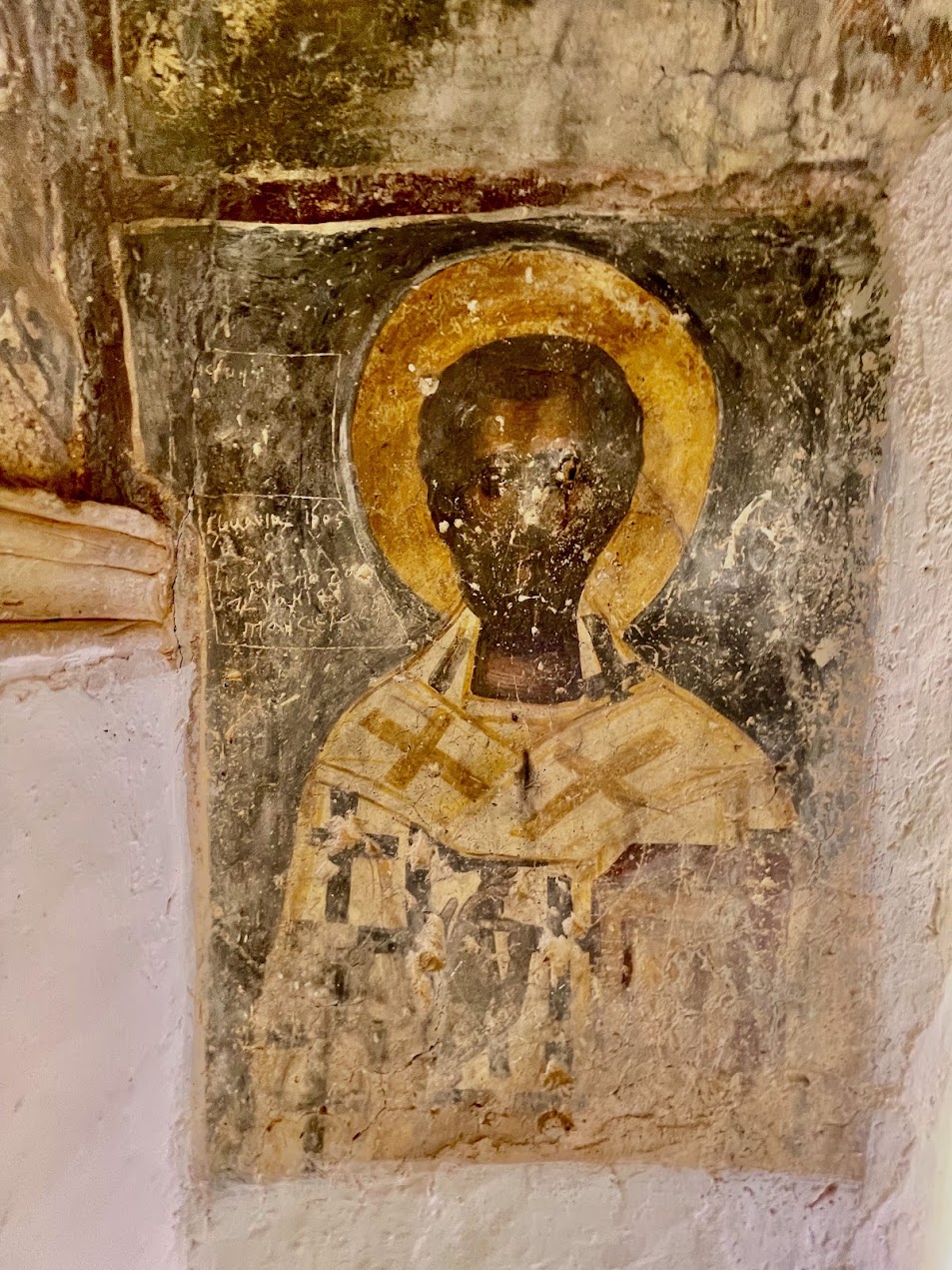
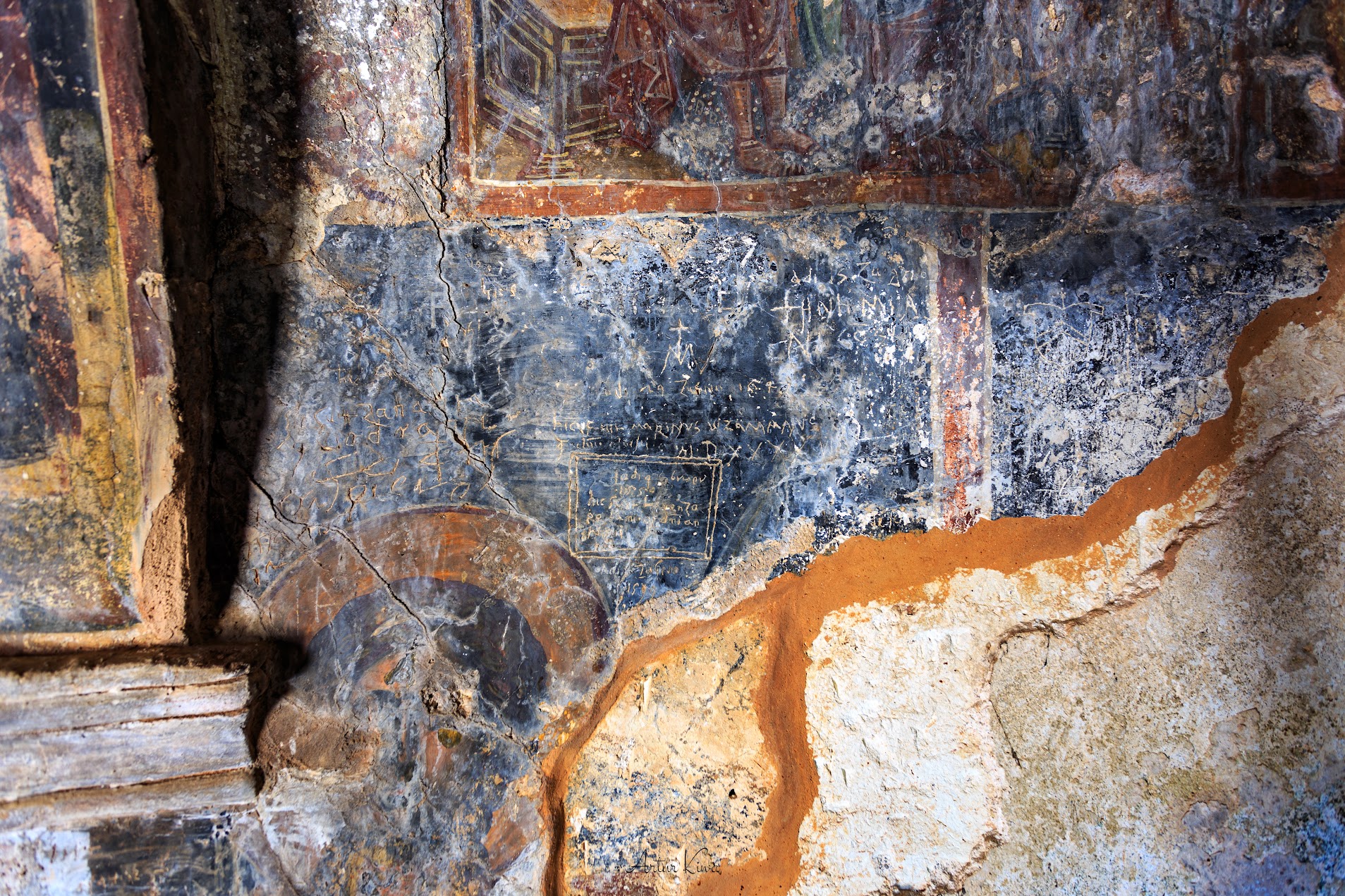
But it is not the frescoes I want to tell you about. At least not primarily. Imagine: it is 1514. A sailor — perhaps a Cretan, perhaps a Venetian, perhaps someone in between, for in this era the boundaries of identity were far more fluid than the boundaries on maps — reaches this small bay. Perhaps the wind drove him here. Perhaps he was looking for fresh water. Perhaps he wanted to pray before continuing his voyage, for beyond Spatha the open sea begins and the shelter of the island ends. He enters the church. He looks at the frescoes. And instead of simply praying, he reaches for a knife or a sharp stone and scratches into the plaster: 1514 / εγραψα εγο — I wrote this. We do not know his name. We do not know where he sailed from. We do not even know whether he was Greek, Venetian, or something else entirely. But that is enough to understand what began to happen to this wall over the next nearly hundred years. People wrote. One after another, year after year, in Greek and in Italian, in cursive and in capitals, with dates and without, with names or only initials. Sixty-six inscriptions in all, between 1514 and 1608.
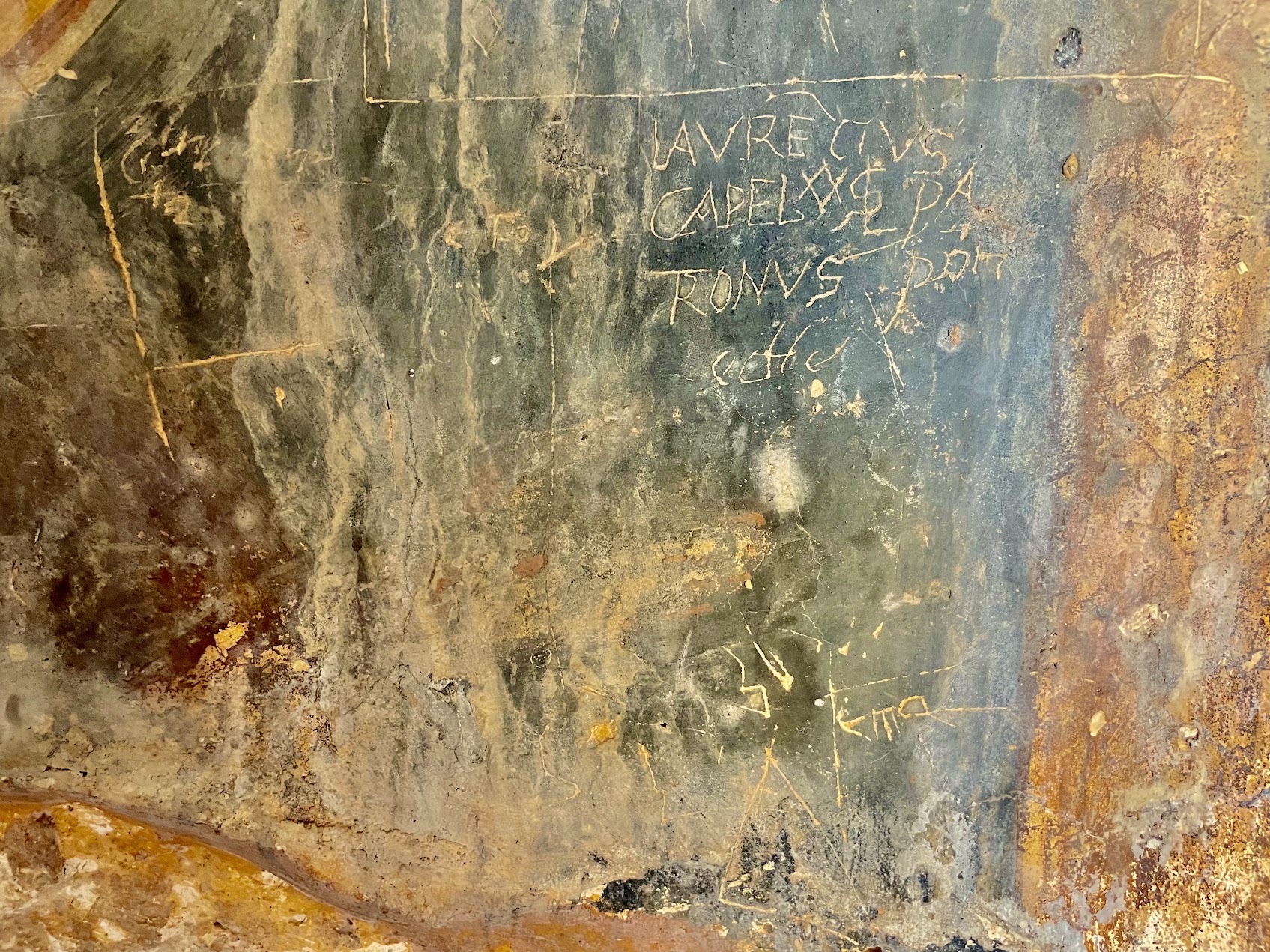
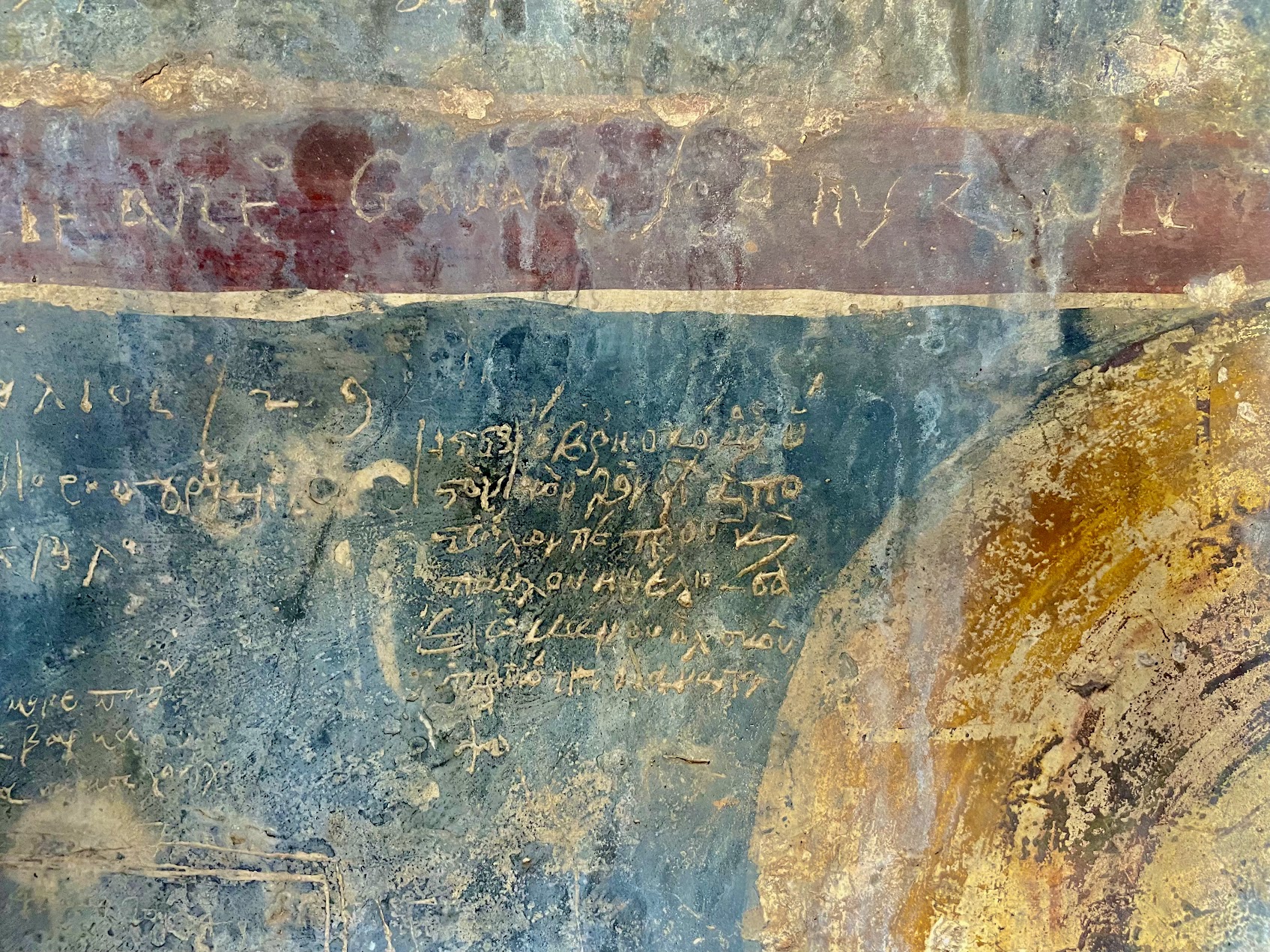
Dimitris Tsougarakis — the scholar who gathered and edited the corpus of graffiti from Cretan churches and monasteries — devoted five pages of his Syntagma Charagmaton, published by the Academy of Athens in 2015, to this single wall. That is unusual. Most churches receive a paragraph or two. This wall deserved more. Who were these people? The year 1523. A certain Georgios, servant of God, left a brief record. The text is damaged and not everything can be read. We know, however, that he arrived here by boat, that he mentions the wind, the journey, his arrival. Five hundred years later, only a few sentences remain of him — and that was enough for him to survive. The year 1535. Manolis — as common a name on Crete as John is with us — describes how he returned from the cape, where a strong wind was blowing. The sea had τρεμουτανα him — shaken him, tossed him, perhaps frightened him. The word carries something very physical: the shudder of the deck, uncertainty, an unpleasant crossing. Manolis does not sound like a pilgrim. He sounds like a man of the sea who has just had a harder day than he planned.
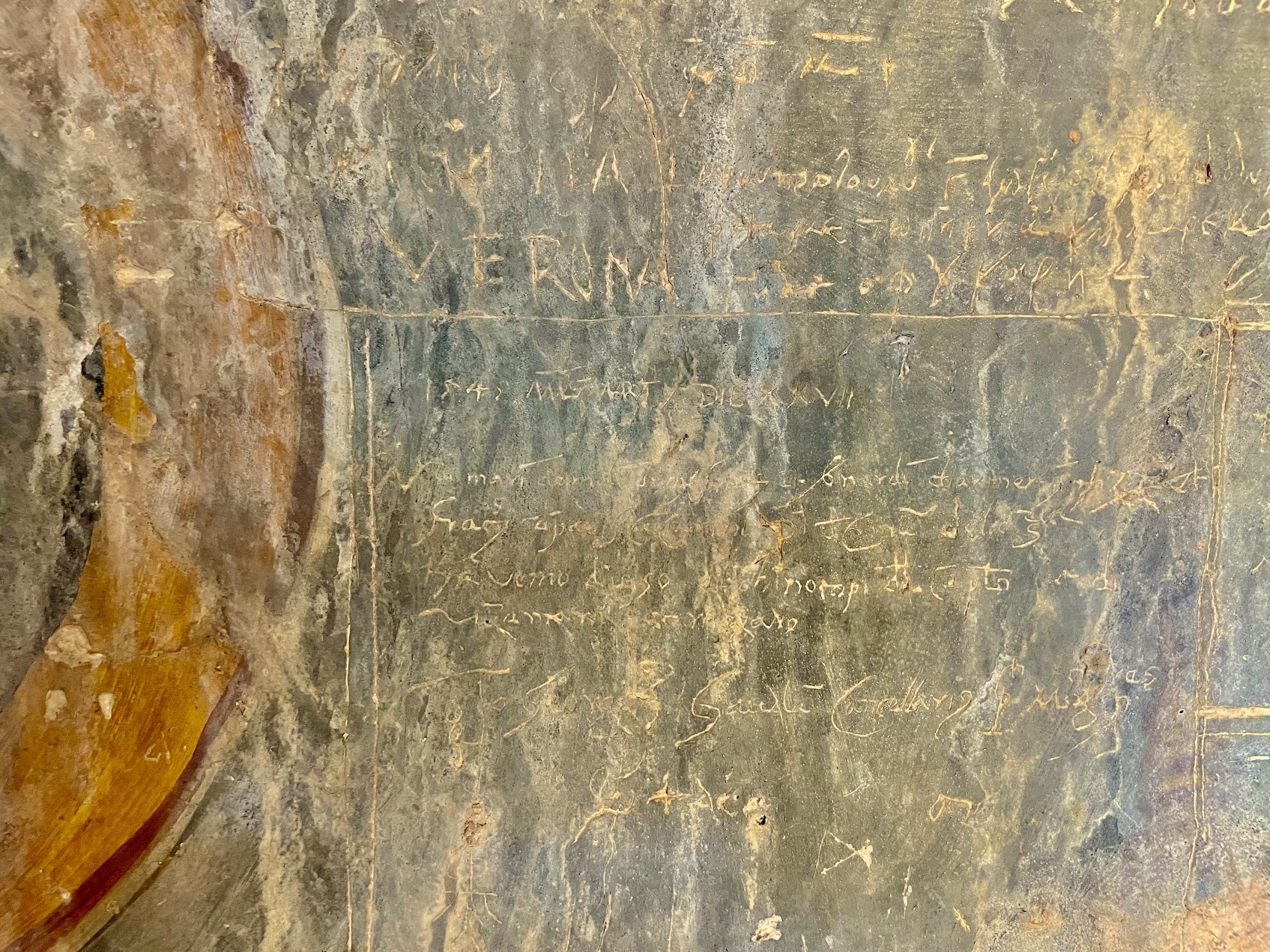
Then comes an inscription that reads almost like an entry in a ship's log: "On the 2nd of September 1540, I arrived here, Francesco Cristafer, son of the late Luca, with the crew of the galleon of the magnificent lord Girolamo Corona, and together with Zane Ulaco of Candia." We do not know who they were. We do not know where they were sailing. We know only that they saw fit to leave their names on the wall of a monastery standing at the end of the world. The year 1545. Georgios Gavalàs, who describes himself as cancellarius — chancellor. Accompanying this is a notarial monogram cut into the plaster with almost the same care as a seal pressed into wax on a document. Gavalàs is a name well known in Cretan history. One of those families which, over the centuries, had learned to operate between the Greek and the Venetian worlds. A chancellor at the far end of the Spatha peninsula. A man of administration, leaving his calling card in a place that many tourists today would not risk driving to.
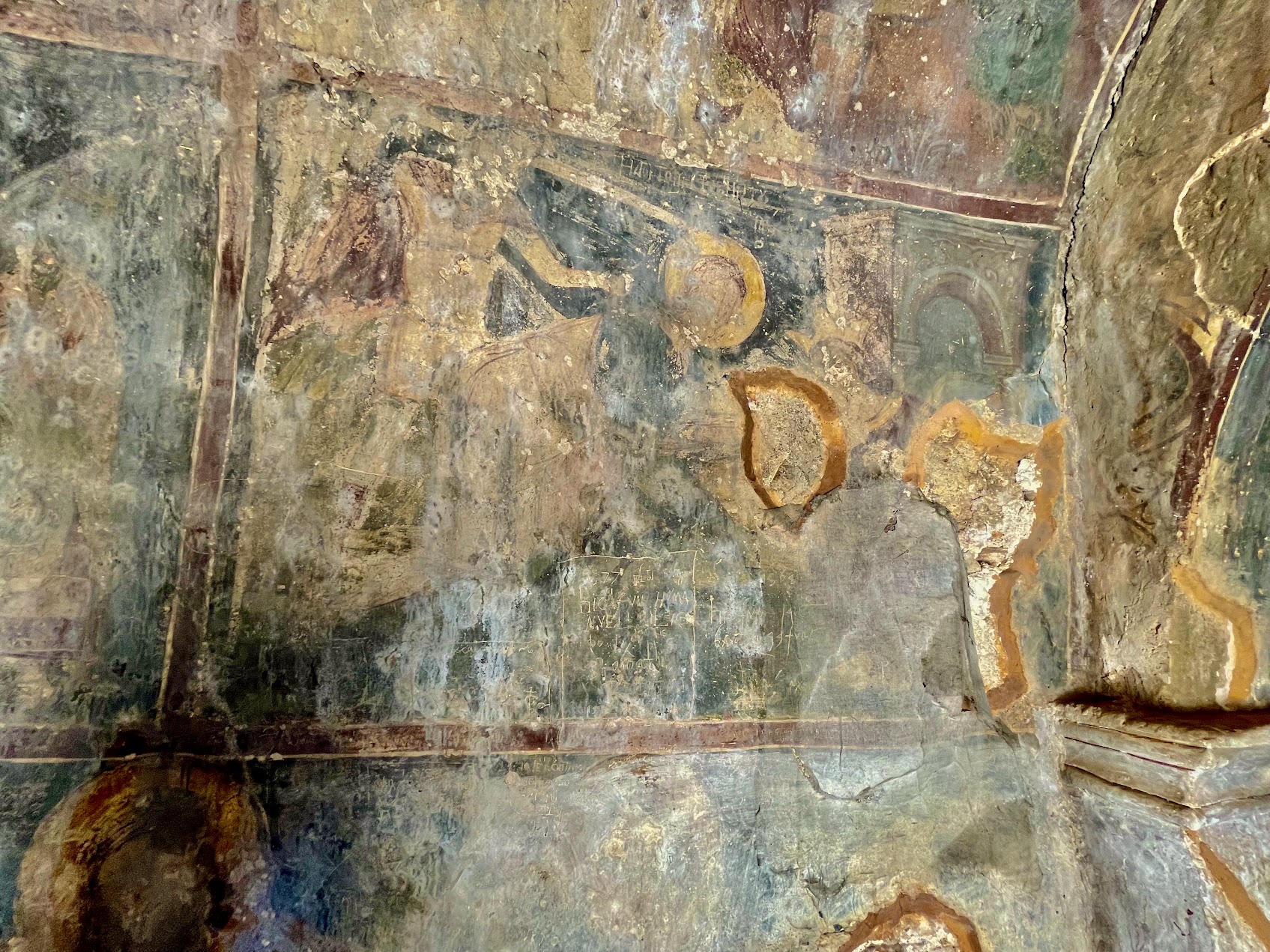
The year 1553. Manuel Skoutariotis records something remarkable. He uses the form ήθελησα — "I wished", "I resolved", "I desired to visit". He does not describe the act of arriving, but the intention. He writes that he wished to visit the church of the Holy Apostles Peter and Paul. It is hard to say why he chose this particular form. Perhaps it was a conventional formula of piety. Perhaps he wanted to emphasise the act of pilgrimage itself rather than its completion. Or perhaps he simply wrote as he spoke.
The year 1607. And here we encounter a genuine gem. Nikolaos Priouli — a name associated with one of the most influential families of Venice, attested in sources since the Middle Ages — doctor of law, arrives with forty companions. Forty. This does not look like a private excursion. It resembles more an inspection, an official mission, the journey of a man who did not travel alone. Priouli at Spatha with forty men sounds rather as though a government minister had arrived today with his entire cabinet at a remote mountain hut in the Scottish Highlands.
What does all this tell us?
Above all, that this wall is a document. Not only a document of religious devotion, though that aspect cannot be ignored. It is, above all, a document of movement. A document of people travelling along the western coast of Crete. Spatha was a point on the maritime map. Sailors knew this bay, they knew about the church, and they stopped here just as we stop at petrol stations or motorway service areas today. Some of them prayed. Some rested. Some left a mark, because the need to leave a trace of oneself proves to be one of the most enduring features of human nature.
But there is something more here.
This church was accessible. Not locked. Not fenced off. Not protected by glass and an alarm system. It stood open to people and wind for decades. Anyone could enter, look at the frescoes and carve their name into the plaster. Today we would call that the vandalism of a historic monument. In the sixteenth century, it was apparently seen differently. For many visitors, it was simply a way of saying: I was here.
Lassithiotakis recorded this site laconically as Agios Pavlos (?) — with a question mark, because he was not certain of the church's dedication. Tsougarakis resolved the uncertainty. Graffito number 27, left by Manuel Skoutariotis in 1553, states plainly: ναόν των Αγίων Αποστόλων Πέτρου και Παύλου — the church of the Holy Apostles Peter and Paul. Five hundred years later, a single scratched sentence solved a problem that the catalogue had been unable to settle.
Is this a place that every tourist should see? I have no idea. I know only that for me it was one of the more remarkable discoveries of recent years. Not because the finest frescoes on Crete have been preserved here. They have not. Not because the architecture makes an overwhelming impression. It does not. The frescoes are heavily damaged and difficult to compare with Agios Nikolaos at Maza or the church of the Transfiguration at Meskla. But that is a story for an entirely different text.