21 July 2026 · Artur Kiwa
The Church Behind My Back
Just a dozen or so metres from my bed, the little church of Agios Athanasios has stood there for years — with hell labelled like a road sign, sinners bitten by snakes, and Ossia Maria, after whom the Samaria Gorge takes its name.
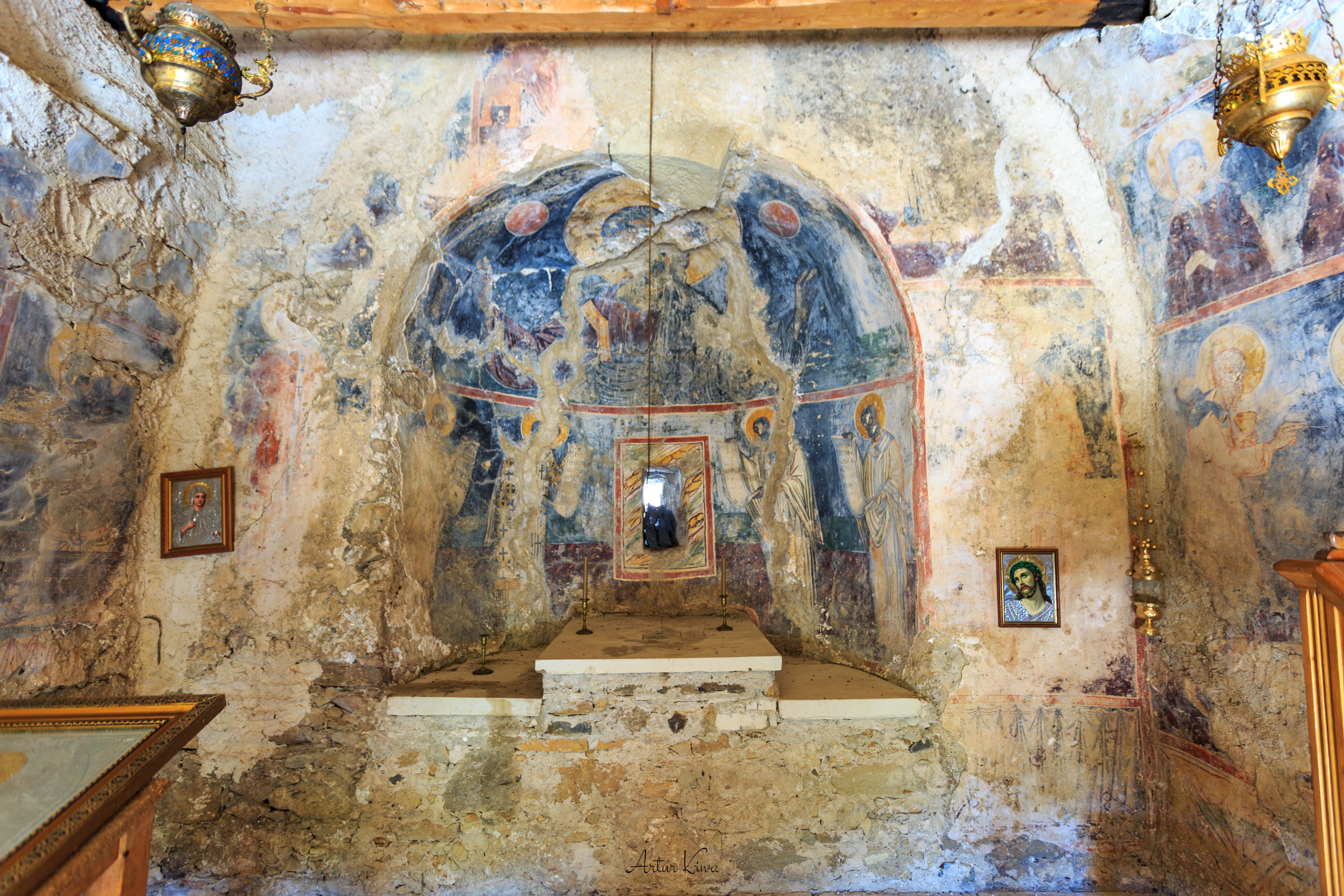
I’ve been renting a house in Mesa Voukolies for several years now. I sleep, eat, curse the heat — and just a dozen or so metres away, behind the wall, there’s this little church of Agios Athanasios, apparently waiting for someone to finally knock on the door. You spend your time hunting Byzantine frescoes all over Crete, digging through archives, driving to places no road seems to reach — and there you have it: one of them sitting quietly right next to your bedroom.
We’ll start with what catches the eye first: the hell scene on the western wall. And here’s something interesting, spotted only by Angeliki Lymberopoulou in her two-volume monograph on hell in Byzantine art: the upper scene — the one showing a procession of sinners heading towards the Dragon of the Abyss — is explicitly labelled here as “Η ΚΌΛΑϹΙϹ”, meaning simply “punishment” or “hell”. Apparently, this is the only such case anywhere on Crete. Every other church leaves you to work it out for yourself; this one puts a sign over the gates of hell, as if someone were worried a tourist might take a wrong turn.
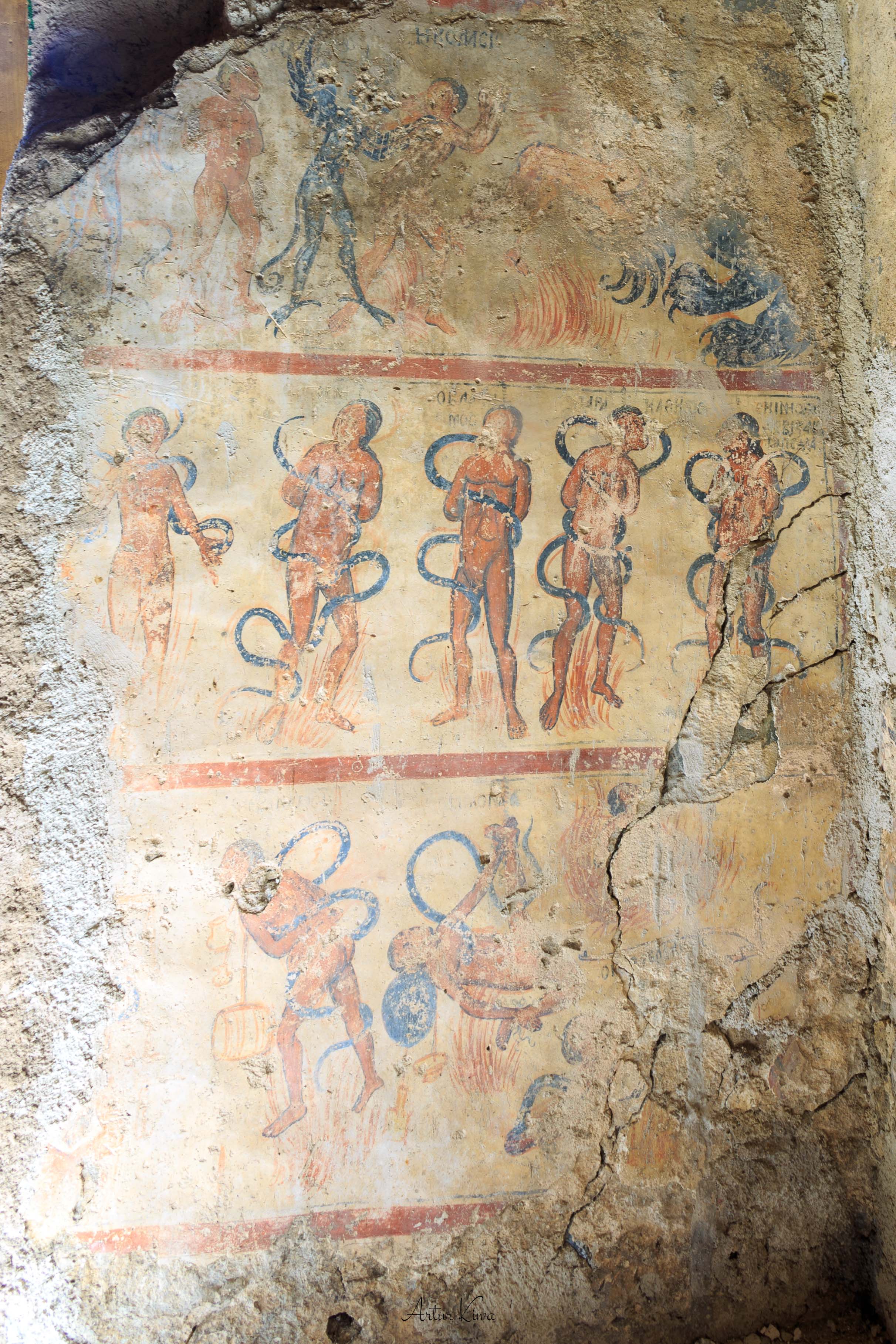
Below, in two registers, the snakes go about their lethargic business — each sin has its own assigned snake and its own designated place to bite, like some medieval catalogue of bespoke punishments. In the second register you can make out the prostitute (the snakes bite her where she sinned), the blasphemer (snake in the mouth), the gossip (snakes in the ears), and the woman who refused to breastfeed her own children (snakes, naturally, at her breasts). In the third register, further down among the flames: an innkeeper hung about with a little barrel and jugs, a cheating miller suspended by one arm and one leg with a millstone around his neck, a rich man (of whom only an arm and part of the head survive), and a farmer who moved his neighbour’s boundary marker — the last identifiable by the handle of a plough sticking up above his head.
It is interesting, incidentally, how differently various scholars have read the same badly damaged wall. Lassithiotakis, writing decades earlier, noted only briefly: the rich man, the prostitute, the blasphemer, the cheat with the scales, the criminal. Lymberopoulou, looking closely at the same place and equipped with the full apparatus of modern iconographic research, sees a different cast of characters: the gossip and the woman who refused to breastfeed instead of the cheat with the scales, and the miller and the boundary-moving farmer instead of a generic criminal. The fresco is damaged badly enough that even the experts disagree over exactly whom the devils have got hold of.
Then — the view towards the apse. Christ blessing with outstretched arms in the conch, and below him a row of bishops celebrating the liturgy. On the triumphal arch, where today there is little more than broken plaster, there was once the Hospitality of Abraham — and indeed, the two beautiful heads noticed by Lassithiotakis are surviving fragments of that scene. On either side of the apse is the Annunciation, while in the lower register we find Saint Euplus, a rather unexpected patron to encounter in a small village church.
And finally, the fresco that made moving here genuinely worthwhile: on the southern wall of the sanctuary, Saint Zosimas giving Communion to Mary of Egypt. Locally, she is known as Ossia Maria — and it is from her that the Samaria Gorge takes its name. So if you’ve ever walked that famous trail and wondered where the name came from — there you are. The answer is painted on a wall just a few kilometres from the entrance to the gorge, except hardly anyone ever comes in here to see it.
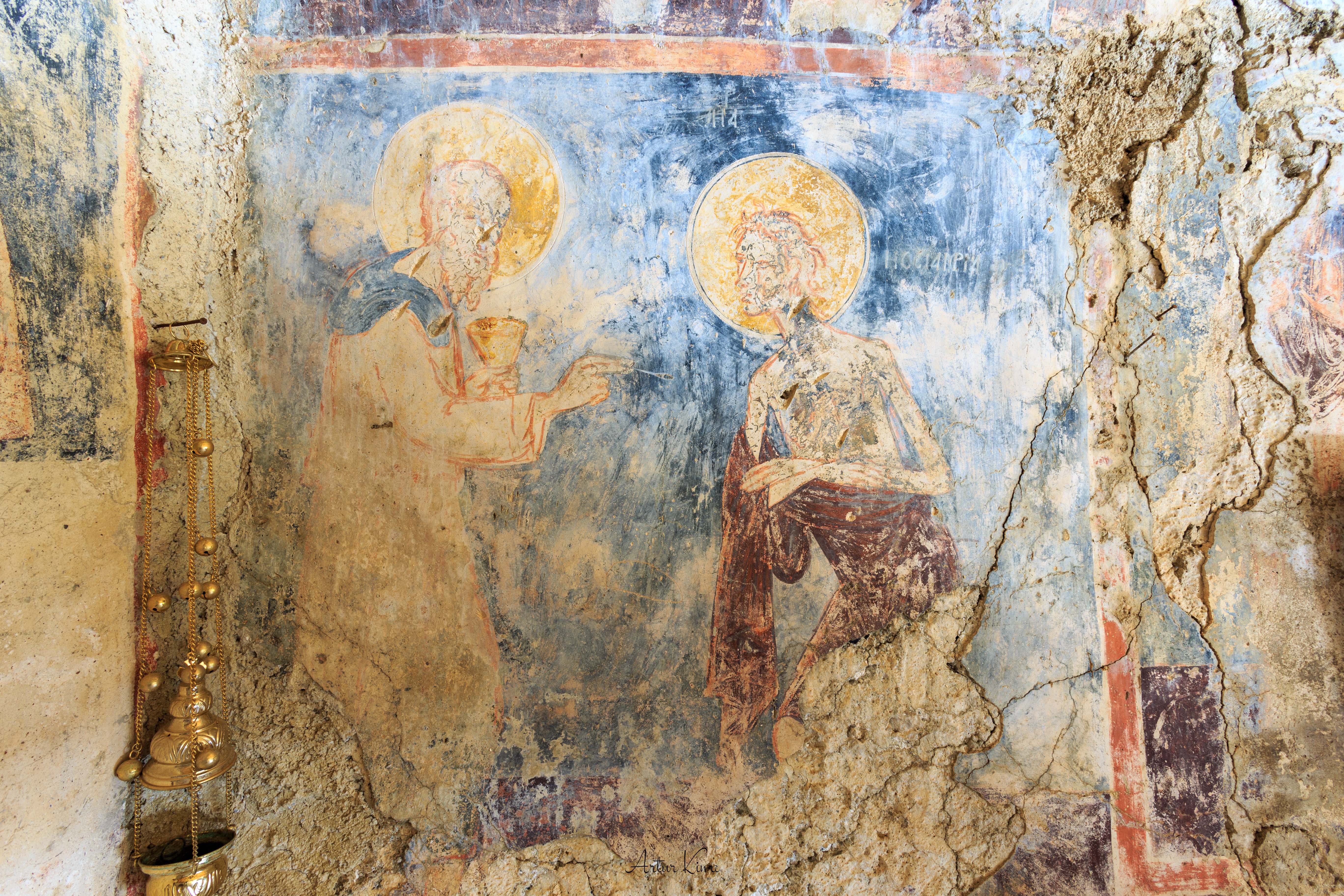
This particular fresco is fairly unusual for Cretan churches. In nearly two hundred churches I’ve visited, I haven’t encountered this scene before. Of course, that proves nothing; it is only an indication — though, taken as such, quite a significant one.
Meanwhile, today it feels like 40 degrees outside, and I find myself wondering whether the sinners in the fresco were sweating too before somebody threw them into hell. Their hell is fiery anyway — perhaps at least they had some air conditioning in the form of an eternal draught blowing through the ruined roof.
A small postscript, or why Ossia Maria rather than Mary of Egypt.
Ὅσιος (Hosios), or its feminine form Ὁσία (Hosia), is one of several honorific titles used in the Orthodox classification of saints, alongside such terms as Ἅγιος (Hagios — the general term for “saint”), Μάρτυς (Martys — martyr), Ἱερομάρτυς (Hieromartyr — a cleric who suffered martyrdom), and Ἰσαπόστολος (Equal-to-the-Apostles).
Ὅσιος/Ὁσία literally means something along the lines of “holy through asceticism” or “sanctified through the monastic life” — in Latin it is commonly rendered as venerabilis or sanctus per abstinentiam. The title is reserved for saints who attained holiness through monastic, eremitic or ascetic life rather than through martyrdom. The distinction is quite sharp in the Eastern Church: a martyr is sanctified through death for the faith; a Hosios or Hosia through life itself — fasting, prayer, renunciation and battling demons in the desert.
Mary of Egypt fits this model perfectly: no martyrdom, just decades spent in the desert in extreme asceticism after her conversion from a life of sexual licence. Hence Ὁσία Μαρία — “Hosia Maria”, holy through asceticism — as opposed, for example, to a virgin martyr, who might be styled Ἁγία Παρθενομάρτυς.